On this page
- Where steam vents need a silencer
- Why a steam vent is so loud
- Safety valves: size on the rated capacity
- Backpressure: the limit that protects the valve
- Reaction force and support
- Condensate, rain and frost
- Setting the noise target
- Inside a steam vent silencer
- Steam vent silencers in service
- What to have ready when you specify a steam vent silencer
A steam vent silencer sits at the end of a boiler safety valve, a start-up vent or a process blow-off line, and has to cut the noise of a sonic steam jet without adding more backpressure than the valve upstream can tolerate. Steam behaves differently from the process gases covered in our guide to sizing vent silencers for gas blowdown: it condenses, it is often vented at every start rather than once in years, and on a safety valve the flow is set by the valve, not by the upset. This article covers the steam-specific inputs that decide the size and construction of a steam vent silencer, and the data to have ready when you specify one.
Where steam vents need a silencer
Most steam vent silencers serve one of four duties. They differ less in physics than in how often they run and in what sets the flow the silencer must pass.
| Steam vent | How often it runs | What sets the sizing case |
|---|---|---|
| Boiler and HRSG safety valves (drum, superheater, reheater) | Rarely in service; at commissioning and periodic set-pressure tests | The rated capacity of every valve that can lift at the same time |
| Start-up and warm-up vents | At every start, for minutes to hours; daily on cycling plant | The vent flow at the worst pressure and temperature of the start-up curve |
| Turbine bypass or trip vents to atmosphere | On a trip, or whenever the turbine cannot take steam | The bypassed flow at bypass conditions |
| Process blow-off (autoclaves, sterilisers, reactors, steam-heated vessels) | Every batch or cycle | The depressuring curve of the vessel |
Duty frequency matters as much as flow. Neighbours and permitting authorities tolerate a safety-valve lift once in several years far more readily than a vent that sounds at every morning start, and a permit or project specification usually reflects that.
Why a steam vent is so loud
Steam chokes at a lower pressure ratio than many engineers expect. Nozzle theory puts the critical pressure ratio at about 0.58 for dry saturated steam and 0.55 for superheated steam, so any vent that discharges to atmosphere from more than roughly 0.8 bar(g) runs choked at its final opening. Boiler and process vents sit far above that threshold, so for most of the event the vent behaves as an underexpanded sonic jet. Shock cells and turbulent mixing in that jet produce intense broadband noise with a hissing, high-frequency character, released from an elevated point with a clear path to the site boundary. API Standard 521 includes a method for estimating the sound pressure level of a relief discharge to atmosphere, and that method applies only while the flow is choked [1].
Steam is also light. With a molecular weight of 18 against about 29 for air, a kilogram of steam occupies roughly 1.6 times the volume of a kilogram of air at the same pressure and temperature (ideal-gas approximation). For the same mass flow, a steam vent silencer therefore needs more internal flow area to hold its passage velocities down, and passage velocity is what sets the flow noise a silencer generates itself [2].
Safety valves: size on the rated capacity
A process relief case is sized on the required relieving rate; a steam safety valve silencer is not. A pop-action safety valve does not modulate to the upset: once it lifts, it passes close to its certified capacity. The vent pipe and the silencer are therefore sized on the rated capacity of the valve at its certified overpressure, not on the flow the boiler or process needed to relieve. Where several valves discharge into one silencer, the sizing case is the combined rated capacity of every valve that can lift at the same time. Sizing on the required rate is a direct route to a silencer that passes the design review and is too restrictive in service.
Backpressure: the limit that protects the valve
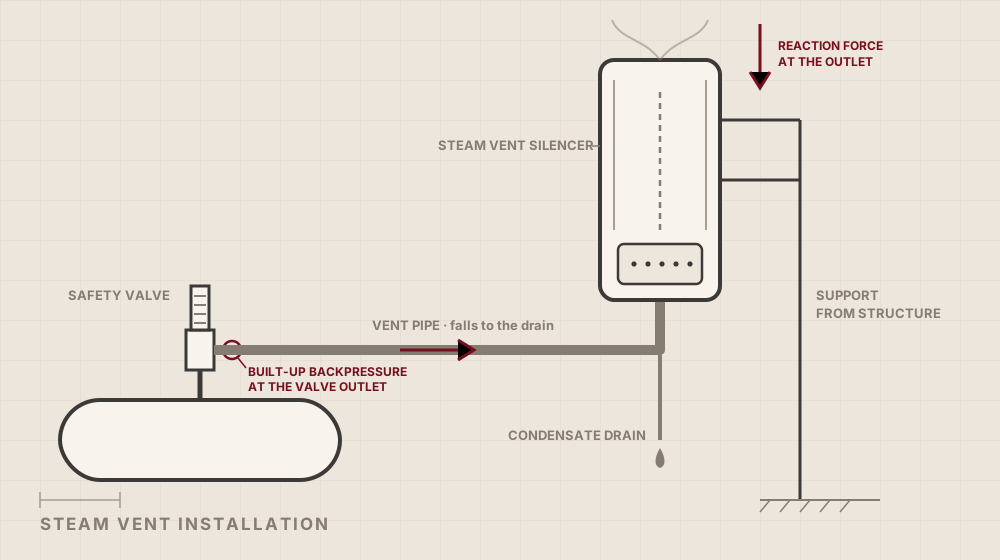
Everything downstream of the safety valve (the discharge elbow, the vent pipe and the silencer) builds up backpressure at the valve outlet while it flows. Too much, and a conventional spring-loaded valve loses capacity, lifts unstably or chatters. API Standard 520 Part I gives the common guideline for conventional valves: built-up backpressure no higher than 10 % of set pressure at 10 % overpressure [3]. Boiler codes and valve manufacturers set their own limits, and the figure for the installed valve governs. That number reaches the silencer designer as a hard constraint, not a target to trade against noise.
The silencer architecture follows from it. A multi-stage diffuser at the inlet takes part of the pressure drop in controlled steps, which lowers the noise generated, but every bar dropped across it adds to the resistance downstream of the valve. The connection between valve and vent pipe changes the picture again. With a closed connection, the full resistance of vent pipe and silencer acts on the valve outlet. With an open, drip-pan style connection, the valve is decoupled from the vent pipe, but the resistance downstream then decides whether steam blows back out of the gap into the boiler house. Either way, silencer and discharge system are best engineered together, as one calculation.
Reaction force and support
An open steam discharge pushes back. The jet leaving the vent produces a reaction force at the outlet, and a valve that lifts suddenly adds a transient load on top. With a silencer on the vent, the silencer shell and its support carry those loads together with the unit’s own weight, wind, and the thermal growth of the vent pipe from cold to steam temperature. ASME B31.1 includes a non-mandatory appendix with rules for the design of safety valve installations, including the reaction forces of open-discharge systems [4], and ISO 4126-9 sets requirements for the application and installation of safety valves on pressure equipment [5]. The practical consequence for the silencer: support it from structure, so that neither the safety valve nor the boiler nozzle carries its weight or its thrust.
Condensate, rain and frost
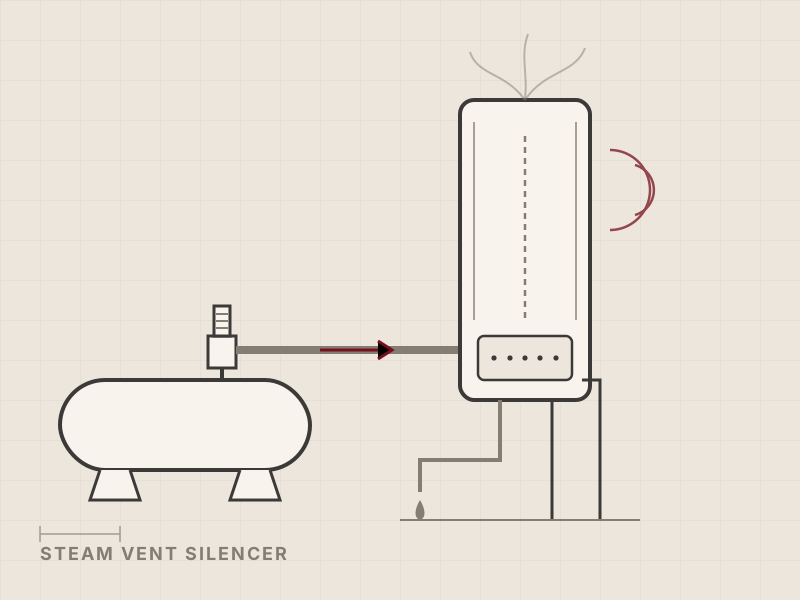
Steam turns to water the moment it meets cold metal. At every start, the first steam into a cold vent pipe and silencer condenses, and wet steam carries droplets in with it. Water left in the silencer is thrown out of the outlet as hot spray on the next event, arrives as slugs that hammer the internals, and in winter freezes in the drain or the bottom of the shell. A steam vent silencer therefore needs:
- a drain at its lowest point, piped to a safe location and sized so it stays open
- a vent pipe that falls toward a drain, with no pockets where water can lie
- on outdoor units in cold climates, a drain arrangement that empties completely between events, or heat tracing where it cannot
- internals and acoustic fill that tolerate wet steam and repeated thermal cycling, with the fill retained behind perforated facings so it cannot migrate or erode
A vertical outlet also takes in rain between events, which gives the drain a second job.
Setting the noise target
A steam vent silencer is sized to a level at a location, never simply to “be quiet”. The basis is usually one of three: a limit at the site boundary or the nearest dwelling from the environmental permit, a workplace limit near the vent (in the EU, occupational noise duties stem from Directive 2003/10/EC [6]), or a project specification at a stated distance. The required insertion loss is the gap, across the frequency spectrum, between the bare vent and that target. State the duty with the target: the same flow can justify a different silencer for a once-a-decade safety-valve lift than for a start-up vent that runs every morning. Our guide to specifying dB(A) noise reduction targets covers how to turn a limit into a specification.
Inside a steam vent silencer
The architecture matches the high-pressure gas case: a multi-stage diffuser that breaks the pressure letdown into many small jets, followed by an absorptive section that attenuates the remaining broadband, high-frequency noise. Our article on diffuser design for pressure letdown explains the first stage. What changes for steam is the detailing: flow areas sized for steam’s larger volume per kilogram, materials and fill matched to temperature and wetness, drains at every low point, and supports designed with the vent pipe. At Axces, each steam vent silencer is sized against a validated aero-acoustic calculation and built at our own facility, Axces Production in Poland.
Steam vent silencers in service
Axces steam vent silencers in service show how wide the duty range is, from a high-pressure superheated vent at a refinery to a low-pressure waste heat boiler vent:
| Plant | Steam at the silencer inlet | Noise target |
|---|---|---|
| Refinery in Scandinavia, high-pressure vent | About 25 t/h superheated steam at 33 bar(a) and 420 °C | 85 dB(A) at 1 m |
| Steam plant in Denmark | About 12.5 t/h of steam | 70 dB(A) at 10 m |
| Waste heat boiler for a plant in India | About 27 t/h of steam at 6.2 bar(a) and 254 °C | At most 90 dB(A) at 3 m |
The refinery vent is written up in full in our high-pressure steam vent silencer reference.
What to have ready when you specify a steam vent silencer
- Vent type and duty: safety valve, start-up vent, bypass or blow-off, and how often it runs
- Steam conditions at the silencer inlet: pressure, temperature, saturated or superheated, and whether wet steam is possible
- Mass flow at the sizing case: for safety valves, the rated capacity of each valve and which valves can lift together; for vents, the flow profile over the event
- Valve data: type, set pressure, outlet size, and the allowable built-up backpressure from the valve manufacturer
- Discharge arrangement: vent pipe length, diameter and bends, open or closed connection to the valve, outlet height and orientation
- Noise requirement: level, location or distance, and its basis (permit, workplace limit or project specification)
- Site conditions: minimum ambient temperature, wind and seismic data, and the support structure available
- Design code and material requirements, for example PED or ASME
The closer this data is to the final boiler and relief-system design, the closer the first proposal will be to the silencer that ships.
If a boiler safety valve, start-up vent or steam blow-off on your project has a noise limit to meet, see our vent silencers for steam and gas venting, or request a quote for a steam vent silencer with the data above and our engineers will come back with a sizing proposal.
References
- American Petroleum Institute. API Standard 521, Pressure-relieving and Depressuring Systems, 7th Edition, June 2020: includes a method for estimating the sound pressure level of a pressure-relief discharge to atmosphere, applicable to critical (choked) flow only. https://www.api.org/products-and-services/standards/important-standards-announcements/standard521
- International Organization for Standardization. ISO 7235:2003, Acoustics: Laboratory measurement procedures for ducted silencers and air-terminal units: Insertion loss, flow noise and total pressure loss. https://www.iso.org/standard/30385.html
- American Petroleum Institute. API Standard 520, Sizing, Selection, and Installation of Pressure-relieving Devices, Part I: Sizing and Selection, 10th Edition, October 2020. https://www.api.org/products-and-services/standards/important-standards-announcements/520parti
- ASME. B31.1, Power Piping: Nonmandatory Appendix II, Rules for the Design of Safety Valve Installations. https://www.asme.org/codes-standards/find-codes-standards/b31-1-power-piping
- International Organization for Standardization. ISO 4126-9:2008, Safety devices for protection against excessive pressure, Part 9: Application and installation of safety devices excluding stand-alone bursting disc safety devices. https://www.iso.org/standard/35393.html
- European Union. Directive 2003/10/EC of the European Parliament and of the Council of 6 February 2003 on the minimum health and safety requirements regarding the exposure of workers to the risks arising from physical agents (noise). https://eur-lex.europa.eu/eli/dir/2003/10/oj/eng