On this page
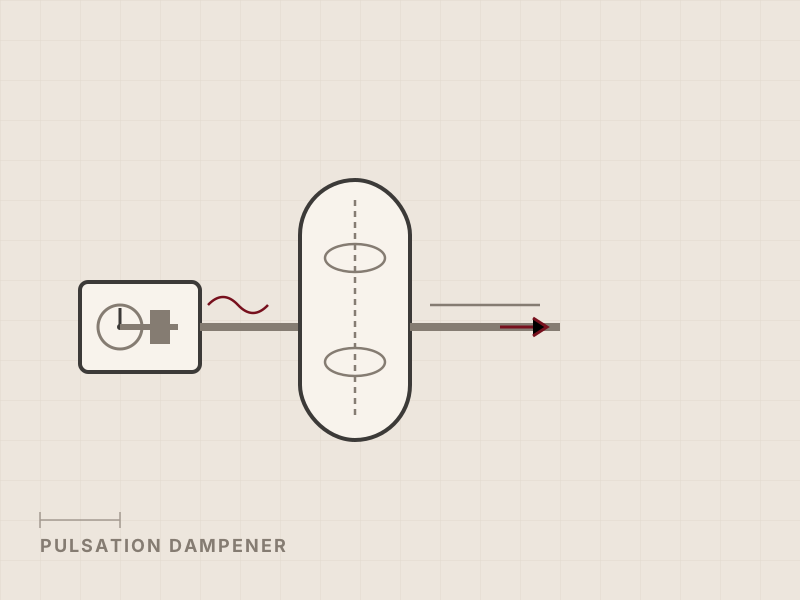
Pulsation dampeners, also called pulsation bottles or pulsation suppression devices, smooth the pressure pulses that a reciprocating compressor sends into its suction and discharge piping. Left uncontrolled, compressor pulsation drives piping vibration, fatigue cracking and instrument errors, and it is the reason API 618 makes pulsation control an explicit part of every reciprocating compressor project. This article explains where the pulsation comes from, what it damages, how dampeners work, and how the current edition of API 618 frames the requirements.
Why reciprocating compressors generate pulsation
A reciprocating compressor does not move gas continuously. Each cylinder draws in and discharges a discrete slug of gas every revolution, so the connected piping experiences an interrupted flow: a train of pressure pulses repeating at the compressor running speed and its integer multiples (harmonics).
These pressure waves travel through the gas at the speed of sound and reflect at every change in the piping: elbows, tees, reducers, vessels, closed branches. Where the acoustic natural frequency of a pipe run coincides with one of the compressor’s excitation harmonics, a standing wave forms and the pulsation is amplified rather than attenuated. Acoustic resonance of this kind can develop far from the machine itself, which is why pulsation problems are routinely found in mainline piping a long way downstream of the compressor [5]. Multi-cylinder machines and variable-speed operation broaden the excitation spectrum and the number of conditions to check.
What unchecked pulsation does to a piping system
Pulsation causes damage through two related, well-documented mechanisms:
- Shaking forces and vibration. Oscillating pressure acting on elbows, reducers and closed ends produces net dynamic forces on the piping. If the restraint system is too flexible, or a mechanical natural frequency of the piping is excited, these forces translate into visible vibration of mainlines, supports and structures [5].
- Fatigue cracking. Sustained vibration produces cyclic stress that accumulates at welds, nozzles and branch connections. Specialist vibration consultancies report small-bore connections (vents, drains, instrument and gauge taps) as the most common failure location on reciprocating compressor systems [5]. On the machine side, pulsation within the bottles and at the cylinder flanges is associated with fatigue cracks in nozzle and flange welds, damage to bottle internals and reduced valve life [5].
Beyond mechanical damage, pulsation degrades operation: flow meters mis-read on a pulsating stream, pressure instruments become noisy, and pulsation at the compressor valves affects valve life and compressor performance. The practical consequences are unplanned shutdowns, leak paths at failed small-bore connections, and maintenance costs that recur until the pulsation itself is addressed.
How pulsation dampeners work
Volume plus acoustic filtering
The simplest pulsation dampener is a volume bottle: a pressure vessel mounted at the compressor cylinder whose gas volume absorbs the flow non-uniformity of each stroke, so a much smoother flow enters the piping. Most engineered dampeners go further and use internals (choke tubes and baffles arranged as volume–choke–volume elements) to form an acoustic low-pass filter. Steady flow passes through; pulsation above the filter’s cut-off frequency is strongly attenuated before it ever reaches the line.
Every internal element also adds pressure drop, which costs compressor power, and API 618 addresses the pressure drop across pulsation suppression devices alongside the allowable residual pulsation [3]. Good dampener design is therefore a balance: enough attenuation to meet the pulsation limits, with no more pressure loss than necessary. The dampener’s acoustic behaviour is always evaluated together with the compressor and the connected piping, because all three interact.
Where dampeners fit in the system
Dampeners are installed directly at the cylinder flanges, on both the suction and the discharge side, so that pulses are intercepted before they enter the piping. The discharge dampener protects the downstream system from the compressor; the suction dampener does the same for the upstream system and also shields the cylinder from pulsation arriving out of the suction line. Because the bottles are large pressure vessels sitting on the machine, their size and nozzle arrangement need to be fixed early, as late changes ripple into piping layout, supports and skid design.
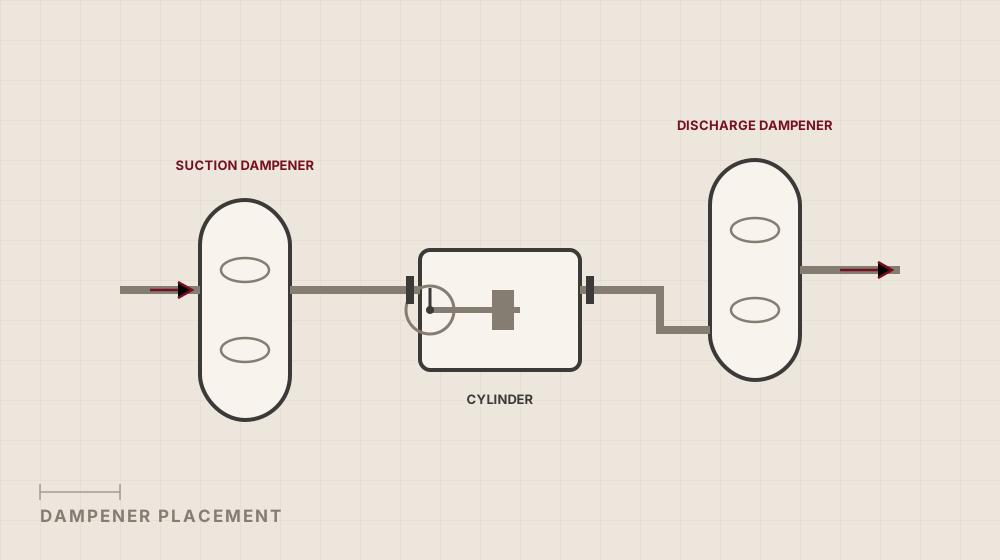
Because they attenuate gas-borne pressure oscillation (an acoustic function) while also managing pressure behaviour in the system, pulsation dampeners sit in both the Axces noise control product range and the pressure control product range.
What API 618 requires
API Standard 618, Reciprocating Compressors for Petroleum, Chemical, and Gas Industry Services, is the purchasing standard for process reciprocating compressors; its current edition is the 6th Edition, published in May 2024 [1] [3]. Pulsation and vibration control and pulsation suppression devices are covered in the standard’s accessories section (sections 7.11 and 7.12 of the 6th Edition) [3]. It is complemented by API Standard 688, Pulsation and Vibration Control in Positive Displacement Machinery Systems for Petroleum, Chemical, and Natural Gas Industry Services, whose 2nd Edition (October 2023) was upgraded from a Recommended Practice to a full Standard and now consolidates pulsation and vibration control requirements for reciprocating compressors and other positive displacement machinery in one document [2] [3].
API 618 historically defined three levels of pulsation and vibration control rigour, known as Design Approach 1, 2 and 3:
- Design Approach 1 relied on empirical sizing of the suppression devices without an acoustic simulation. It has been removed from the 6th Edition and is no longer available as a compliance route [4].
- Design Approach 2 requires an acoustic simulation of the compressor, dampeners and connected piping to determine pulsation levels in the piping and at the compressor flanges, with non-resonant shaking forces assessed and resonance avoided by separating acoustic excitation from the mechanical natural frequencies of the piping and its restraints [4] [5].
- Design Approach 3 combines the acoustic study with a mechanical response analysis: the shaking forces calculated in the acoustic model are applied to a mechanical model of the compressor manifold system and piping, and the resulting vibration and cyclic stresses are assessed against allowable limits. The added engineering effort can pay back through a more economical piping and support design [4] [5].
Which approach applies has historically been set by the compressor’s discharge pressure and rated power per cylinder, with the purchaser always free to specify the more rigorous approach [5]. The standard defines maximum allowable residual pulsation levels in the line-side piping and limits on the pressure drop across the suppression devices; demonstrating compliance is the purpose of the pulsation study, which checks pulsation levels, shaking forces, separation margins and the effect of the devices on compressor performance across the operating envelope [3] [4]. The study belongs early in the project, while the dampener volumes and internals it produces can still be accommodated in the layout.
Specifying a pulsation dampener
Pulsation dampeners for API 618 service are engineered-to-order pressure vessels, not catalogue items. A supplier will typically ask for the gas composition and molecular weight, the full operating envelope (pressures, temperatures, speed range and load steps), cylinder and compressor data, the piping arrangement, the design approach specified for the project, and the applicable pressure vessel code. Having this information available at enquiry stage shortens the loop between the pulsation study and the mechanical design.
Axces designs and manufactures pulsation dampeners for reciprocating compressor systems and supports EPCs and plant engineers from specification through delivery. If you are scoping pulsation control for a compressor project, our engineers can review your operating data and advise on a dampener configuration. Contact us to discuss your requirements.
References
- American Petroleum Institute, API Standard 618: Reciprocating Compressors for Petroleum, Chemical, and Gas Industry Services, 6th Edition, May 2024. https://www.apiwebstore.org/standards/618
- American Petroleum Institute, API Standard 688: Pulsation and Vibration Control in Positive Displacement Machinery Systems for Petroleum, Chemical, and Natural Gas Industry Services, 2nd Edition, October 2023.
- European Forum for Reciprocating Compressors (EFRC), Review of the sixth edition of the API 618 and the second edition of the API 688, Part 1: Review of the sixth edition of the API 618, Version 1, 2025 (sections 2.1, 4.54 and 4.55 on pulsation and vibration control, sections 7.11–7.12 of API 618 6th Edition). https://www.recip.org/wp-content/uploads/2025/05/EFRC-Report-Review-API-618-6th-edition-API-688-2nd-edition-Part-1-V1.pdf
- Dynaflow Research Group, Pulsation Analysis for Reciprocating Equipment (API 618 & API 674): description of API 618 Design Approaches 2 and 3 and removal of Design Approach 1 in the 6th Edition (2024). https://dynaflow.com/consulting/expertise/pulsation-analysis/
- The Equity Engineering Group, Guide to API 618 Acoustic-Mechanical Design Validations for Repurposed or Modified Reciprocating Gas Compressor Systems: pulsation excitation mechanisms, damage symptoms, small-bore connection failures, and design approach summary per API 618 5th Edition. https://e2g.com/industry-insights-ar/guide-to-api-618-acoustic-mechanical-design-validations-for-repurposed-or-modified-reciprocating-gas-compressor-systems/