On this page
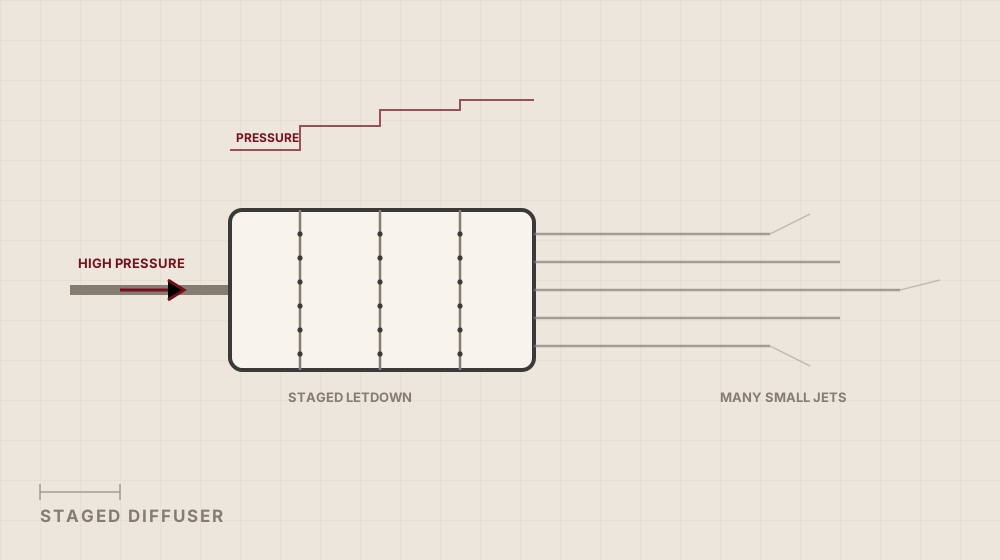
A pressure letdown diffuser, also called a vent diffuser or blowdown diffuser, is a static device that brings high-pressure gas or steam down to near-atmospheric pressure in controlled steps rather than in one violent expansion. By dividing the flow into many small jets and spreading the pressure drop over stages, it keeps velocity, noise, and erosion at the vent point within acceptable bounds. This article explains why unrestricted venting is a problem, how a diffuser solves it, and which process parameters actually drive the design.
Why unrestricted high-pressure venting is a problem
Open a high-pressure line straight to atmosphere and the pressure ratio across the opening sits far above the critical value. The flow chokes: the gas reaches sonic velocity at the restriction and keeps expanding and accelerating in the free jet beyond it. The result is an underexpanded, shock-laden jet, one of the most intense noise sources on an industrial site, bringing three problems at once.
Noise. The acoustic power of a free jet climbs with a very high power of jet velocity: in classic jet-noise theory, roughly the eighth power for subsonic jets, with shock-associated noise added once the jet runs sonic. A single large jet also radiates much of its energy at low frequencies, which carry far, pass through building façades, and are the hardest to absorb downstream.
Mechanical loads. Choked discharge at high pressure exerts a substantial reaction thrust on the vent pipe, and the acoustic energy generated inside the pipework can fatigue welded connections over time, the phenomenon known as acoustic-induced vibration. Pipe supports, tailpipe layout, and the location of the pressure drop all have to account for these loads.
Erosion. Sustained high velocity wears whatever it passes. Add entrained liquid droplets (wet steam, condensate) or solid particles such as scale and construction debris, and the flow becomes actively erosive at exactly the point where the geometry is most complex.
How a diffuser works: many small jets instead of one large jet
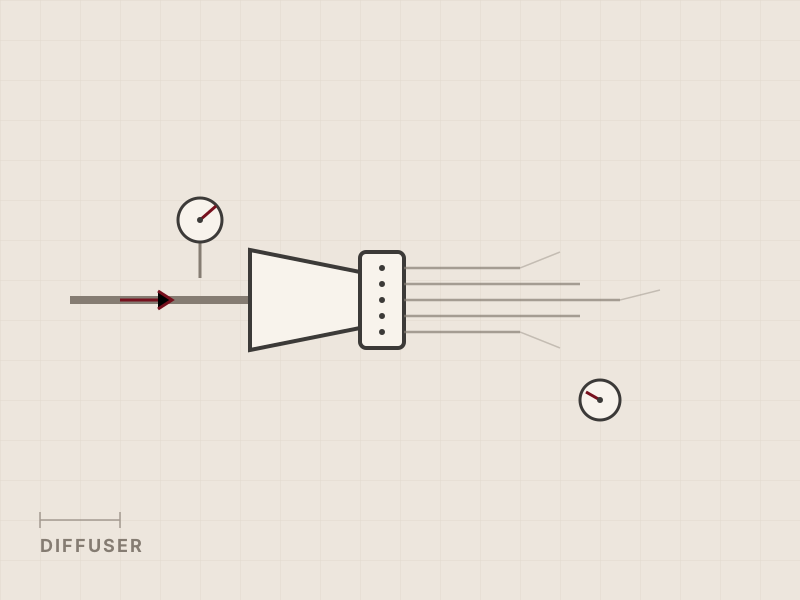
A diffuser replaces the single uncontrolled expansion with a structured one. The flow passes through one or more perforated elements, each taking a share of the total pressure drop, so that no single stage sees an extreme pressure ratio and the final exit velocity ends up far below that of a raw vent. That is staged letdown: a drop too large to manage safely in one step, divided into several that are.
Dividing the flow has a second effect, just as important and equally settled jet acoustics: the peak frequency of jet noise scales inversely with jet diameter. Many small jets shift the noise spectrum upward, away from the far-carrying low frequencies and into a range where atmospheric absorption is stronger and absorptive silencer packing performs at its best. Part of the acoustic energy moves above the range where the human ear, and most noise limits, are most sensitive.
A well-designed diffuser also conditions the flow. It breaks up the concentrated core jet, delivers a more uniform velocity profile to whatever sits downstream, and prevents direct jet impingement on silencer internals. That is why the diffuser is usually the first component the gas meets inside a vent silencer.
Diffuser and vent silencer: two stages of one job
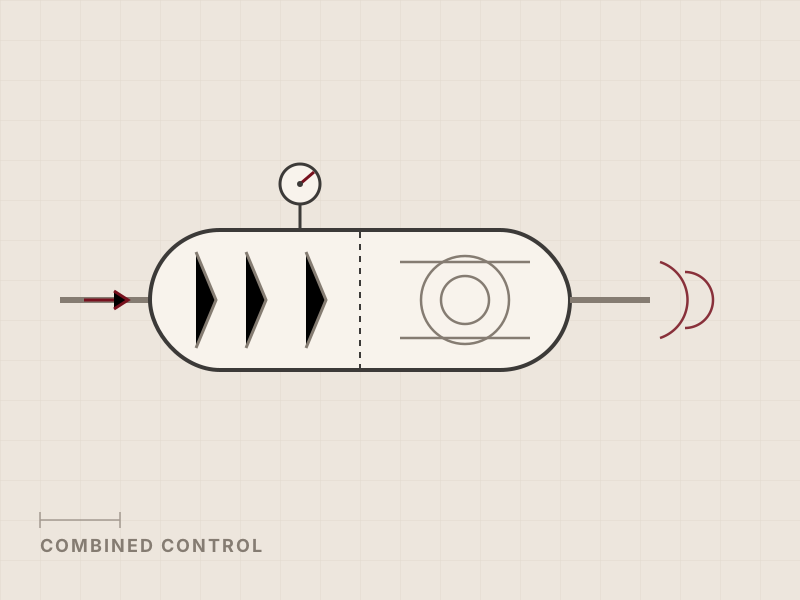
On demanding vents the diffuser rarely works alone. It takes the bulk of the pressure drop and reshapes the noise spectrum; an absorptive silencer section around or after it then removes the remaining mid- and high-frequency noise. This division of labour is what makes deep noise reduction achievable in a practical envelope. The same process parameters drive both halves of the system; for the silencer side, see our article on what drives vent silencer sizing for gas blowdown systems.
What actually drives a diffuser design
Six inputs shape a diffuser design, and each one moves the answer.
Pressure ratio
The ratio between the upstream pressure and the vent destination sets how much expansion must be managed, and whether a single perforated stage is enough or the letdown is better spread across several. The larger the ratio, the more deliberately the drop has to be staged.
Mass flow
The governing flow case (emergency depressuring, start-up venting, a stuck-open valve) sets the capacity the diffuser must pass. Flow area follows from it: too little restricts the vent and drives up backpressure; too much gives away velocity and noise control. Where that balance lands is the heart of the sizing work, and it is case-specific.
Gas and steam properties
Molecular weight, temperature, and the fluid’s thermodynamic behaviour determine sonic velocity, density, and how the jets develop. Steam brings its own questions: superheated steam behaves like a clean gas, while saturated or wet steam carries droplets that change the erosion picture entirely. Rapid depressuring of gas can also chill the hardware enough that low-temperature toughness enters the material specification.
Allowable backpressure
A diffuser is flow resistance installed downstream of a safety valve, blowdown valve, or control valve, and the upstream device has limits. Built-up backpressure beyond what a relief valve tolerates can reduce its capacity or destabilise its operation, and tolerance differs by valve type. The diffuser is therefore designed around the relieving function, never the other way around: protective capacity governs, and the diffuser works inside the backpressure budget that remains.
Noise target
The requirement is set at a receptor (a site boundary, a workplace, a neighbouring platform), not at the pipe exit. Target level, distance, the duration and frequency of venting (a rare emergency case is judged differently from a daily start-up vent), and other noise sources nearby together determine how much reduction the diffuser must contribute and whether an absorptive stage is needed on top.
Service and erosion duty
How often the vent operates, how clean the gas is, and how wet the steam is decide what the diffuser must survive. A unit that operates once a year in an emergency is a different design problem from one that vents every morning. Duty drives material selection, the robustness of the perforated elements, drainage provisions in steam service, and inspection access.
Velocity and erosion: the conservative view
Velocity is the common thread: it is the quantity a diffuser exists to control. High velocity alone wears internals gradually; with droplets or particles in the stream, wear concentrates on hole edges and impingement surfaces and progresses much faster. How fast is strongly service-dependent, which is why velocity and erosion margins in vent service are chosen conservatively rather than tuned to the limit. The diffuser deliberately sits at the harshest point of the vent system, taking the abuse so the downstream silencer, stack, and surroundings do not, so its own materials, fabrication quality, and inspectability are part of the design, not an afterthought.
Specifying a diffuser
Evaluating a diffuser for a letdown or venting application starts with six pieces of information: upstream pressure and temperature, the fluid and its condition, the governing mass flow case, the backpressure the upstream device can accept, the noise requirement and where it applies, and the expected duty. With those on the table, the design space is well defined.
Axces engineers pressure letdown diffusers as standalone units and as the primary stage inside vent silencers, as part of our wider pressure control solutions. If you have a venting or letdown case on the drawing board, send us your process conditions and we will tell you what the application needs, and which data is still missing.
References
All content in this article is settled flow and acoustic engineering: choked flow across large pressure ratios, staged pressure letdown, the multi-jet noise principle, erosion from high-velocity flow with entrained droplets or particles, reaction loads, and backpressure interaction with upstream relief devices. No code limits or standard-specific numeric criteria are stated, so no standards are cited.