On this page
A dB(A) reduction target is the start of a silencer specification, not the whole of it. Before anyone can size hardware against the number, three things must be defined: the quantity it refers to (insertion loss, or a resulting level at a stated position), the frequency content of the source, and the conditions under which performance will be verified. Here is what each term means, and the recurring specification mistakes that produce under-sized or over-sized silencers.
What a dB(A) value actually tells you
A dB(A) figure is an A-weighted sound pressure level. The A-weighting curve suppresses the low and very high frequencies where human hearing is least sensitive, so the weighted total tracks perceived loudness reasonably well. The weighting, and the meters that apply it, are defined in IEC 61672-1, the international standard for sound level meters [1]. Two properties of the quantity matter for specification work.
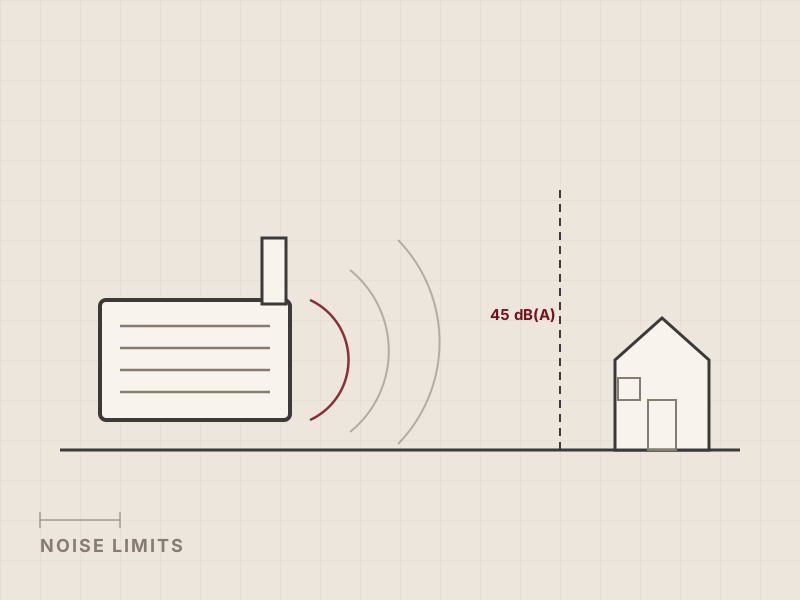
It is a level at a point, not a property of the equipment. Sound pressure depends on distance and environment: a compact source in free-field conditions loses roughly 6 dB per doubling of distance, and reflections, barriers and neighbouring equipment shift the result further. The quantity that characterises the source itself, independent of position, is sound power, determined by engineering methods such as ISO 3744 [2]. A dB(A) requirement is incomplete until it states where it applies.
It collapses an entire spectrum into one number. A low-frequency diesel exhaust rumble and the broadband hiss of a high-pressure gas vent can return the same dB(A) reading while having almost nothing in common acoustically. The single number hides exactly the information a silencer designer needs most.
Insertion loss is not net level reduction
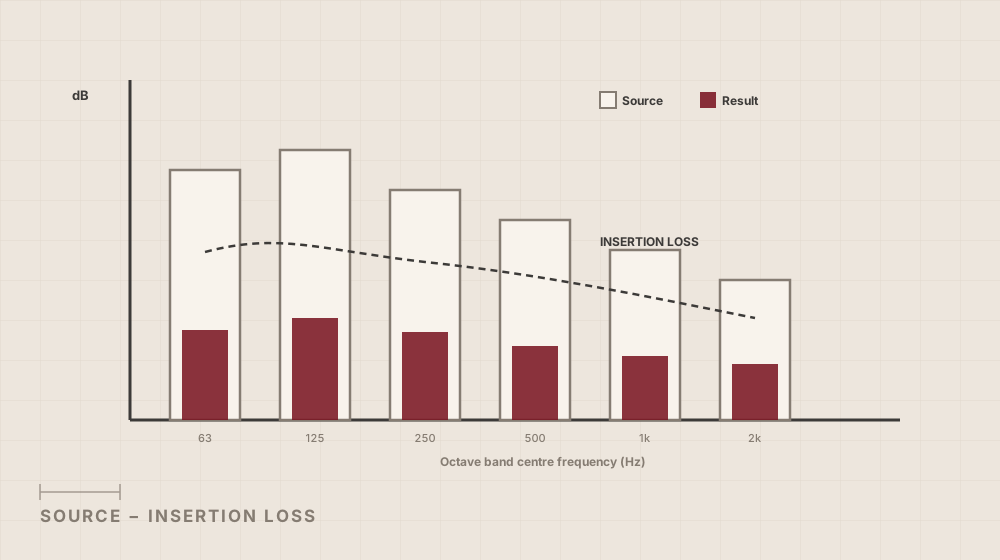
The contractual performance quantity for a silencer is insertion loss: the difference in sound level at a given point with and without the silencer installed, all other conditions unchanged. Laboratory determination of insertion loss for ducted silencers, together with flow noise and pressure loss, is standardised in ISO 7235 [3]; measurement on silencers in their installed state is covered by ISO 11820 [4].
Insertion loss is routinely confused with the net level reduction experienced at a receptor, a site boundary, a dwelling, a workstation. The two are equal only when the silenced path is the only significant contributor. In real installations, other sources and flanking paths (casing breakout, structure-borne transmission, enclosure openings) keep radiating, and the total can never fall below the local background. A silencer can deliver its full 30 dB insertion loss while the boundary level improves by only a few dB, with the silencer performing exactly to specification. Receptor levels, and how they are determined, belong to environmental-noise standards such as ISO 1996-2 [5]; insertion loss is what the silencer supplier can guarantee. A clean specification states both and never substitutes one for the other.
(A third quantity, transmission loss (incident versus transmitted sound power across the element), is useful in analysis but not directly measurable on an installed system. For procurement, specify insertion loss.)
Why a single dB(A) target under-specifies a silencer
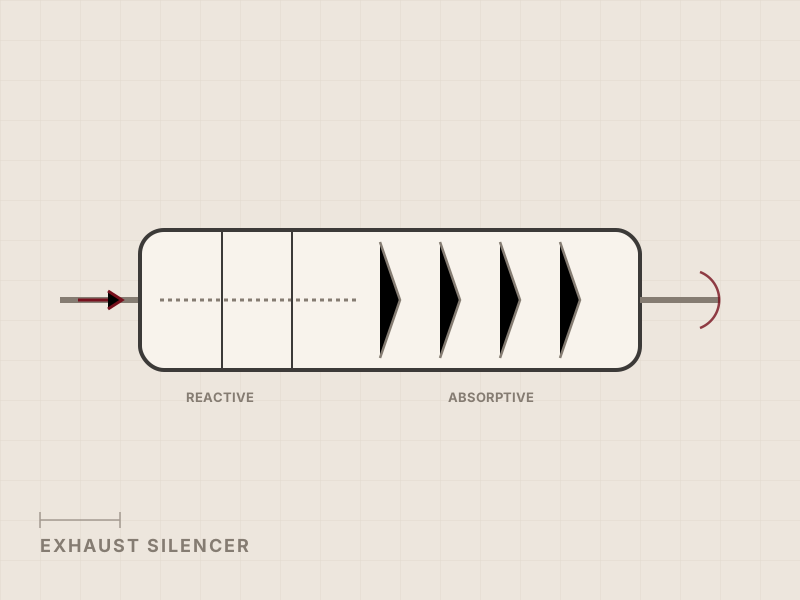
Silencer attenuation is strongly frequency-dependent: absorptive splitter designs work best in the mid and high octave bands, while reactive chambers are tuned to low frequencies; the differences are laid out in our overview of exhaust silencer types and how they work. Source spectra are just as uneven: reciprocating engines concentrate energy at low-frequency firing orders, while vents and safety-valve outlets radiate mostly broadband, high-frequency noise.
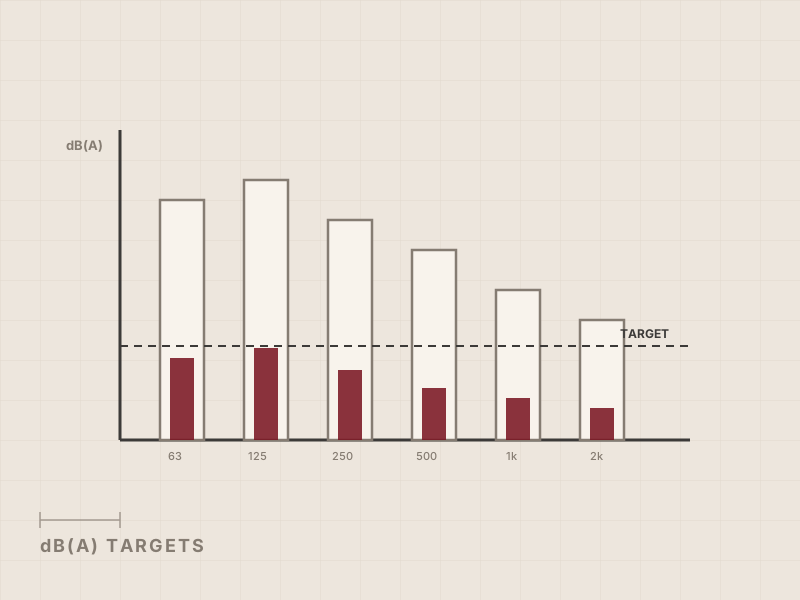
A dB(A) reduction can therefore only be engineered once the octave-band spectrum of the source is known. Octave-band analysis uses the standardised filter banks of IEC 61260-1 [6], customarily reported in the 63 Hz–8 kHz bands for industrial sources. Because the A-weighted total is dominated by whichever bands carry the most weighted energy, the same “25 dB(A) reduction” can mean a compact absorptive unit against a high-frequency spectrum, or a much larger multi-chamber engine exhaust silencer against a spectrum dominated by the 63 and 125 Hz bands.
When the spectrum is missing, the supplier must assume one. An optimistic assumption produces a system that misses the target; a conservative one produces size, weight and pressure drop the project did not need. Octave-band data is the difference between a calculated design and a priced guess.
Flow-generated self-noise sets a floor
A silencer in operation generates noise of its own: gas moving through its passages regenerates sound, at a level that rises steeply with flow velocity. This self-noise sets a hard floor under the achievable downstream level: once regenerated noise dominates, adding attenuation upstream changes nothing. It is why ISO 7235 covers determination of flow-generated sound power alongside insertion loss [3].
The practical consequence: a specification combining a very low resulting level with a high gas velocity, or a pressure-drop budget so tight it forces high velocity, can be physically self-contradictory. The trade-off is most acute in high-flow applications such as vent silencers for gas blowdown and pressure relief; our article on vent silencer sizing for gas blowdown covers it in depth. A workable spec states the required level and the process conditions, and leaves the designer room to balance attenuation against flow area.
Five specification mistakes we see repeatedly
-
A dB(A) reduction with no source spectrum and no measurement position. “Reduce noise by 20 dB(A)” defines neither what is being reduced nor where the result counts: without a spectrum it cannot be engineered, and without a position it cannot be verified.
-
Insertion loss written where net level reduction is meant. “The silencer shall reduce the boundary level by 25 dB(A)” makes one component responsible for a result governed by every source and path on site. Specify the silencer’s insertion loss, and set the receptor limit separately with its own measurement standard.
-
Flow-generated self-noise ignored. A spec that fixes attenuation but says nothing about flow can be met on paper by a silencer whose own regenerated noise dominates the outlet. Required levels must be stated, and checked, as achievable including self-noise at the actual flow conditions.
-
A single-number target with no octave-band data. The supplier is forced to assume a spectrum: optimistic assumptions end in non-compliance, defensive ones in over-sized equipment, and both invite acceptance disputes when the assumed and actual spectra differ.
-
No reference conditions. Gas temperature, composition and flow change acoustic behaviour (the speed of sound shifts the tuning of reactive elements), and the measurement basis changes the numbers: ISO 11820 notes that in-situ results are not comparable with ISO 7235 laboratory data, because sound fields, flow, temperature and mounting differ [4]. State the operating case and the standard the guarantee refers to.
What a complete noise specification contains
A checklist for the RFQ:
- Source data: equipment type, operating cases (loads, valve scenarios), and octave-band sound power or sound pressure levels at a stated position, with the data basis (e.g. measured to ISO 3744, or a manufacturer datasheet).
- The acoustic requirement: required insertion loss per octave band, and/or the required resulting level at defined positions and conditions, with the governing verification standard (ISO 7235 laboratory, ISO 11820 in-situ, or ISO 1996-2 at the receptor).
- Process conditions: gas composition, temperature, flow rate, pressure, and the allowable pressure drop across the silencer.
- Installation constraints: available envelope, orientation, connection sizes and loads.
- Acceptance: who measures, when, at which positions, with what instrument class (IEC 61672-1 class 1), and what tolerance applies.
A specification carrying these items can be answered with a firm, comparable quotation instead of a list of clarification questions.
From noise limit to specification
Few projects have all of this data at enquiry stage, and that is normal. If you are working from a permit condition, a complaint, or a single-number limit, our industrial noise control team works from whatever is available and tells you plainly which missing data drives the uncertainty. Send us your current specification or measurement data and we will review it before you commit to a target.
References
- IEC 61672-1:2013, Electroacoustics: Sound level meters, Part 1: Specifications. International Electrotechnical Commission. https://webstore.iec.ch/en/publication/5708
- ISO 3744:2025, Acoustics: Determination of sound power levels of noise sources using sound pressure, Engineering methods for an essentially free field over a reflecting plane. International Organization for Standardization. https://www.iso.org/standard/80866.html
- ISO 7235:2003, Acoustics: Laboratory measurement procedures for ducted silencers and air-terminal units, Insertion loss, flow noise and total pressure loss. International Organization for Standardization. https://www.iso.org/standard/30385.html
- ISO 11820:1996, Acoustics: Measurements on silencers in situ. International Organization for Standardization. https://www.iso.org/standard/20231.html
- ISO 1996-2:2017, Acoustics: Description, measurement and assessment of environmental noise, Part 2: Determination of sound pressure levels. International Organization for Standardization. https://www.iso.org/standard/59766.html
- IEC 61260-1:2014, Electroacoustics: Octave-band and fractional-octave-band filters, Part 1: Specifications. International Electrotechnical Commission. https://webstore.iec.ch/en/publication/5063