On this page
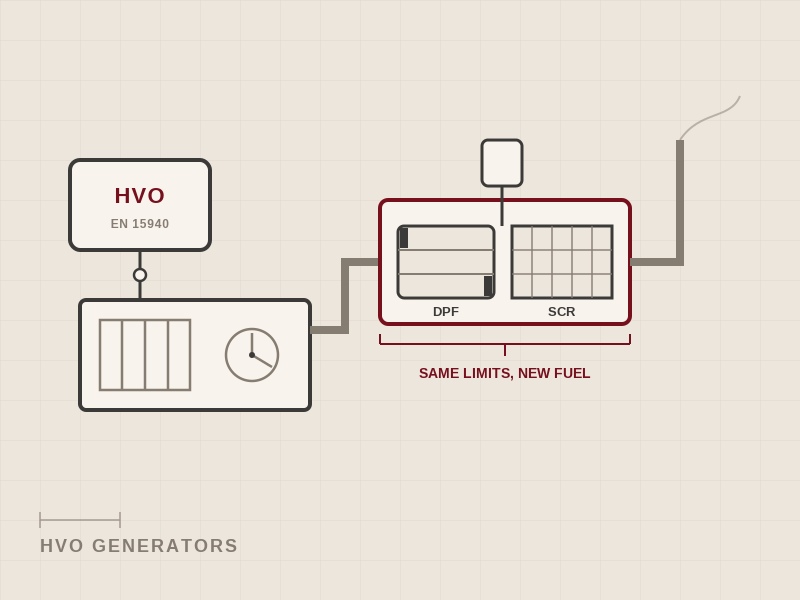
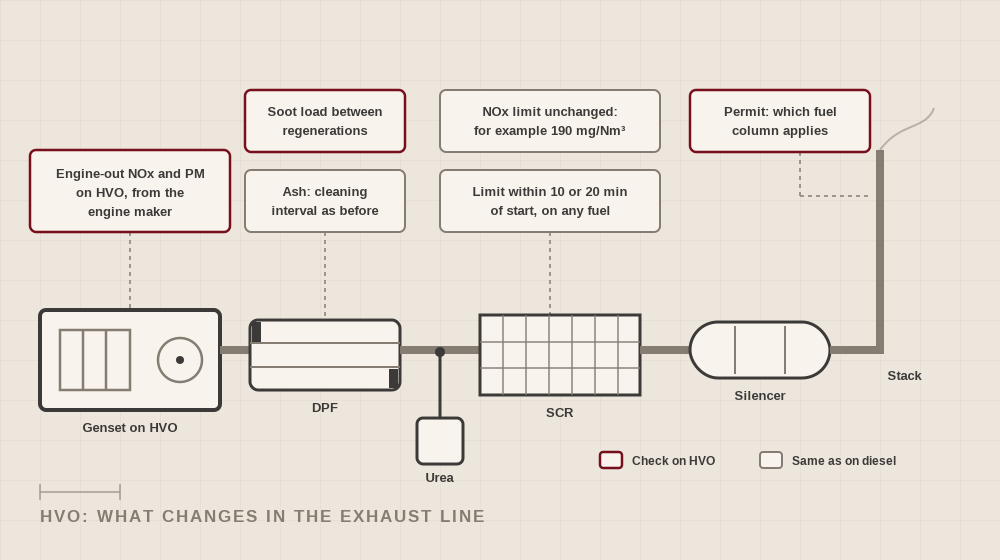
Running an HVO generator instead of a diesel one changes the fuel, not the emission limit. HVO (hydrotreated vegetable oil) is a paraffinic diesel fuel to EN 15940, which the UK regulator describes as a drop-in replacement for gas oil, and in England a permitted generator may switch to it under its existing gas oil limits if the operator meets the conditions of the Environment Agency’s regulatory position statement RPS 337 [3][4]. The 190 mg/Nm³ NOx limit for specified generators applies whatever the fuel [2], and in Germany the NOx limit and the soot-filter duty for new emergency gensets are written for liquid fuels in general [5]. An engine that needed SCR or a particulate filter on diesel therefore needs it on HVO too. What changes is the paperwork, the fuel column that some regulators read the limits from, and a few design inputs for the SCR and the DPF. This guide covers all three.
What HVO is, and how the emission rules class it
HVO is made by treating vegetable oils and fats with hydrogen, and the product is a paraffinic diesel fuel with its own standard, EN 15940. The Environment Agency’s position statement covers only HVO that meets EN 15940 [3], and German fuel law requires paraffinic diesel of the “XTL” quality sold to end users to meet DIN EN 15940, July 2023 edition (10. BImSchV, § 4(3)) [6].
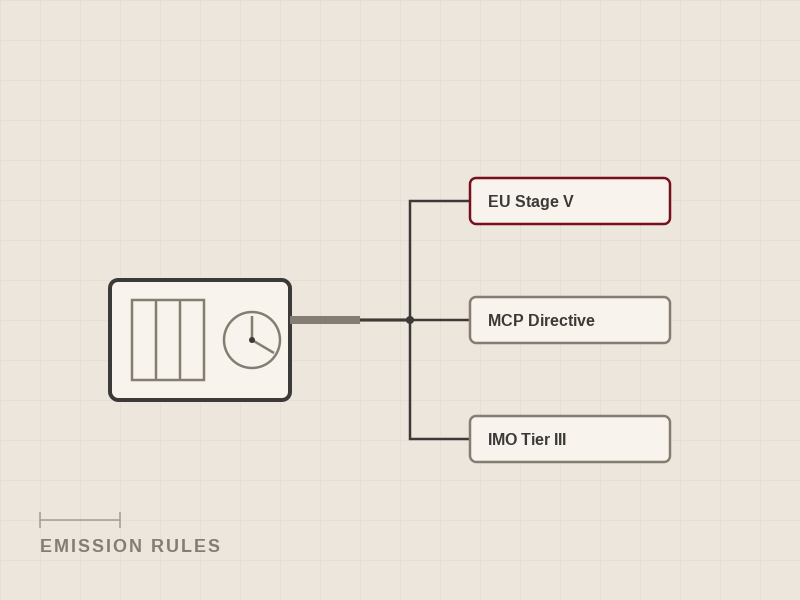
Emission rules, however, sort liquid fuels by origin. The MCP Directive defines gas oil as a petroleum-derived liquid fuel (Article 3(19)) [1], and Germany’s 44. BImSchV uses the same definition and lists “liquid fuels other than gas oil” as a separate fuel type (§ 2(9) and (18)) [5]. Read literally, HVO is not gas oil. For a new engine, that moves it from the gas oil column of the directive’s limit table to the column for other liquid fuels (Annex II, Part 2, Table 2, new engines, dry gas at 15 % O₂) [1]:
| mg/Nm³ | Gas oil | Other liquid fuels |
|---|---|---|
| NOx | 190 | 190 |
| SO₂ | None | 120 |
| Dust | None | 10 (20 for 1–5 MW) |
Footnotes to the table allow 225 mg/Nm³ NOx for dual fuel engines in liquid mode and, in the second column only, for diesel engines up to 20 MW running at 1,200 rpm or less [1]. The NOx limit is the same in both columns. The difference is that the second column adds an SO₂ and a dust limit that gas oil does not carry. Which column your regulator applies to HVO is the first question to settle, before any equipment is sized.
England: RPS 337 and the specified generator rules
For England the regulator has answered it. The Environment Agency’s guidance on MCP emission limit values says that HVO is a drop-in replacement for gas oil, that you can use the gas oil limits, and that you do not need to vary your permit to burn HVO instead of gas oil where you meet RPS 337 [4]. The position statement applies to combustion plant in England whose permit allows gas oil as a fuel, and sets these conditions [3]:
- hold an environmental permit that allows the combustion of gas oil;
- confirm with the original equipment manufacturer that the fuel is suitable for your plant;
- comply with the emission limits and fuel specification in your permit;
- notify the Environment Agency, through your local regulatory officer, before you rely on the statement;
- burn only HVO that meets EN 15940, and no fuel that neither your permit nor the statement names;
- keep records for two years from the last use, and show them on request.
The statement also warns that replacing fossil fuel may change your UK Emissions Trading Scheme reporting, and that HVO may be partly made from palm oil, so the supply should be checked against your company’s sustainability criteria. The Agency intends to review it by 4 July 2028, and to amend permits over time so that drop-in fuels no longer need it [3]. RPS 337 covers England only: in Wales, Scotland and Northern Ireland, ask Natural Resources Wales, SEPA or NIEA how they treat HVO.
The specified generator rules do not depend on the fuel at all. A specified generator must meet a NOx limit of 190 mg/Nm³ from its permitting date. Where secondary abatement such as SCR is needed to get there, the limit must be met within 10 minutes of start-up for a Tranche B generator, or 20 minutes for a Tranche A generator, and emissions must be monitored at least every three years (Schedule 25B, paragraph 5) [2]. Back-up generators run for testing no more than 50 hours a year are excluded from the definition (paragraph 2) [2]. Under the MCP rules, a new plant running no more than 500 hours a year, as a three-year rolling average, is not required to meet the limit values if the operator signs the declaration (Schedule 25A, paragraph 8) [2]. None of these thresholds moves with the fuel: switching to HVO takes a generator neither out of a regime nor into one.
EU member states and Germany
The MCP Directive itself says nothing about HVO, so outside England the classification is for the national authority. Ask early which column it will apply, and whether your test-run profile fits the limited-hours exemption, which the directive leaves to each member state (Article 6(8)) [1]. Our guide to data center backup power and emission regulations explains that exemption and how the Netherlands, Germany and the Nordic countries transposed it.
In Germany the answer for NOx and soot does not depend on the classification, because the 44. BImSchV writes those rules for liquid fuels in general [5]:
- NOx. Engines on liquid fuels must meet 0.1 g/m³. The limit does not apply to engines run under 300 hours a year or only for emergencies; those must use in-engine measures to the state of the art instead (§ 16(7)).
- Soot filter. A new liquid-fuelled engine plant run for peak load up to 300 hours a year, or only for emergencies, must carry a state-of-the-art soot filter, with a test certificate within four months of start-up showing total dust at or below 5 mg/m³. An operator who does without the filter must hold 50 mg/m³ (§ 16(5)).
- Dust in normal operation. § 16(3) sets 20 mg/m³ for heating oil, EN 590 diesel, methanol, ethanol, vegetable oils and their methyl esters. Pure HVO to EN 15940 is not named there, and § 16(4) refers other liquid fuels to the limits of § 11(4): 20 mg/m³ below 20 MW and 10 mg/m³ from 20 MW, converted to the engine’s reference oxygen content of 5 %. Agree with the authority which paragraph your permit uses.
A new German emergency genset therefore carries a particulate filter on HVO exactly as it does on diesel. The German rules are set out in full in our article on the 44. BImSchV für Notstromaggregate und BHKW (in German).
What HVO changes for the SCR system
An SCR system is sized for the NOx it has to remove: the engine-out NOx minus the limit, at the exhaust flow and temperature of each load point. HVO leaves the limit where it was, so the input that can change is the engine’s own NOx on HVO. Ask the engine maker for emission data on HVO at your reference loads; that is the figure the catalyst volume and the urea dosing are designed to. Unless those data show the engine below the limit without abatement, the SCR stays, and its design changes only as far as the HVO figures differ from the diesel ones.
Three points to settle in the specification:
- Both fuels. A permit that allows HVO under RPS 337 still allows gas oil [3], and a site may fall back on diesel when HVO is short. Size the SCR for whichever fuel gives the higher engine-out NOx, so compliance does not depend on what is in the tank.
- Heat-up. The catalyst must reach its working temperature quickly whatever the fuel: under the specified generator rules the limit applies within 10 or 20 minutes of start [2]. Catalyst position, insulation of the line and the temperature at which dosing starts are designed for cold starts and short test runs.
- Commissioning. Set the dosing and measure NOx at the reference loads on the fuel the genset will actually burn, and keep the results with the fuel records that RPS 337 already asks for [3].
What HVO changes for the particulate filter
Where a dust limit or a filter duty applies, the diesel particulate filter stays. The German soot-filter rule for new emergency gensets covers liquid fuels in general [5], and a regulator that reads HVO into the second column of the MCP table applies a dust limit of 10 or 20 mg/Nm³ [1]. Two design inputs can change:
- Soot load. If the engine maker’s data show lower particulate emissions on HVO, the filter loads more slowly between regenerations. The hard case does not change: standby gensets that run short tests at low load never reach the temperatures for passive regeneration on any fuel, so the regeneration strategy is still designed for that duty.
- Ash. Ash comes from lubricating-oil additives and fuel impurities, cannot be burned off, and is removed only by cleaning. Plan the cleaning interval on the engine’s oil consumption and running hours as before.
What to have ready when you specify SCR or DPF for an HVO generator
- Engine make, model and rating, and the engine maker’s confirmation that HVO to EN 15940 is approved for it
- Engine-out NOx and particulate emissions on HVO, and on diesel if the site may switch back, at each reference load
- Exhaust flow, temperature and the maximum allowable exhaust back pressure
- Country, regulator and permit basis: MCP plant, specified generator (Tranche A or B), or both; the fuel the permit names; and whether you rely on RPS 337
- The limits that apply and their reference oxygen content: NOx, dust and SO₂, and which fuel column the regulator uses
- Operating profile: emergency only, test-run hours and duration, peak shaving or grid services, and the time allowed to reach the limit after start
- Monitoring and reporting duties, including any change to UK ETS reporting
- Layout: space for the SCR and DPF, the silencer and the stack, and the noise limit at the site
With these inputs the SCR and the filter can be designed to the limits your site actually faces on HVO, and the switch can be made without a second round of engineering later.
Axces designs SCR systems for NOx reduction and particulate filters for soot reduction for generator fleets, from 28 SCR systems holding the backup gensets of a Dutch data center to 190 mg/Nm³, to 21 containerised DOC, DPF and SCR systems for a Swiss data center. If your gensets are moving to HVO, request a quote for an SCR system with the data above, and our engineers will tell you what the switch means for your exhaust line.
References
- Directive (EU) 2015/2193 of the European Parliament and of the Council of 25 November 2015 on the limitation of emissions of certain pollutants into the air from medium combustion plants: Article 3(19), Article 6(8) and Annex II, Part 2, Table 2. EUR-Lex: https://eur-lex.europa.eu/eli/dir/2015/2193/oj; Annex II as published on legislation.gov.uk: https://www.legislation.gov.uk/eudr/2015/2193/annex/II
- The Environmental Permitting (England and Wales) Regulations 2016 (SI 2016/1154), Schedule 25A, paragraphs 6 and 8, and Schedule 25B, paragraphs 2 and 5, inserted by SI 2018/110. https://www.legislation.gov.uk/uksi/2016/1154/schedule/25A and https://www.legislation.gov.uk/uksi/2016/1154/schedule/25B
- Environment Agency. Using drop-in fuels in combustion plant instead of gas oil: RPS 337, published 4 July 2025. https://www.gov.uk/government/publications/using-drop-in-fuels-in-combustion-plant-instead-of-gas-oil-rps-337
- Environment Agency and Natural Resources Wales. Medium combustion plant (MCP): comply with emission limit values, section “Hydrotreated vegetable oil (HVO)”, updated 9 July 2025. https://www.gov.uk/guidance/medium-combustion-plant-mcp-comply-with-emission-limit-values
- Verordnung über mittelgroße Feuerungs-, Gasturbinen- und Verbrennungsmotoranlagen (44. BImSchV): § 2(9) and (18), § 11(4) and § 16(3) to (7). Gesetze im Internet: https://www.gesetze-im-internet.de/bimschv_44/__2.html and https://www.gesetze-im-internet.de/bimschv_44/__16.html
- Zehnte Verordnung zur Durchführung des Bundes-Immissionsschutzgesetzes (10. BImSchV): § 4(3). Gesetze im Internet: https://www.gesetze-im-internet.de/bimschv_10_2010/__4.html