On this page
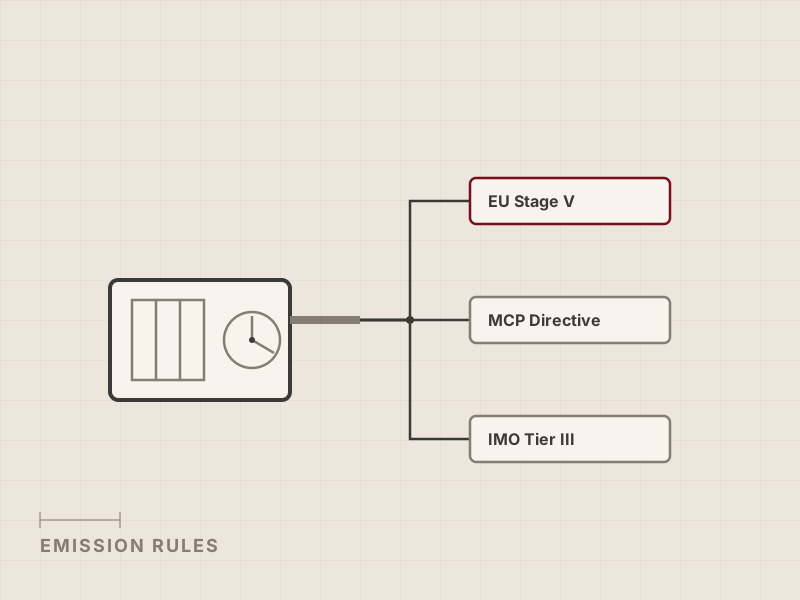
Emission regulations for data center backup generators in the EU run through two instruments: the Medium Combustion Plant Directive (EU) 2015/2193 for permanently installed gensets of 1–50 MW thermal input, and the Stage V Regulation (EU) 2016/1628 for mobile and transportable sets. Whether hard limit values actually apply to an emergency genset usually comes down to one provision, the limited-operating-hours derogation, and how each member state transposed it. This guide maps the thresholds, the limit values, and the point at which SCR and particulate control stop being optional.
Which EU rules apply to backup generators
The MCP Directive (MCPD) applies to combustion plants with a rated thermal input of at least 1 MW and less than 50 MW, irrespective of fuel (Article 2(1)) [1]. Thermal input, not electrical output, is the yardstick, so virtually every permanently installed data center backup engine qualifies. Two or more new plants discharging through a common stack, or judged capable of doing so, count as a single plant with summed thermal input (Article 4) [1], so a multi-genset plant room can be assessed as one installation.
The Stage V Regulation is a type-approval regime for engines in non-road mobile machinery. It explicitly does not apply to stationary machinery: equipment permanently installed (bolted or otherwise fixed) in one location for its first use (Articles 2(2)(d), 3(36)–(37)) [2]. Transportable generating sets are non-road mobile machines in their own right (Article 3(35)) and need Stage V type-approval [2].
The two regimes are mutually exclusive by design: the MCPD excludes plants covered by the non-road mobile machinery rules (Article 2(3)(b) of the directive, read with Article 64(2) of the regulation) [1][2]. In short: permanently installed genset → MCPD; mobile or rental genset → Stage V.
MCP Directive limit values for engines
Engine and gas turbine limit values are referenced to dry gas at 15 % O₂ [1]. For new plants, put into operation from 20 December 2018 (Article 3(6)–(7)), the Annex II, Part 2, Table 2 values apply from day one (Article 6(7)) [1]:
| Pollutant (mg/Nm³, 15 % O₂) | Gas oil | Other liquid fuels | Natural gas |
|---|---|---|---|
| NOx | 190 | 190 | 95 |
| SO₂ | None | 120 | None |
| Dust | None | 10 (20 for 1–5 MW) | None |
Those entries matter: for engines burning gas oil, the standard data center fuel, the MCPD sets no SO₂ or dust limit value; sulphur is controlled through fuel quality, leaving NOx at 190 mg/Nm³ as the binding number [1]. Existing engines face the same 190 mg/Nm³ headline, relaxed to 225–250 mg/Nm³ in smaller size bands and 1,850 mg/Nm³ for the oldest pre-2006 diesels; compliance runs from 1 January 2025 above 5 MW and from 1 January 2030 at or below 5 MW (Article 6(2); Annex II, Part 1, Table 3) [1].
Registration is separate: new plants before operation, existing plants above 5 MW since 1 January 2024, the rest by 1 January 2029, exempt emergency sets included (Article 5) [1].
The limited-operating-hours derogation
This is the provision most data center projects are built around. Member states may exempt:
- new plants operating no more than 500 hours per year, as a rolling average over three years, from the Part 2 limit values (Article 6(8)) [1];
- existing plants at the same 500-hour threshold, as a rolling average over five years, extendable to 1,000 hours for backup power on connected islands during a supply interruption, or for heat production in exceptionally cold weather (Article 6(3)) [1].
Three caveats: the derogation is a member-state option, not an operator right; “operating hours” means time discharging emissions, excluding start-up and shut-down (Article 3(22)) [1], so monthly load tests count; and registration and hour-logging remain even when limit values are waived. A middle band exists too: engines running 500–1,500 hours per year may be exempted from the 190 mg/Nm³ value if they apply primary (in-engine) NOx measures and meet relaxed limits: 750 mg/Nm³ for high-speed diesels above 1,200 rpm, the usual data center class (Annex II, Part 2, Table 2, footnotes) [1].
Stage V and stationary backup gensets
Stage V does not bind a permanently installed genset, but it still shapes projects: temporary and rental power for commissioning or bridging must be type-approved, and operators increasingly specify “Stage V-equivalent” performance for fixed plant voluntarily. The relevant Annex II limits (g/kWh) [2]:
| Category | Power | NOx | PM | PN |
|---|---|---|---|---|
| NRE-v/c-6 | 130–560 kW | 0.40 | 0.015 | 1 × 10¹² |
| NRG-v/c-1 (gensets) | > 560 kW | 0.67 | 0.035 | None |
The particle-number limit in the 130–560 kW band effectively forces a wall-flow particulate filter; the NOx values force SCR, which is why authorities and operators increasingly reference these numbers even for fixed plant.
National transposition: one directive, three outcomes
Netherlands
Under the Besluit activiteiten leefomgeving (Bal, § 4.126), emission limit values do not apply to combustion plants operated at most 500 hours per year (Article 4.1343); the operator must notify the competent authority, keep a monthly hour log, and loses the exemption if the threshold is exceeded [4]. Dutch guidance treats commercial deployment, peak shaving or grid-support pools, as regular operation outside the exemption. Separately, nitrogen-deposition permitting around Natura 2000 areas has become a decisive factor for Dutch data center projects and has pushed SCR onto emergency gensets that would otherwise enjoy the derogation.
Germany
Germany transposed the MCPD through the 44. BImSchV, and went further. Liquid-fuelled engine plants face a NOx limit of 0.10 g/m³, referenced to 5 % O₂ rather than the directive’s 15 % and substantially stricter (§ 16(7)) [3]. Those NOx and CO limits do not apply to plants run under 300 hours per year or exclusively in emergency duty, though in-engine abatement must be exhausted to the state of the art (§ 16(6)–(7)) [3]. Crucially, new liquid-fuelled peak-load or emergency plants must carry a state-of-the-art soot filter, certified within four months of commissioning to hold total dust below 5 mg/m³; an operator who waives the filter must hold 50 mg/m³ instead (§ 16(5)) [3]. A new German data center genset therefore effectively carries a particulate filter even when its NOx limits are waived.
Nordics
Sweden’s ordinance on medium combustion plants (2018:471) tracks the directive: new plants running at most 500 hours per year (three-year rolling average) are exempt, extendable to 1,000 hours in emergencies caused by exceptionally cold weather or an island supply interruption, subject to notification (§ 35 and the accompanying emergency provision) [5]. Finland transposed the directive through Government Decree 1065/2017 on medium-sized energy producing units [6]. Notification routes, logging duties and local air-quality conditions still differ, and Article 6(9) of the directive lets any member state impose stricter values in non-attainment zones [1].
Specifying the exhaust line
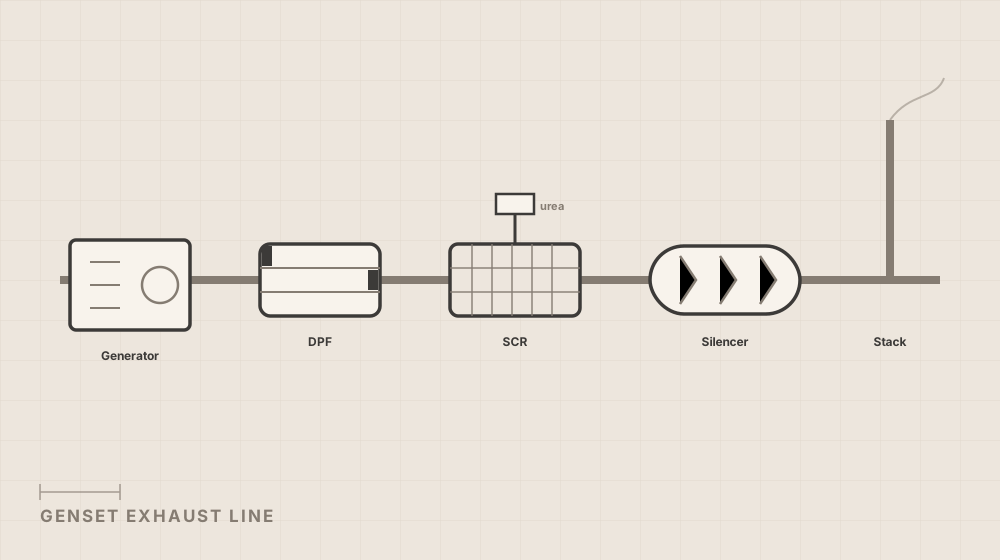
Where the hours derogation holds and no national rule intervenes, the minimum scope is an exhaust system with engineered silencing, a registered plant, and a defensible hour log. Once a project leaves that envelope (German new-builds, Dutch nitrogen-sensitive sites, grid-support revenue above 500 hours, or a voluntary Stage V-equivalent spec), two abatement stages enter the design: SCR systems for NOx reduction, which take a diesel engine from raw four-digit mg/Nm³ emissions past the 190 mg/Nm³ mark, and particulate control for soot for filter-grade dust numbers like Germany’s 5 mg/m³.
Backup duty makes both harder than baseload: the catalyst must reach temperature quickly from cold starts, reagent dosing must follow fast load steps, and the combined backpressure of silencer, SCR and filter must stay inside the engine maker’s budget. Integrating attenuation and catalyst housings into one emission control package is usually the cleanest way to hold all three at once.
If you are specifying backup power for a data center and need to know which limits your site will actually face, talk to our engineers about an SCR and particulate control package matched to your gensets.
References
- Directive (EU) 2015/2193 of the European Parliament and of the Council of 25 November 2015 on the limitation of emissions of certain pollutants into the air from medium combustion plants: Articles 2–6 and Annex II. EUR-Lex: https://eur-lex.europa.eu/eli/dir/2015/2193/oj
- Regulation (EU) 2016/1628 of the European Parliament and of the Council of 14 September 2016 on requirements relating to gaseous and particulate pollutant emission limits and type-approval for internal combustion engines for non-road mobile machinery: Articles 2(2)(d), 3(1), 3(35)–(37), 64(2) and Annex II, Tables II-1 and II-2. EUR-Lex: https://eur-lex.europa.eu/eli/reg/2016/1628/oj
- Vierundvierzigste Verordnung zur Durchführung des Bundes-Immissionsschutzgesetzes (44. BImSchV): § 16(3), (5), (6), (7). Gesetze im Internet: https://www.gesetze-im-internet.de/bimschv_44/__16.html
- Informatiepunt Leefomgeving (IPLO), Rijkswaterstaat: exemptions from emission limit values for small and medium combustion plants under § 4.126 / Article 4.1343 Besluit activiteiten leefomgeving: https://iplo.nl/regelgeving/regels-voor-activiteiten/kleine-middelgrote-stookinstallaties-standaard/uitzonderingen-emissiegrenswaarden-kl-mg-sb/
- Förordning (2018:471) om medelstora förbränningsanläggningar: § 35 (500-hour exemption for new plants) and the emergency extension to 1,000 hours. Sveriges riksdag: https://www.riksdagen.se/sv/dokument-och-lagar/dokument/svensk-forfattningssamling/forordning-2018471-om-medelstora_sfs-2018-471/
- Statsrådets förordning om miljöskyddskrav för medelstora energiproducerande enheter och energiproducerande anläggningar (1065/2017). Finlex: https://finlex.fi/en/legislation/collection/2017/1065