On this page
- The three regimes at a glance
- Start here: stationary, mobile, or marine?
- The MCP Directive (EU) 2015/2193: stationary plant from 1 to 50 MW
- Stage V (EU) 2016/1628: non-road mobile machinery
- IMO MARPOL Annex VI Tier III: marine NOx in emission control areas
- Where the lines blur: read the caveats
- Getting the routing right
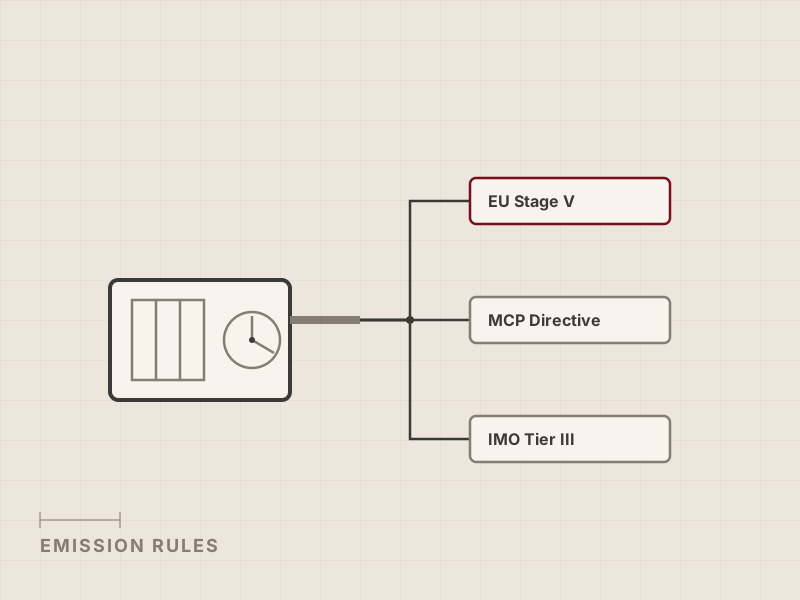
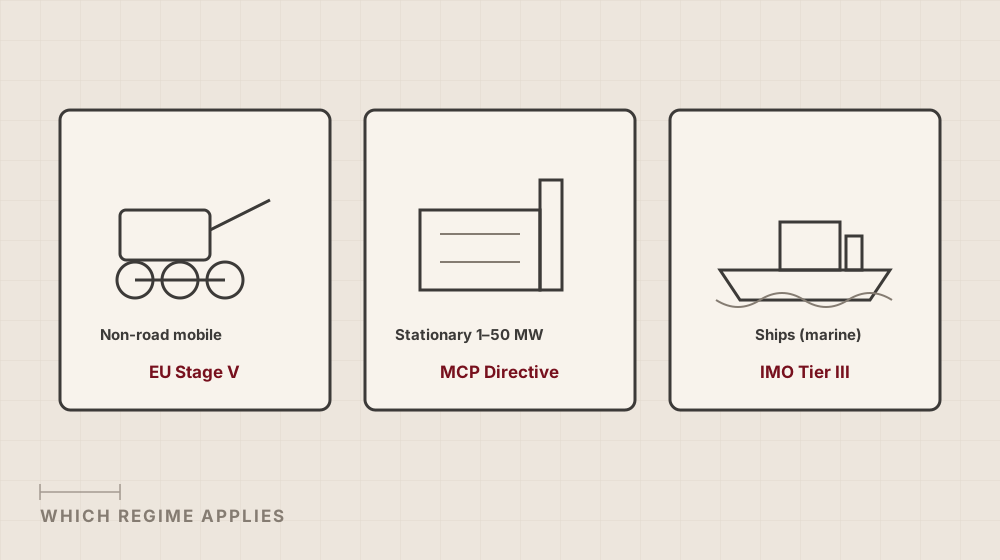
Working out which emission regulation applies to an engine or plant usually comes down to three questions: is the engine stationary, mobile, or marine; how big is it; and where and when was it installed? Answer those and the right regime almost always falls out. This guide maps the three frameworks an industrial operator in Europe meets (EU Stage V for non-road machinery, the EU Medium Combustion Plant (MCP) Directive for stationary plant, and IMO MARPOL Annex VI Tier III for ships), and gives a plain-language way to route any engine correctly.
One caution: these boundaries are set by EU and IMO law, but EU directives are transposed nationally and the final numbers for any installation are fixed by its permit. Treat this as a routing tool, not a compliance determination.
The three regimes at a glance
| Stage V | MCP Directive (MCPD) | IMO MARPOL Annex VI Tier III | |
|---|---|---|---|
| Legal instrument | Regulation (EU) 2016/1628 | Directive (EU) 2015/2193 | MARPOL Annex VI, Regulation 13 |
| What it governs | Engines in non-road mobile machinery (incl. mobile/transportable gensets) | Stationary combustion plant (boilers, engines, turbines) | Marine diesel engines on sea-going ships |
| Size / scope band | By engine power category (Annex III) | Rated thermal input ≥ 1 MW and < 50 MW (Art. 2(1)) | Engines > 130 kW output, excl. emergency-only (Reg. 13) |
| Pollutants | NOx, HC, CO, PM/PN | SO₂, NOx, dust (CO monitored) | NOx (Tier III) |
| Jurisdiction | EU type-approval, placing on market | EU-wide, via national transposition + per-site permit | Flag state + port state; Tier III only inside NOx ECAs |
| Typical Axces market | Not an Axces market (routing branch only) | Emergency gensets at data centres | Commercial / industrial vessels |
Start here: stationary, mobile, or marine?
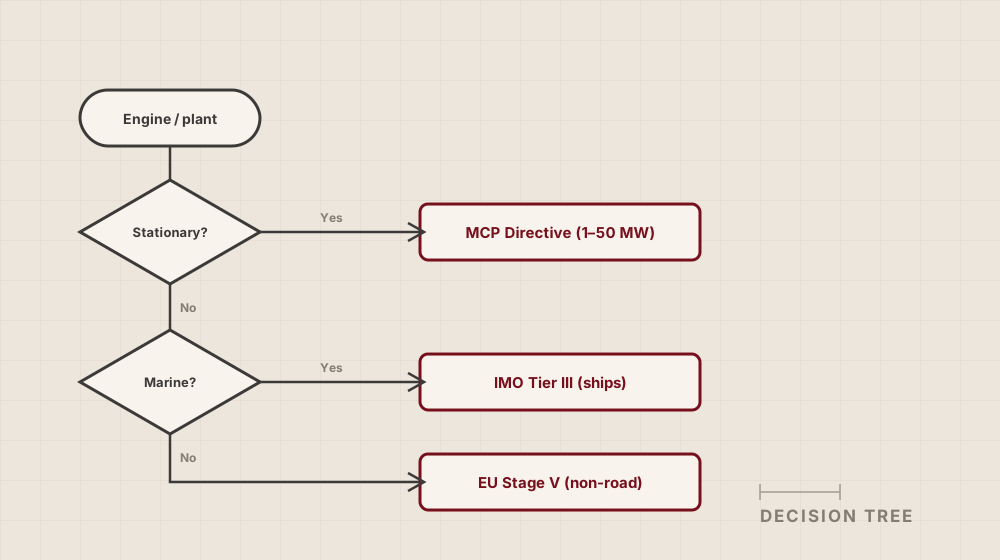
The first fork separates the three regimes cleanly.
Is the engine installed on a sea-going ship?
If yes, you are in the IMO MARPOL Annex VI world, not an EU machinery regime. Stage V explicitly excludes sea-going vessels that require a maritime navigation or safety certificate (Regulation (EU) 2016/1628, Art. 2(2)(e)). Marine NOx on commercial and industrial vessels is covered below under MARPOL Annex VI, Regulation 13.
Is the engine part of mobile or transportable machinery?
If the engine sits in something designed to move (an excavator, a crane, a mobile or towable generator set) it is non-road mobile machinery (NRMM) and falls under Stage V. NRMM is defined broadly as any mobile machine, transportable equipment or vehicle not intended for carrying passengers or goods on roads (Regulation (EU) 2016/1628, Art. 3(1)); a “generating set” is an independent non-road mobile machine primarily intended to produce electric power (Art. 3(35)).
Is the engine a fixed, permanently installed plant?
If the engine or boiler is bolted down to run in one place (the classic case being a standby generator hard-wired into a building) it is stationary, and Stage V drops away: it does not apply to “stationary machinery” (Art. 2(2)(d)), i.e. machinery permanently installed and not intended to be moved (Art. 3(36)–(37)). A stationary combustion plant of 1–50 MW thermal input is instead governed by the MCP Directive.
The MCP Directive (EU) 2015/2193: stationary plant from 1 to 50 MW
The MCPD is the regime that matters most for fixed industrial combustion, including the emergency standby generators Axces equips for data centres, where our emission control systems meet MCPD limits.
Scope. It applies to combustion plants with a rated thermal input ≥ 1 MW and < 50 MW, whatever the fuel (Art. 2(1)). “Engine” here means a gas, diesel or dual-fuel engine (Art. 3(8)), so a stationary reciprocating genset is squarely in scope. Above 50 MWth you leave the MCPD for the Industrial Emissions Directive 2010/75/EU (large combustion plants); the MCPD’s aggregation rule can also combine plants sharing a stack into one larger plant (Art. 2(2), Art. 4).
The boundary that catches people out. The MCPD does not apply to engines covered by the non-road machinery regime (Art. 2(3)(b) excludes plant under Directive 97/68/EC, now replaced by Stage V). This is the stationary-vs-mobile fork again: a permanently installed genset is MCPD, a transportable one is Stage V. It also excludes vehicle, ship and aircraft propulsion engines and offshore-platform engines (Art. 2(3)(g)–(h)).
New vs existing: the dates differ. A plant in operation before 20 December 2018 is “existing”; later plants are “new” (Art. 3(6)–(7)). New plants have met the Annex II limits since 20 December 2018 (Art. 6(7)); existing plants phase in by size: > 5 MW from 1 January 2025, ≤ 5 MW from 1 January 2030 (Art. 6(2)). All must also be permitted or registered (existing > 5 MW by 1 January 2024, ≤ 5 MW by 1 January 2029; Art. 5(2)).
The limits, and the running-hours exemption. Annex II sets NOx, SO₂ and dust limits at a standardised 15 % O₂ for engines. For new stationary engines the headline NOx limit is 190 mg/Nm³ (Annex II, Part 2, Table 2), though the figure shifts with fuel, size and age (e.g. 1 850 mg/Nm³ for existing diesels built before 18 May 2006, Part 1, Table 3). Crucially, member states may exempt units running ≤ 500 operating hours per year (rolling average) from the limits (Art. 6(3), Art. 6(8)), which is why low-runtime emergency generators are often treated differently from prime-power units. For the full data-centre treatment, see our deep dive on backup-power emission rules for data centres.
Where NOx abatement is needed to hit those limits, the usual route is selective catalytic reduction; see how SCR NOx reduction works and our NOx reduction systems. Where particulates are the binding constraint (the MCPD also sets dust limits), our soot and particulate reduction systems apply.
Stage V (EU) 2016/1628: non-road mobile machinery
Stage V is the routing branch, not an Axces market; but you need it to tell a mobile genset from a stationary one. It applies to engines installed in non-road mobile machinery (Art. 2(1)), with limits and placing-on-the-market dates set per power category in Annex III (type-approval from 2018, market placement phased over 2019–2020). The decisive test is mobility: a transportable genset is Stage V; a permanently installed genset is excluded (Art. 2(2)(d); definitions in Art. 3(36)–(37)) and falls to the MCPD if it is 1–50 MWth.
IMO MARPOL Annex VI Tier III: marine NOx in emission control areas
For commercial and industrial sea-going vessels (not pleasure craft) marine NOx is governed by MARPOL Annex VI, Regulation 13.
What is covered. The NOx controls apply to every installed marine diesel engine of more than 130 kW output, other than engines used solely for emergencies, whatever the ship’s tonnage (Reg. 13). Compliance is shown through an Engine International Air Pollution Prevention (EIAPP) Certificate under the NOx Technical Code 2008.
The Tier III limits. The tier is set by the ship’s construction date; within a tier the limit depends on the engine’s rated speed n (rpm). Tier III, the strictest, requires (in g/kWh): 3.4 for n < 130; 9 × n⁻⁰·² for n = 130–1999; and 2.0 for n ≥ 2000 (Reg. 13), roughly an 80 % cut versus Tier II, which in practice means after-treatment such as SCR.
Where and when it bites. Tier III applies only while the ship operates inside a NOx Emission Control Area (ECA); outside an ECA, Tier II applies. The trigger pairs construction date with area: ships built on or after 1 January 2016 in the North American and US Caribbean Sea ECAs, and on or after 1 January 2021 in the Baltic Sea and North Sea ECAs. Certain small ships are exempt from installing Tier III engines (Reg. 13.5.2). For a vessel trading into the North Sea or Baltic NOx ECAs, this regime drives the scope.
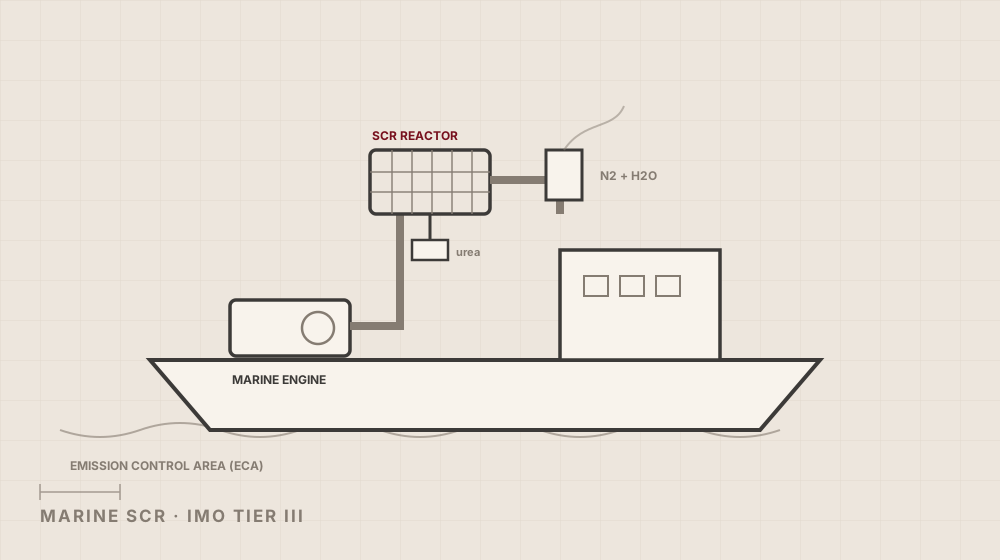
Meeting Tier III on a commercial vessel typically means SCR-based NOx reduction; where smoke or particulates are also a concern, soot and particulate reduction applies.
Where the lines blur: read the caveats
A few situations genuinely sit on a boundary. Escalate these rather than guess:
- National transposition of the MCPD varies. The band, dates and Annex II limits are EU-set, but each member state’s implementing law, and air-quality zones (Art. 6(9)), can be stricter. Confirm against the law of the country of installation.
- Per-site permits decide the final number. The directive sets a floor; the binding limit comes from the plant’s permit or registration.
- Mobile vs stationary is a legal test. “Permanently installed” has a precise definition (Art. 3(37)); how a genset is fixed and used decides whether Stage V or the MCPD applies.
- Marine major conversions can pull an older engine into a higher tier (Reg. 13.2), so re-engining or uprating is not automatically grandfathered.
Getting the routing right
The map above routes most engines correctly, but the boundary cases (aggregation, low-runtime exemptions, ECA trading patterns) are where a project’s abatement scope is won or lost. For a view on which regime governs a specific generator or vessel, and what it means for NOx and particulate control, talk to the Axces emission-control team.
References
- Directive (EU) 2015/2193 (Medium Combustion Plant Directive): Art. 1 (subject matter), Art. 2 (scope: 1–50 MWth and exclusions, incl. Art. 2(3)(b) NRMM exclusion), Art. 3 (definitions, incl. 3(6)–(8)), Art. 5 (permits and registration), Art. 6 (emission limit values and ≤500 h/yr exemptions), Art. 17 (transposition by 19 December 2017). EUR-Lex: https://eur-lex.europa.eu/eli/dir/2015/2193/oj
- Directive (EU) 2015/2193, Annex II: Emission limit values referred to in Art. 6 (Part 1 Table 3 existing engines/turbines; Part 2 Table 2 new engines/turbines; 15 % O₂ reference for engines and turbines). https://www.legislation.gov.uk/eudr/2015/2193/annex/II/adopted
- Regulation (EU) 2016/1628 (Stage V, non-road mobile machinery): Art. 2 (scope; 2(2)(d) stationary-machinery exclusion; 2(2)(e) sea-going vessel exclusion), Art. 3 (definitions: 3(1) NRMM, 3(35) generating set, 3(36)–(37) stationary / permanently installed), Annex III (emission-stage dates by engine category). EUR-Lex: https://eur-lex.europa.eu/eli/reg/2016/1628/oj
- IMO MARPOL Annex VI, Regulation 13 (Nitrogen Oxides, NOx): applicability (> 130 kW, excl. emergency-only); Tier III limits (3.4 g/kWh for n<130; 9·n⁻⁰·² for 130–1999; 2.0 g/kWh for n≥2000); Tier III ECA-only application and dates (1 Jan 2016 North American & US Caribbean Sea ECAs; 1 Jan 2021 Baltic Sea & North Sea ECAs); small-ship provision (Reg. 13.5.2). IMO: https://www.imo.org/en/OurWork/Environment/Pages/Nitrogen-oxides-(NOx)-%E2%80%93-Regulation-13.aspx
- NOx Technical Code 2008 (resolution MEPC.177(58), as amended by MEPC.251(66)): EIAPP certification basis referenced in MARPOL Annex VI Reg. 13. IMO, via reference 4.
- Directive 2010/75/EU (Industrial Emissions Directive): large combustion plants ≥ 50 MWth; the upper boundary above the MCPD’s scope (referenced in MCPD Art. 2(2)). EUR-Lex: https://eur-lex.europa.eu/eli/dir/2010/75/oj