On this page
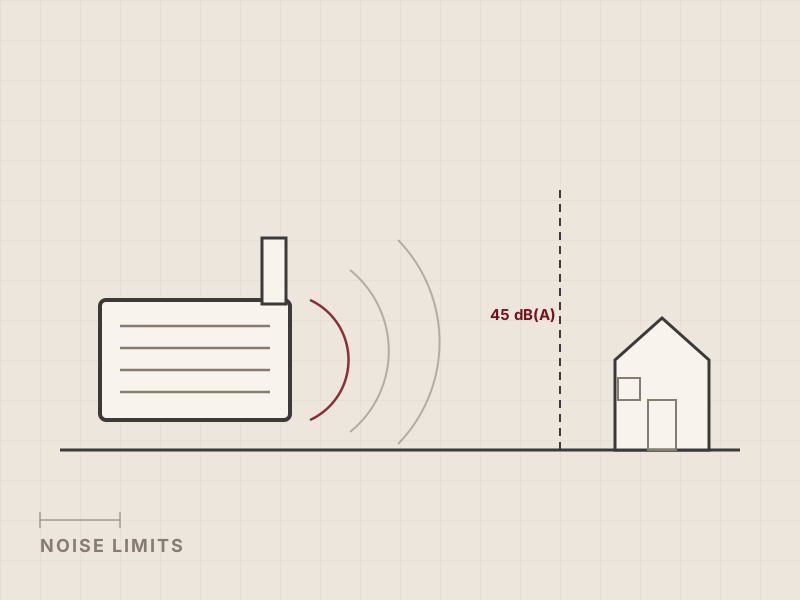
When a data center runs into environmental noise limits, the backup generators are almost always the reason. There is no single EU-wide noise limit for a data center: the EU sets a mapping and management framework, while the numbers that bind a specific site come from national rules and the site’s own permit, assessed at nearby homes or other noise-sensitive locations, and significantly stricter at night. This article explains where those limits come from, why standby generator fleets dominate the assessment, and how exhaust silencers and enclosure design work together, as complementary measures, to meet them.
Why backup generators set the noise agenda
A large colocation or hyperscale site can carry dozens of MW-class diesel generator sets. They run rarely, but never invisibly. Two operating modes matter acoustically:
- Regular load testing. Generators are exercised periodically to guarantee availability. Each test is a planned, repeated noise event that neighbours learn to recognise, and that authorities assess like any other industrial operation.
- Emergency operation. Grid failures do not respect office hours, so the fleet has to be assessed against night-time values, the lowest of the day.
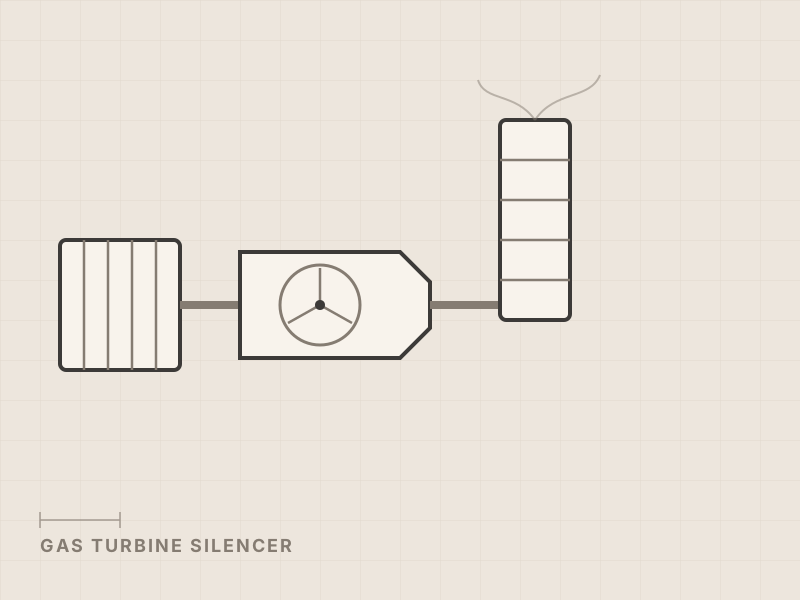
Within each generator set, the unsilenced exhaust is typically the dominant noise source. Its energy is concentrated at low frequencies tied to the engine firing frequency, and low-frequency sound is exactly the kind that carries: it diffracts around barriers and loses little to air absorption, so at hundreds of metres the exhaust often remains the controlling contribution at the receptor. Cooling plant defines a site’s continuous noise baseline; the generator fleet defines its worst case. Both must fit under the same permitted value.
An EU framework, but local numbers
What Directive 2002/49/EC actually does
The EU Environmental Noise Directive (2002/49/EC) is frequently cited in data center noise discussions, so it is worth being precise about its role. The directive establishes a common approach to assessing and managing environmental noise: harmonised indicators (Lden and Lnight), strategic noise maps (including industrial noise in larger agglomerations), action plans, and public information (Articles 7 and 8, with assessment methods in Annex II) [1][2].
What it does not do is set an EU-wide noise limit for any installation. Limit values remain a member-state matter: under Article 5(4), member states only had to report to the Commission the limit values in force or under preparation in their territory, including for industrial sites [1]. Treat 2002/49/EC as policy context; the number your generator fleet must meet comes from national legislation and, ultimately, from your site’s permit.
Where the binding numbers live: two examples
The Netherlands. Under the Omgevingswet system, the Besluit kwaliteit leefomgeving (Bkl) instructs municipalities to include standard values for noise from activities in their local environment plan (omgevingsplan). Table 5.65.1 of the Bkl sets the standard long-term average levels (LAr,LT) on a noise-sensitive building at 50 dB(A) by day (07:00–19:00), 45 dB(A) in the evening (19:00–23:00) and 40 dB(A) at night (23:00–07:00), with separate maximum-level (LAmax) values for peaks [3]. Crucially, these are standard values, not universal ones: the municipality may set different values per location (for example, 5 dB(A) higher on a designated industrial estate, Bkl Art. 5.65(2)) or stricter ones where local policy demands [3]. The value that binds a particular data center is the one in its omgevingsplan and permit.
Germany. TA Lärm, the federal technical instruction on noise, sets immission guide values that depend on the zoning of the receiving area (No. 6.1): for example, 70 dB(A) in industrial areas, 65/50 dB(A) day/night in commercial areas, 55/40 dB(A) in general residential areas and 50/35 dB(A) in purely residential areas [4][5]. Daytime runs 06:00–22:00 and night 22:00–06:00, and the night is judged on the loudest full night hour (No. 6.4) [4], so a single generator run can define a site’s compliance for the whole night period.
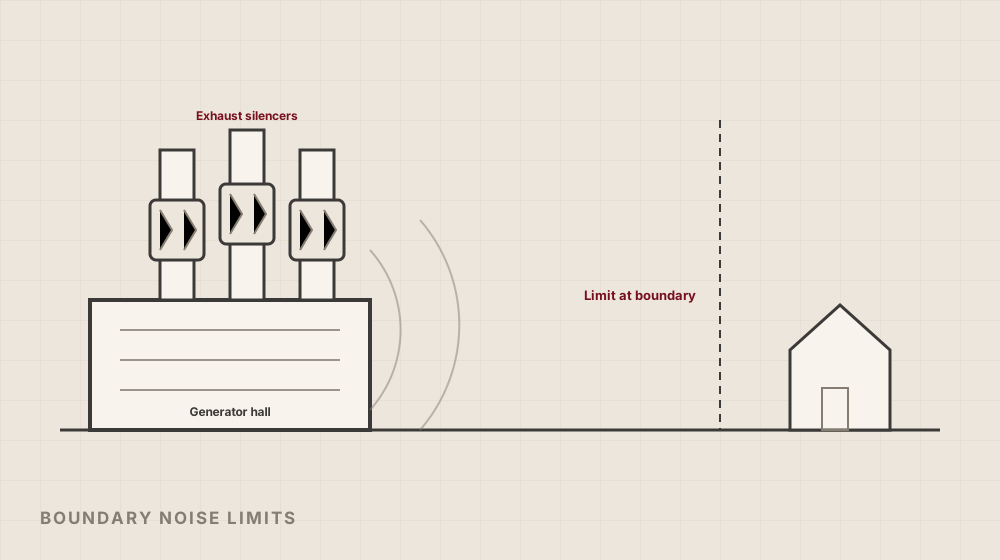
Frameworks differ in detail across Europe, but the pattern is consistent: limits are assessed at the receptor (nearby dwellings or designated immission points), they drop sharply at night, and the binding value is fixed per site in the permitting process. The same generator fleet can face a 15 dB(A) tougher target simply because of where it stands.
What this means for a generator fleet
Three design consequences follow directly:
- The night value usually governs. Emergency operation can occur at night, and many operators want flexibility in test scheduling, so most projects design the fleet against the night-time value.
- The limit is a budget, not a per-machine number. All sources on site, every generator, plus cooling and auxiliaries, must together stay under the permitted value at each assessment point. The allowable contribution per exhaust stack is therefore far below the limit itself.
- Assessment procedures can penalise character. Rating methods commonly account for tonal or impulsive character, which can effectively tighten the target for sources with audible tones.
The practical conclusion: noise compliance has to be engineered into the generator installation from the procurement specification onward. Retrofitting silencing onto an operating fleet after a complaint or an enforcement measurement is far more disruptive and expensive.
The compliance path: treat each noise path on its own terms
A typical compliance path runs from an acoustic study (predicting site contributions at the assessment points) to source-by-source treatment, then verification. Two measures carry most of the load, and they are complementary, each addressing a different transmission path.
Exhaust silencers: treating the dominant source
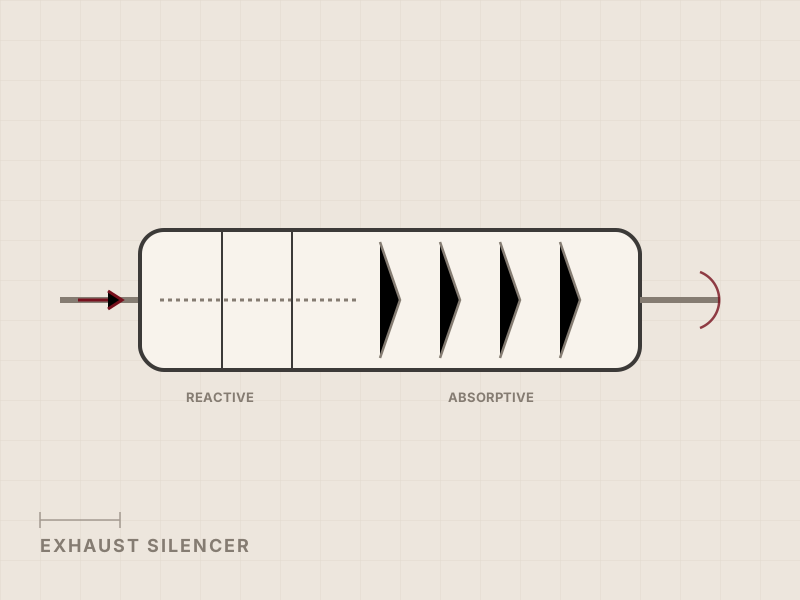
The exhaust is treated with a dedicated exhaust silencer selected for the required attenuation across the engine’s spectrum, including the low-frequency firing components that dominate far-field levels. Reactive (chamber-based) elements target those low frequencies, absorptive sections handle the mid and high range, and combination designs serve sites with residential neighbours; the trade-offs between these types are covered in our guide to exhaust silencer types and attenuation grades. The silencer must deliver its attenuation within the engine manufacturer’s allowable exhaust backpressure, one of the central constraints in silencer selection, and a reason silencing should be specified with the genset, not after it.
Enclosures and ventilation openings: closing the other paths
The generator enclosure (or plant room) controls noise radiated from the engine casing, but every enclosure needs large openings for combustion and cooling air, and untreated openings short-circuit it. Attenuated ventilation inlets and discharges close that flanking path. Silencer and enclosure belong together because the installation’s result is set by its weakest path: a well-silenced exhaust above an open ventilation louvre, or a sealed enclosure under a bare exhaust, both fail the same boundary measurement. Each measure is specified against its own path and its own required performance; combined performance is established per project in the acoustic study, not promised as a catalogue number.
Prove it at the receptor
Compliance is ultimately demonstrated by measurement at the permit’s assessment points during representative operation, typically a witnessed load test. Building that verification step into commissioning closes the loop between the acoustic study, the installed hardware and the permit.
Noise and emissions: one exhaust line, one permitting conversation
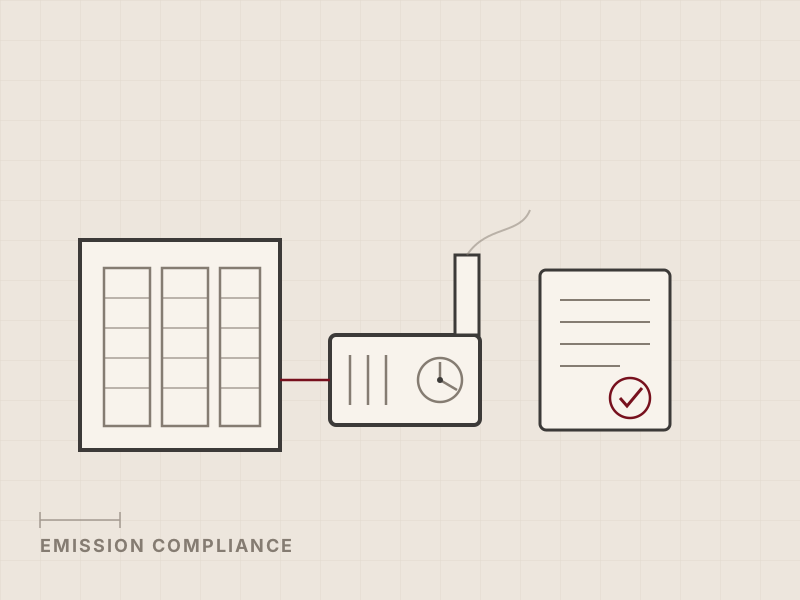
The same generator fleet faces a parallel and equally site-specific set of emission requirements; see our companion article on emission regulations for data center backup power. Exhaust silencing and exhaust aftertreatment occupy the same exhaust line, so noise control and emission control are best coordinated from the start: routing, space reservation and stack design all benefit from treating them as one integrated exhaust system rather than two sequential retrofits.
If you are specifying backup power for a data center and need to meet a boundary noise limit, involve a silencing partner before the genset order is placed. Axces engineers exhaust silencers and complete silenced exhaust lines for generator fleets across Europe. Contact us to discuss your site’s noise targets.
References
- Directive 2002/49/EC of the European Parliament and of the Council of 25 June 2002 relating to the assessment and management of environmental noise (OJ L 189, 18.7.2002, p. 12–25): esp. Art. 1 (objectives), Art. 5(4) (member states report national limit values), Arts. 7–8 (strategic noise maps, action plans), Annex II (assessment methods). EUR-Lex: https://eur-lex.europa.eu/eli/dir/2002/49/oj
- EUR-Lex, Summary of legislation: “Assessment and management of environmental noise” (Directive 2002/49/EC). https://eur-lex.europa.eu/EN/legal-content/summary/assessment-and-management-of-environmental-noise.html
- Besluit kwaliteit leefomgeving (Bkl), Art. 5.65 and Table 5.65.1 (standard values for noise from activities on noise-sensitive buildings; Art. 5.65(2) for designated industrial estates). Consolidated text: https://wetten.overheid.nl/BWBR0041313/
- TA Lärm, Sechste Allgemeine Verwaltungsvorschrift zum Bundes-Immissionsschutzgesetz (Technische Anleitung zum Schutz gegen Lärm), 26 August 1998, as amended: Nos. 6.1 (immission guide values by area type) and 6.4 (assessment periods). Official text: https://www.verwaltungsvorschriften-im-internet.de/bsvwvbund_26081998_IG19980826.htm
- TA Lärm, English translation, Umweltbundesamt (German Environment Agency). https://www.umweltbundesamt.de/sites/default/files/medien/377/dokumente/talaerm_en.pdf