On this page
- The chemistry: NOx plus ammonia becomes nitrogen and water
- From urea to ammonia: the reagent and dosing system
- Catalysts and the temperature window
- What determines conversion efficiency
- The emission limits that make SCR necessary
- Where SCR fits in the exhaust line
- From principle to a guaranteed stack value
Selective catalytic reduction (SCR) removes nitrogen oxides (NOx) from exhaust gas by injecting an ammonia-based reagent, usually a urea solution, into the hot gas stream and passing the mixture over a catalyst, where the NOx is converted into nitrogen and water vapour. It is the reference technology for deep NOx reduction on diesel and gas engines, gas turbines and boilers. This article explains the reaction chemistry, the reagent and dosing system, the catalyst families, and what determines conversion efficiency in a real exhaust line.
The chemistry: NOx plus ammonia becomes nitrogen and water
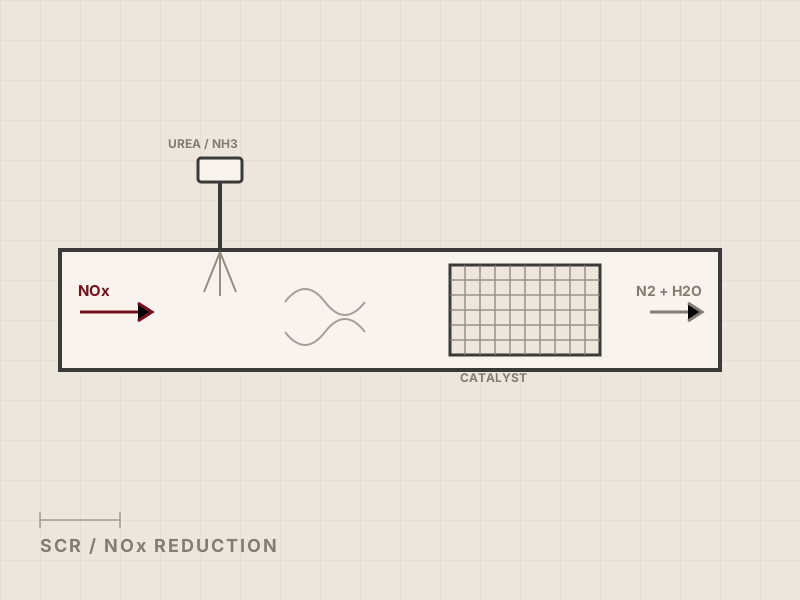
Engine-out NOx is mostly nitric oxide (NO) with a smaller fraction of nitrogen dioxide (NO₂). Over the catalyst, ammonia (NH₃) reduces both to molecular nitrogen. The dominant reaction in oxygen-rich exhaust, the standard SCR reaction, is:
4 NO + 4 NH₃ + O₂ → 4 N₂ + 6 H₂O
Where NO and NO₂ are present in roughly equal amounts, the considerably faster fast SCR reaction takes over:
NO + NO₂ + 2 NH₃ → 2 N₂ + 3 H₂O
The “selective” in SCR is the essential property: the catalyst steers ammonia towards NOx rather than letting it burn in the excess oxygen engine exhaust always contains, so dosing stays near-stoichiometric: roughly one ammonia molecule per molecule of NOx. Both products occur naturally in air: SCR converts the pollutant rather than capturing it, leaving no residue to dispose of.
From urea to ammonia: the reagent and dosing system
Ammonia can be dosed directly as an aqueous solution, but most industrial and marine installations use urea dissolved in demineralised water: non-toxic and safe to store. Injected into hot exhaust gas, urea releases ammonia in two steps:
(NH₂)₂CO → NH₃ + HNCO followed by HNCO + H₂O → NH₃ + CO₂
This conversion needs time and temperature, which shapes the hardware upstream of the catalyst:
- an injection lance atomises the urea solution into fine droplets;
- a mixing section gives the droplets length to evaporate and decompose, and distributes the ammonia evenly across the duct;
- a dosing control system meters reagent against engine load or measured NOx.
Dosing accuracy matters in both directions. Underdosing leaves NOx unconverted; overdosing sends unreacted ammonia out of the stack, ammonia slip, which permits typically cap, and which can combine with sulphur trioxide from the fuel to form ammonium bisulphate, a sticky salt that fouls catalyst and downstream surfaces at low temperatures.
Catalysts and the temperature window
SCR only proceeds at a useful rate within a band of exhaust temperatures, the temperature window, and the catalyst formulation sets where that window lies.
Vanadium-based catalysts
The workhorse of stationary and marine SCR is vanadium pentoxide on a titanium dioxide carrier, usually promoted with tungsten trioxide and supplied as an extruded honeycomb monolith or coated plates. The effective window most commonly cited in the literature for these formulations is roughly 300–400 °C [4][5]. Vanadium catalysts tolerate fuel sulphur comparatively well. Below the window, reaction rates drop and ammonium-sulphate fouling becomes a risk; well above it, ammonia begins to oxidise, consuming reagent and, at the extreme, forming additional NOx [4].
Zeolite catalysts
Metal-exchanged zeolites widen the options: copper-exchanged types are strong at lower exhaust temperatures, while iron-exchanged types perform better towards the high-temperature end [6]. They dominate mobile applications and appear in industrial systems where the temperature profile or fuel calls for them.
Geometry is the third lever: channel pitch and cell density are chosen against the dust load of the gas, trading reactive surface area against plugging risk and back pressure.
What determines conversion efficiency
How much of the incoming NOx a system converts is never a property of the catalyst alone. The main factors:
- Gas temperature at the catalyst face: the system must sit inside the catalyst window across the real load profile, not just at the design point.
- Catalyst volume relative to gas flow: more contact time means higher conversion (expressed as space velocity).
- Dosing ratio and control quality: conversion cannot exceed what the injected ammonia allows, and slip rises sharply as dosing approaches the theoretical maximum.
- Mixing uniformity: a correctly sized catalyst underperforms if the ammonia distribution across its face is uneven.
- NO₂/NO ratio: a balanced split favours the fast SCR reaction at lower temperatures.
- Fuel quality and ageing: sulphur, ash and catalyst poisons erode activity over time, hence design margins and replaceable catalyst layers.
The design task is balancing three competing quantities: NOx conversion, ammonia slip and pressure drop. Pushing conversion higher demands more catalyst volume or more reagent: the first costs space and back pressure, the second risks slip. Because these variables interact, credible SCR sizing is always project-specific rather than read from a table.
The emission limits that make SCR necessary
Modern NOx limits sit far below what in-engine measures alone can reliably achieve, which is why SCR has become standard equipment across sectors.
| Framework | Applies to | NOx limit for new equipment |
|---|---|---|
| EU Medium Combustion Plant Directive (EU) 2015/2193, Art. 6 and Annex II, Part 2, Table 2 [1] | Stationary engines and gas turbines in combustion plants of 1–50 MW rated thermal input (Art. 2(1)) | Engines: 190 mg/Nm³ (liquid fuels), 95 mg/Nm³ (natural gas); gas turbines: 75 / 50 mg/Nm³, at 15 % O₂; annex footnotes adjust dual-fuel and special cases |
| EU Stage V, Regulation (EU) 2016/1628, Annex II, Table II-1 [2] | Engines in non-road mobile machinery (category NRE), 56–560 kW | 0.40 g/kWh |
| IMO MARPOL Annex VI, Regulation 13, Tier III [3] | Marine diesel engines over 130 kW, ships constructed on or after 1 Jan 2016 (North American, US Caribbean ECAs) or 1 Jan 2021 (Baltic, North Sea ECAs), while operating inside those areas | 3.4 g/kWh below 130 rpm; 9·n⁻⁰·² g/kWh at 130–1,999 rpm; 2.0 g/kWh at or above 2,000 rpm |
The depth of reduction demanded points directly at SCR. The MCP Directive still tolerates 1,850 mg/Nm³ from certain diesel engines built before 18 May 2006 (Annex II, Part 1, Table 3, footnote (c)); reaching the 190 mg/Nm³ required of new engines means removing roughly 90 percent of the NOx [1]. At sea, the step from Tier II to Tier III is a cut of about 75 percent [3], and further NOx emission control areas have since been adopted. Reductions of that depth, sustained across the load profile, are exactly what ammonia-based SCR delivers.
Where SCR fits in the exhaust line
The reactor sits between the engine or turbine outlet and the stack, at a point where gas temperature stays within the catalyst window across the operating profile. Three requirements drive the layout: enough straight duct upstream for injection and mixing, gas inside the temperature window, and a total pressure drop the engine supplier will accept.
In space-constrained installations, generator sets, ships, backup power plants, the reactor is therefore often combined with the exhaust silencer in a single casing, so one vessel delivers both NOx conversion and noise attenuation within one pressure-drop budget. This integrated approach is the basis of Axces NOx reduction systems, part of our wider emission control solutions. Where permits demand it, an oxidation or slip catalyst can be added downstream; a bypass protects the catalyst during start-up and prolonged low-load running.
From principle to a guaranteed stack value
The principle of SCR is straightforward chemistry; the engineering lies in the application: flow and temperature across the load profile, fuel and sulphur level, permitted ammonia slip, back-pressure budget and available space. If you are specifying NOx abatement for an engine, turbine or boiler project, explore Axces NOx reduction systems or talk to our emission control engineers about meeting the limit named in your permit.
References
- Directive (EU) 2015/2193 of the European Parliament and of the Council of 25 November 2015 on the limitation of emissions of certain pollutants into the air from medium combustion plants: Article 2(1) (scope: 1–50 MW rated thermal input); Article 6 and Annex II, Part 2, Table 2 (emission limit values for new engines and gas turbines); Annex II, Part 1, Table 3, footnote (c) (1,850 mg/Nm³ for diesel engines whose construction commenced before 18 May 2006). EUR-Lex: https://eur-lex.europa.eu/eli/dir/2015/2193/oj
- Regulation (EU) 2016/1628 of the European Parliament and of the Council of 14 September 2016 on requirements relating to gaseous and particulate pollutant emission limits and type-approval for internal combustion engines for non-road mobile machinery: Annex II, Table II-1 (Stage V emission limits for engine category NRE, referred to in Article 18(2)). EUR-Lex: https://eur-lex.europa.eu/eli/reg/2016/1628/oj
- International Maritime Organization, MARPOL Annex VI, Regulation 13, Nitrogen Oxides (NOx): Tier I–III limit values and emission control area application dates. https://www.imo.org/en/OurWork/Environment/Pages/Nitrogen-oxides-%28NOx%29-%E2%80%93-Regulation-13.aspx
- Busca, G., Lietti, L., Ramis, G., Berti, F., “Chemical and mechanistic aspects of the selective catalytic reduction of NOx by ammonia over oxide catalysts: A review”, Applied Catalysis B: Environmental, Vol. 18 (1–2), 1998, pp. 1–36. https://www.sciencedirect.com/science/article/abs/pii/S092633739800040X
- Forzatti, P., “Present status and perspectives in de-NOx SCR catalysis”, Applied Catalysis A: General, Vol. 222 (1–2), 2001, pp. 221–236. https://www.sciencedirect.com/science/article/abs/pii/S0926860X01008328
- “Research Progress of the Selective Catalytic Reduction with NH₃ over ZSM-5 Zeolite Catalysts for NOx Removal”, Catalysts, Vol. 13 (10), 2023, art. 1381. https://www.mdpi.com/2073-4344/13/10/1381