On this page
A diesel particulate filter (DPF) is the established way to control soot reduction in diesel exhaust: it physically traps the carbon particles a diesel engine emits, removing the visible smoke and the fine particulate matter (PM) that drives the health and regulatory concern. This article explains how the filter captures soot, why getting rid of the accumulated soot again, regeneration, is the hard part for lightly loaded engines, the backpressure trade-off, and where particulate control sits in the exhaust line relative to NOx aftertreatment.
What soot is, and why diesel engines produce it
Diesel combustion is heterogeneous: fuel and air never mix perfectly, and the fuel-rich pockets that burn at high temperature with too little oxygen produce soot: agglomerated carbon particles with adsorbed hydrocarbons and sulphates. Together with the lubricant- and fuel-derived ash that rides along with it, this is what regulators measure as particulate matter. The particles are small, which is the problem: fine and ultrafine PM penetrates deep into the lungs, so modern rules increasingly target not just particle mass but particle number.
You cannot fully tune soot away at the source. In-cylinder measures, injection strategy, charge-air management, combustion-chamber design, reduce it, but on most duty cycles a filter is the only way to reach current particulate targets. That is the role of the DPF.
How a diesel particulate filter captures soot
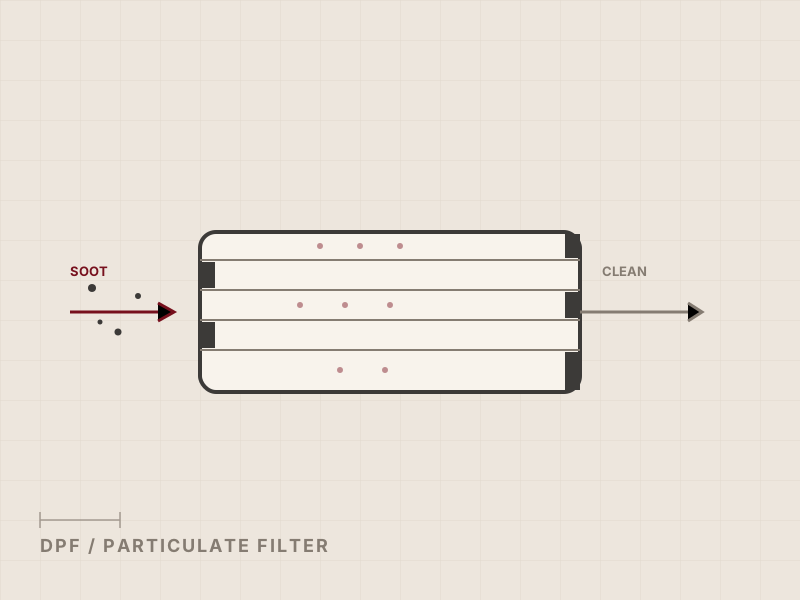
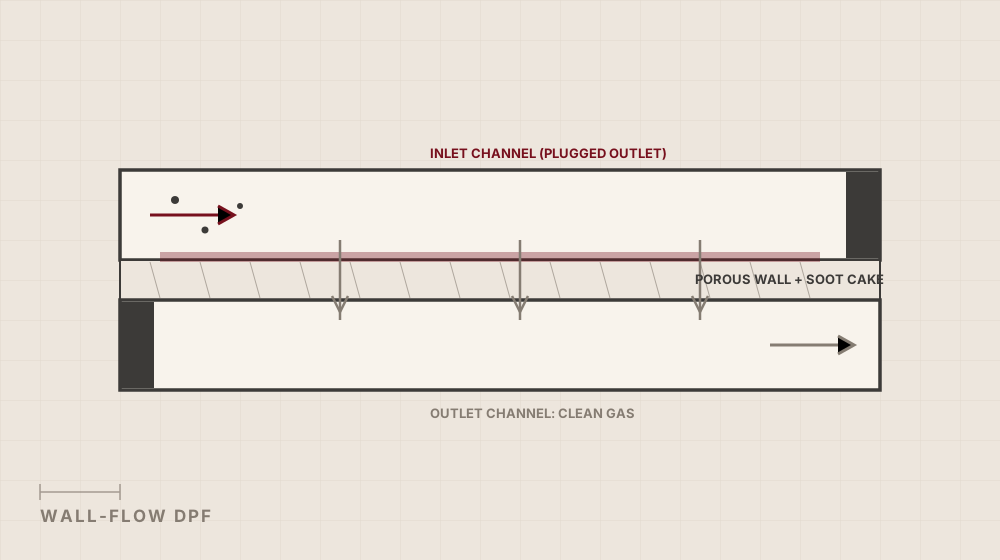
The dominant device is the wall-flow filter: a ceramic honeycomb (cordierite or silicon carbide) whose channels are alternately plugged at each end. Exhaust is forced through the porous channel walls, and the soot it carries is left behind. This is what makes wall-flow filters so effective: gas has no path that bypasses the filtration medium.
Capture happens in two regimes. When the substrate is clean, particles lodge inside the pore structure of the wall, deep-bed filtration. As soot builds up, it forms a layer on the wall surface, a soot cake, and that cake itself becomes the filter, raising efficiency further. A well-conditioned wall-flow filter removes the great majority of incoming soot mass and, importantly, the ultrafine particle count.
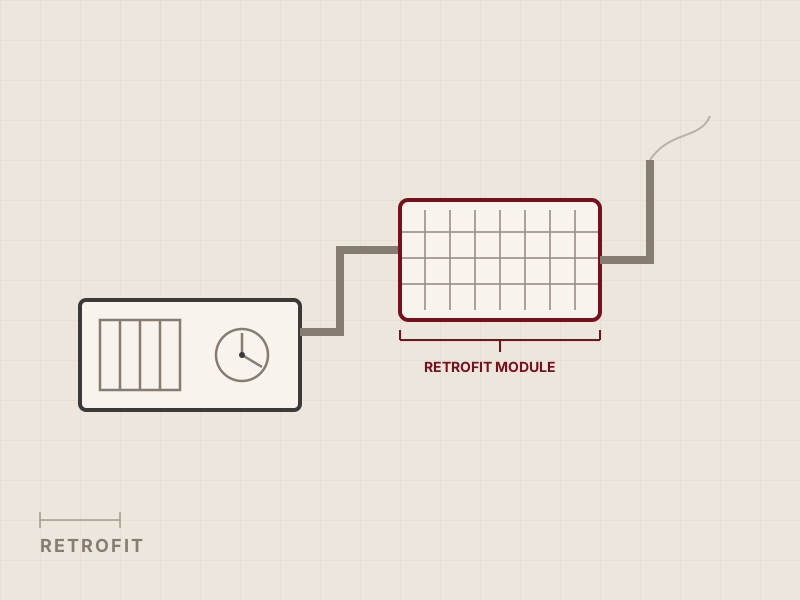
A flow-through (partial) filter, by contrast, lets gas pass along open channels and relies on turbulence and catalytic surfaces to intercept a fraction of the particles. It cannot clog and needs no plug geometry, but its capture efficiency is far lower than a wall-flow filter’s: a reasonable retrofit where a modest reduction is enough, not a route to the strictest limits.
One distinction matters for the life of the filter: soot versus ash. Soot is carbon and can be burned off (see regeneration below). Ash, from lube-oil additives and fuel impurities, is incombustible. It accumulates permanently and is removed only by periodic cleaning or replacement, which is why oil specification and consumption feed directly into filter maintenance intervals.
The regeneration problem
A filter that only collects would block solid. The soot it holds has to be removed by oxidising the trapped carbon back to CO₂, regeneration, and there are two ways to do it.
Passive regeneration
If exhaust is hot enough and contains enough nitrogen dioxide (NO₂), the carbon is oxidised continuously at the temperatures of normal running, with no intervention. An upstream oxidation catalyst is often used to generate the NO₂ that does this work. Passive regeneration is the ideal: it is invisible, costs no extra fuel, and keeps the soot load low at all times, provided the engine runs hot enough often enough.
Active regeneration
When the duty cycle does not deliver those temperatures, the soot load climbs and the system must deliberately raise exhaust temperature to ignite the cake, typically by injecting extra fuel to be oxidised over a catalyst, or by other heat-input measures, until the trapped carbon burns off. Active regeneration works, but it consumes fuel and depends on a control system recognising when it is needed.
Why emergency gensets are the hard case
Standby and emergency generating sets are the awkward duty for any filter. They sit idle, then run for short tests or brief outages, often at low load, where exhaust never reaches the temperature window that passive regeneration needs. Soot accumulates without ever burning off, so the filter trends toward blockage and the system becomes reliant on active regeneration that the operating pattern rarely allows to complete. Any soot-control concept for backup power has to confront this head-on rather than assume the self-cleaning behaviour seen on a hard-working mobile engine. We design emission control for exactly this profile: intermittent, low-load, standby diesel duty.
Backpressure and the engine trade-off
A filter is a restriction. As soot loads the wall, the pressure drop across it rises, and that backpressure pushes back on the engine: higher pumping losses, higher fuel consumption, and, if it climbs far enough, a real risk of having to derate the engine to protect it. This is the central tension in particulate control: filtration efficiency and exhaust restriction pull in opposite directions, and the soot that makes the cake more efficient is the same soot that raises backpressure. Sound design keeps the working pressure drop within the engine maker’s limit across the whole regeneration cycle, not just when the filter is clean. (These are qualitative relationships; the actual limits are engine- and project-specific.)
Where particulate control fits alongside SCR
Diesel aftertreatment usually has to handle two pollutants at once: particulate matter and nitrogen oxides. Particulate control (the DPF) and NOx control by selective catalytic reduction are complementary stages in the same exhaust line, and the order is not arbitrary.
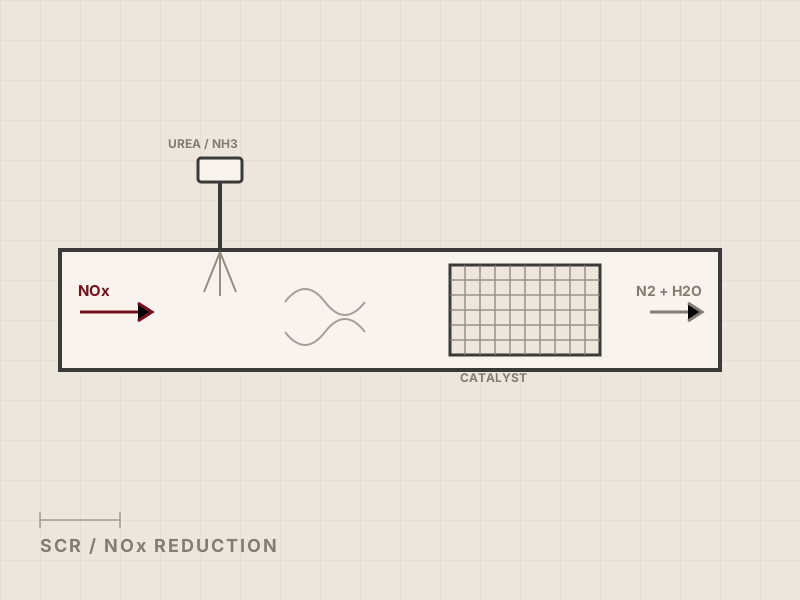
A common arrangement places an oxidation catalyst and the particulate filter upstream, then SCR downstream. There is a temperature logic to this: the oxidation catalyst raises the NO₂ fraction that both helps passive soot oxidation and improves low-temperature SCR performance, while the filter removes particulate before it can foul the downstream SCR catalyst. The interplay is thermal as much as chemical: both stages have temperature windows in which they work well, and the layout has to satisfy both. For how the NOx stage itself works, see our deep-dive on selective catalytic reduction for NOx. (The specific layout, staging, and temperature management are engineered per application.)
What the rules require
Filtration physics is settled; the limits that decide whether you need a filter are set by regulation, and they differ sharply between mobile and stationary engines.
EU Stage V: mobile and non-road engines
For non-road mobile machinery, Regulation (EU) 2016/1628 (Stage V) is what forced filters into the mainstream. Its Annex II tightened the mass-based PM limit for several diesel categories to 0.015 g/kWh (down from the previous 0.025 g/kWh) and, decisively, added a particle-number (PN) limit of 1 × 10¹² #/kWh for compression-ignition engines from 19 kW up to 560 kW. That PN limit is, in practice, only achievable with a wall-flow particulate filter, so for those categories Stage V effectively mandates a DPF. Note the boundary: the largest generating-set engines above 560 kW (category NRG) carry a higher PM limit of 0.035 g/kWh and no PN limit, so the DPF-forcing pressure does not reach them through Stage V.
MCPD: stationary medium engines (and a gap worth knowing)
Stationary engines fall under the Medium Combustion Plant Directive, Directive (EU) 2015/2193 (MCPD), which covers plants with a rated thermal input of 1 MW or more and less than 50 MW. New plants have had to meet the Annex II Part 2 emission limit values since 20 December 2018 (Article 6(7)).
Here the detail matters. In Annex II Part 2 Table 2 (new engines and gas turbines), the dust limit is set only for “liquid fuels other than gas oil”, essentially heavy/residual fuel oil, at 10 mg/Nm³ (20 mg/Nm³ for plants of 1–5 MW; with a higher transitional value for certain diesel engines in isolated systems until 1 January 2025), all referenced to 15 % O₂. For engines burning gas oil (ordinary diesel) or gaseous fuels, the table shows no dust ELV at all. On top of that, Article 6(8) lets Member States exempt new plants running no more than 500 hours a year, the classic emergency-genset pattern, from the Part 2 limits entirely. In other words, MCPD on its own leaves a typical new diesel standby genset on gas oil with no EU-level particulate limit. That gap is exactly what stricter national rules close.
Germany’s 44. BImSchV: a national soot-filter mandate
Germany’s transposition, the 44. BImSchV, goes further. Under § 16(5), a new engine plant burning liquid fuel that runs up to 300 hours a year for peak-load cover, or exclusively for emergency operation, must be fitted with a soot filter to the state of the art, and the operator must submit a test certificate within four months of commissioning proving total dust does not exceed 5 mg/m³. The operator may forgo the filter only if total dust stays below 50 mg/m³ (existing plants of this type: 80 mg/m³). This applies to new plants, not existing ones. For the regulatory picture around backup power in particular, including how this rule lands on data-centre generators, see our data centre backup-power emission regulations article.
Designing soot reduction into the exhaust line
Soot control is not a bolt-on. The filter, its regeneration strategy, the backpressure budget, and the interaction with any downstream SCR all have to be resolved together against the engine’s real duty cycle, and standby and low-load diesels are the cases where that judgement counts most. If you are scoping particulate control for a new or existing installation, our soot reduction systems team can review your duty profile and applicable limits, or you can contact our engineers directly.
References
- Regulation (EU) 2016/1628 (Stage V), Annex II: PM and particle-number emission limits for non-road engine categories NRE and NRG. EUR-Lex: https://eur-lex.europa.eu/eli/reg/2016/1628/oj/eng
- DieselNet, EU: Nonroad Engines: consolidated Stage V limit tables (NRE Table 4: PM 0.015 g/kWh, PN 1×10¹² /kWh for 19–560 kW; NRG Table 5: PM 0.035 g/kWh, no PN limit) and note that the PN limit requires wall-flow particulate filters. https://dieselnet.com/standards/eu/nonroad.php
- Directive (EU) 2015/2193 (MCPD), Article 6(7)–(8) (application dates and the ≤500 h/yr exemption) and Annex II, Part 2, Table 2 (dust ELV for new engines/gas turbines applies only to “liquid fuels other than gas oil”; reference O₂ 15 %). EUR-Lex: https://eur-lex.europa.eu/eli/dir/2015/2193/oj/eng
-
- BImSchV, § 16(3) and § 16(5): soot-filter requirement and 5 mg/m³ total-dust certificate for new liquid-fuel peak-load/emergency engine plants; 20 mg/m³ general dust limit for diesel/gas oil. Gesetze im Internet: https://www.gesetze-im-internet.de/bimschv_44/__16.html