On this page
Effective industrial odor control starts with the compound, not the catalogue. The right abatement method depends on what is in the exhaust (the chemical family of the odorant), how concentrated it is, and how much gas you have to treat. This guide compares the main odor-abatement technologies for industrial exhaust, shows how to match the method to the compound and concentration, then covers the measurement standard and the national regulations that judge the result.
Characterise the stream first
Three properties drive every selection decision:
- Compound family. Reduced sulphur compounds (hydrogen sulphide, H2S, and mercaptans) behave nothing like alkaline gases (ammonia, amines), which in turn behave nothing like volatile organic compounds (VOCs). Each family steers the choice toward a different technology class.
- Concentration and mass load. A trace nuisance odour at the detection threshold is a different problem from a high-load VOC stream off a dryer or reactor. Adsorption suits low concentrations; oxidation suits high loads; biological systems suit dilute, steady, biodegradable streams.
- Flow, temperature, and humidity. Volumetric flow sets the size and operating cost of any system. Temperature and moisture decide whether a stream needs cooling or conditioning first, and whether a biological bed can survive at all.
Get these three right and the shortlist usually narrows to one or two options.
The main odor-abatement technologies
Chemical (wet) scrubbing
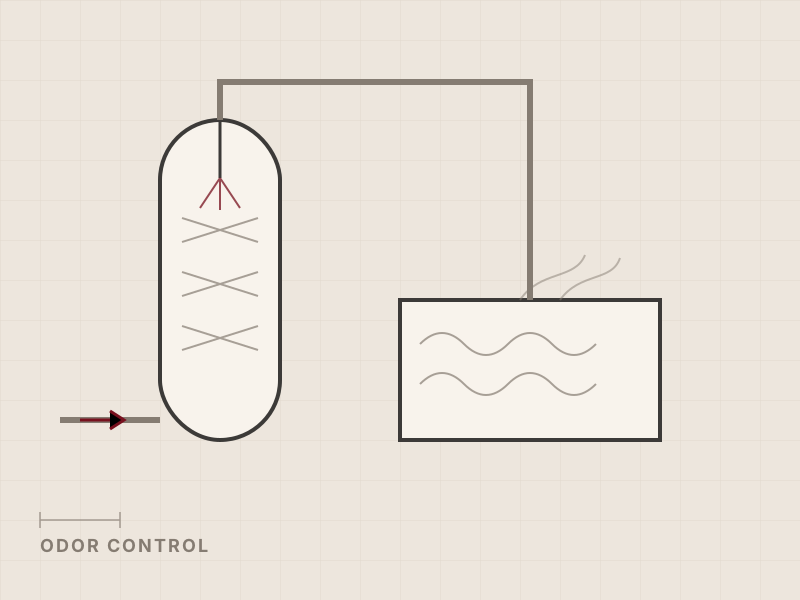
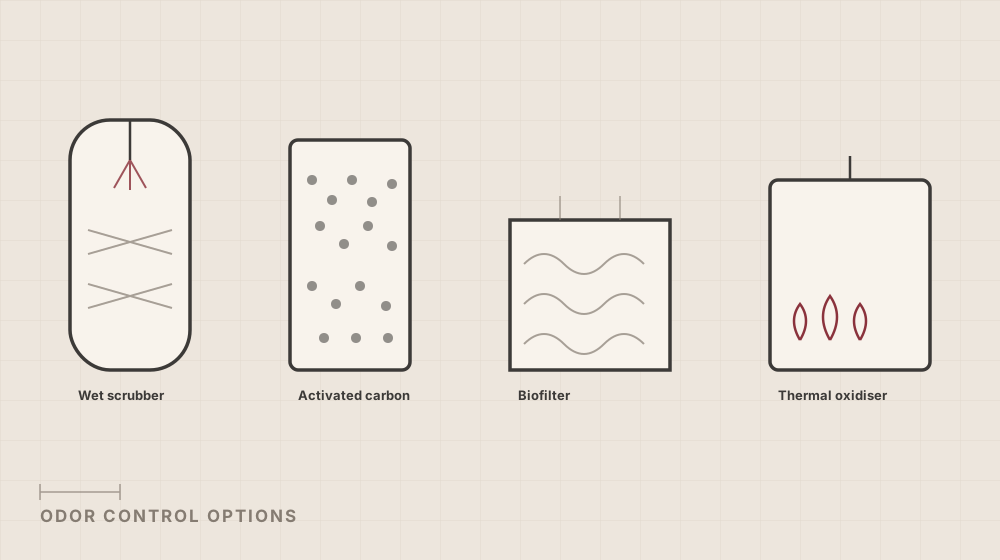
A packed tower contacts the gas with a recirculating liquid that absorbs and chemically converts the odorant. The reagent is matched to the compound family: acid scrubbing (sulphuric or similar) neutralises alkaline gases such as ammonia and amines; alkaline scrubbing (caustic) captures acidic gases including H2S; and an oxidative stage (hypochlorite, hydrogen peroxide, or ozone) destroys reduced sulphur and many organic odorants. Complex streams are often handled in multiple stages (for example acid, then alkaline-oxidative). Scrubbers tolerate high humidity and a wide concentration range but carry reagent consumption and a liquid effluent to manage.
Activated-carbon adsorption
Porous carbon adsorbs odorant molecules onto its internal surface. It is simple, effective for low-concentration VOCs and for polishing the residual odour after a scrubber, and impregnated grades target specific compounds such as H2S. The limitation is loading and breakthrough: the bed has a finite capacity, and once it approaches saturation the odorant passes through. Carbon is therefore best for low concentrations and as a final polishing stage, not as the primary control on a heavily loaded stream where media-change frequency would be impractical.
Biofiltration and biotrickling filters
Micro-organisms growing on a packed or organic medium metabolise the odorant into CO2, water, and biomass. Biological systems excel at dilute, steady, biodegradable streams (H2S, many sulphur and nitrogen odorants, biodegradable VOCs) at low operating cost, and are common on wastewater, composting, and food-processing exhausts. They need controlled temperature, humidity, and pH, take time to acclimatise, and cope poorly with sudden load swings or toxic shock.
Thermal and catalytic oxidation
For high-load VOC streams, oxidation converts the organics to CO2 and water. Thermal oxidisers (including regenerative designs that recover heat) operate at high temperature; catalytic oxidisers use a catalyst to achieve destruction at a lower temperature and lower fuel cost, provided the stream is free of catalyst poisons. Oxidation gives very high destruction efficiency on concentrated organic loads but is over-specified, and expensive to run, on dilute, low-load nuisance odours.
Matching method to compound and concentration
The table below is a qualitative starting point: compound family and concentration band point to a technology class. Final selection always depends on the full stream analysis, and complex or variable streams are frequently treated with a multi-stage train.
| Technology | Best-suited compounds | Concentration band | Notes |
|---|---|---|---|
| Acid scrubbing | Ammonia, amines (alkaline gases) | Low–high | Reagent + effluent to manage; tolerant of humidity |
| Alkaline / oxidative scrubbing | H2S, mercaptans, reduced sulphur; many VOCs | Low–high | Often staged; oxidant destroys odorant |
| Activated-carbon adsorption | VOCs; H2S (impregnated grades) | Low; polishing | Breakthrough limits use on high loads |
| Biofiltration / biotrickling | H2S, biodegradable VOCs and odorants | Low, steady | Low running cost; sensitive to shock and temperature |
| Thermal / catalytic oxidation | High-load VOC mixtures | Medium–high | High destruction; fuel cost; catalyst poisons matter |
As part of a broader emission control strategy, odor abatement frequently sits alongside particulate, NOx, and noise control on the same exhaust, so the odor stage has to be designed to fit the pressure drop, temperature, and footprint constraints of the whole system.
How odor is measured
Odor concentration is quantified by dynamic olfactometry under EN 13725:2022, Stationary source emissions: Determination of odour concentration by dynamic olfactometry and odour emission rate [1]. A panel of human assessors is presented with progressively diluted samples; the result is expressed in European odour units per cubic metre (ouE/m3), where 1 ouE/m3 is the concentration at the detection threshold [1]. This is the common currency for comparing an emission rate or a downwind nuisance prediction against a regulatory value.
Odor regulation is national, not EU-harmonised
There is no harmonised EU-wide numeric odor limit. Odor is regulated at national, and often regional or municipal, level, so the acceptance criterion for a given plant depends entirely on where it is. At EU level the closest instruments are sector-specific: the Industrial Emissions Directive’s best-available-techniques conclusions for waste treatment, Commission Implementing Decision (EU) 2018/1147, require periodic odor monitoring by dynamic olfactometry to EN 13725 (with field-inspection methods to EN 16841 for exposure) but apply only to that sector, not to industry generally [2].
National frameworks fill the gap:
- Germany. Odor provisions are set in the TA Luft 2021 (the federal air-quality administrative regulation), which incorporated the former GIRL odour guidance as Annex 7 (Anhang 7), in force since 1 December 2021 [3]. Acceptability is expressed as the maximum fraction of the year during which odor may be perceptible at a receptor, more stringent in residential areas than in commercial/industrial areas (the established immission values are 10% and 15% of annual hours, respectively) [3].
- Netherlands. Under the Omgevingswet, there is no single national numeric odor limit; the competent authority (usually the province or municipality) sets an aanvaardbaar hinderniveau, an acceptable nuisance level, case by case, using the national industrial odor guidance and dispersion modelling [4].
The practical consequence: confirm the local framework and the competent authority’s expectations early, because they set the target the technology has to hit. Where odor or emission limits are cited for a project, they should be drawn from that national framework, not from any assumed EU value.
Designing for the real exhaust
A clean lab result does not survive a dirty stream. Hot streams usually need cooling; high dust or aerosol loads need pre-treatment so they do not blind carbon or foul a biofilter; and humidity has to be managed both ways: too dry kills a biological bed, too wet floods a carbon bed. Because real industrial odors are usually mixtures, the robust answer is often a staged train that plays each technology to its strength: a scrubber to strip the bulk and the alkaline/acid gases, then carbon or a biological stage to polish the residual to threshold.
Axces engineers odor control systems matched to the process and the applicable local limit. To discuss a specific stream, see our odor control solutions or contact the Axces emission-control team with your compound analysis, concentration, and flow.
References
- CEN. EN 13725:2022: Stationary source emissions: Determination of odour concentration by dynamic olfactometry and odour emission rate. European Committee for Standardization, 2022 (current edition). https://standards.iteh.ai/catalog/standards/cen/67f31e88-f81d-4e78-bbf6-ce1dcb766eeb/en-13725-2022
- European Commission. Commission Implementing Decision (EU) 2018/1147 of 10 August 2018 establishing best available techniques (BAT) conclusions for waste treatment, under Directive 2010/75/EU: BAT 34 and associated monitoring (dynamic olfactometry to EN 13725; field inspection to EN 16841). EUR-Lex. https://eur-lex.europa.eu/eli/dec_impl/2018/1147/oj/eng
- Bundesministerium für Umwelt. Erste Allgemeine Verwaltungsvorschrift zum Bundes-Immissionsschutzgesetz (Technische Anleitung zur Reinhaltung der Luft, TA Luft), Neufassung vom 18.08.2021, Anhang 7 (Geruch); in force 1 December 2021. https://www.verwaltungsvorschriften-im-internet.de/bsvwvbund_18082021_IGI25025005.htm
- Informatiepunt Leefomgeving (Rijkswaterstaat). Geur: odor under the Omgevingswet, including aanvaardbaar hinderniveau (acceptable nuisance level set by the competent authority). https://iplo.nl/thema/geur/