On this page
Stack height is rarely a free design choice; it is set by dispersion. The stack must be tall enough that the pollutants it releases are diluted to acceptable concentrations by the time they reach ground level, where ambient air quality limits apply. This article traces the causal chain from emission limits in the operating permit, through project-specific dispersion modelling, to a required stack height, and what that height means for industrial stack design.
Two limits, two compliance points
An industrial installation in the EU answers to two distinct kinds of air-pollution limits at the same time:
- Emission limit values (ELVs) apply to the flue gas itself, typically in mg/Nm³, and are set in the installation’s permit under the Industrial Emissions Directive 2010/75/EU (IED). Article 15(1) is explicit: ELVs apply at the point where the emissions leave the installation, and any dilution before that point is disregarded [3]. A taller stack therefore never relaxes an ELV.
- Ambient air quality limit values apply to the outdoor air people breathe, in µg/m³ at ground level, and are set by the recast EU Ambient Air Quality Directive (EU) 2024/2881 [1].
The stack is the physical link between the two compliance points. Flue gas that leaves the stack at its permitted concentration still has to arrive at ground level at a small fraction of that concentration; the designer’s main levers are stack height and the outlet conditions that govern plume rise.
How dispersion turns a stack emission into a ground-level concentration
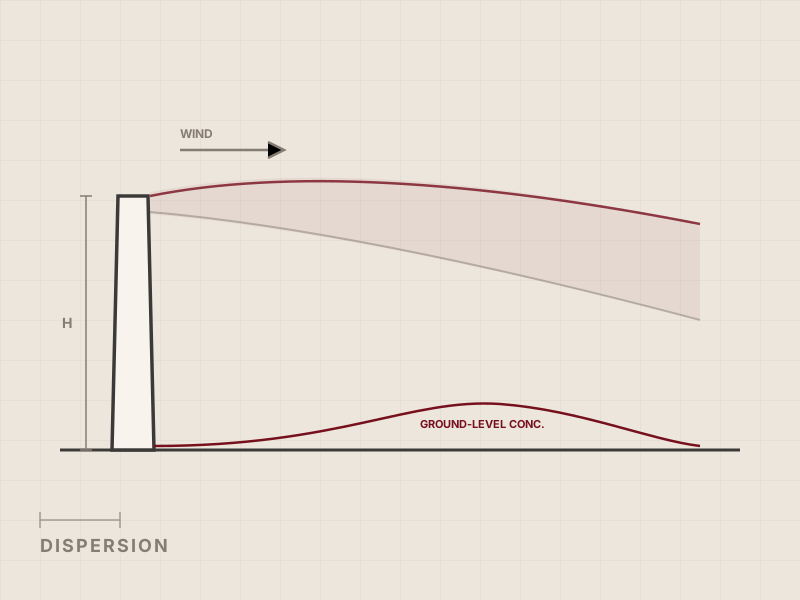
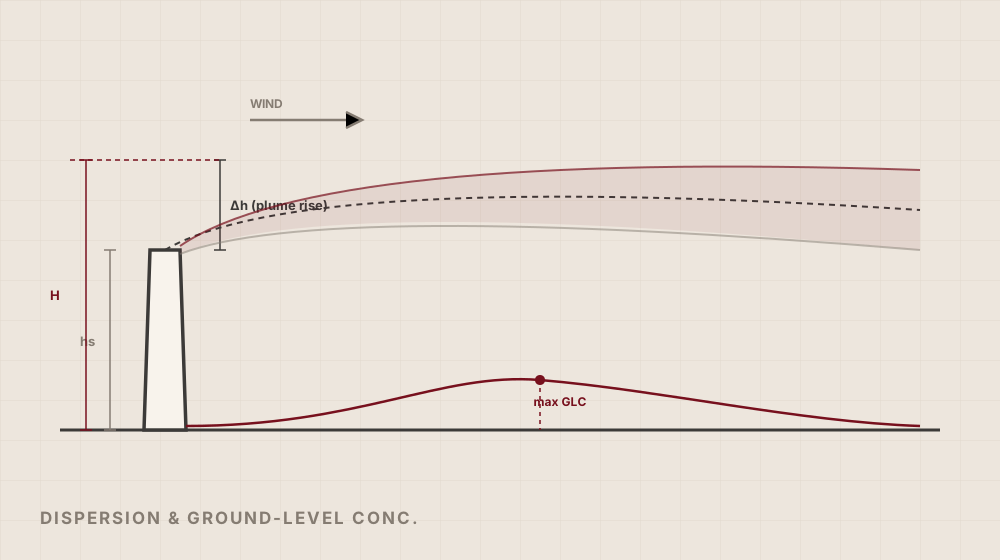
Hot flue gas leaves the stack with upward momentum and thermal buoyancy and keeps rising after release (the plume rise), so the plume effectively starts from an effective stack height above the physical tip. From there it spreads and dilutes in the wind. The resulting ground-level concentration is essentially zero at the stack base, peaks some distance downwind, and then decays. Raising the effective stack height lowers that peak and pushes it further away. That is the entire mechanism: height buys dilution at the receptor, which is where the legal limit applies.
Dispersion modelling quantifies this for one specific project. Source parameters (outlet height, exit diameter, exit velocity, gas temperature, pollutant mass flow), local meteorology, terrain, surrounding buildings, and the existing background concentration go in; predicted concentration contributions at the surrounding receptors come out, to be added to background and tested against the limit values. Two consequences follow:
- The result is site-specific. The same engine with the same emission can need a markedly taller stack on one site than another because of background levels, neighbouring buildings, or terrain; heights do not transfer between projects.
- Exit conditions are part of the answer. Exit velocity and temperature feed plume rise, so outlet diameter and flue arrangement are dispersion parameters, not just mechanical details.
Building downwash: the most common reason stacks grow
When the stack tip sits within the aerodynamic wake of an adjacent building, the plume can be pulled down into the recirculating cavity behind it, producing high concentrations close to the source. Regulators codified the countermeasure long ago. The US “good engineering practice” (GEP) stack height, the height needed to escape building influence, is defined in 40 CFR 51.100(ii) as the greater of 65 m and H + 1.5L (H = nearby building height, L = the lesser of its height or projected width); US rules also cap the height that may be credited when emission limits are set at the GEP height, so excess height cannot substitute for emission control (40 CFR 51.118) [5]. In Germany, TA Luft (2021) prescribes a minimum stack height procedure (Nr. 5.5, with the dispersion calculation of Annex 2): the outlet must clear building and terrain cavity zones and achieve undisturbed transport and sufficient dilution of the exhaust gas [6]. Most other Member States reach the same result through project-specific modelling in the permit application rather than a fixed formula.
The ambient limits that drive the height requirement
The EU’s ambient framework has just been recast. Directive (EU) 2024/2881 of 23 October 2024 on ambient air quality and cleaner air for Europe replaces Directives 2008/50/EC and 2004/107/EC with effect from 12 December 2026; Member States must transpose it by 11 December 2026 [1] [2]. It sets binding air quality standards for 13 pollutants, requires regular review against the latest WHO guidelines, and aims to eliminate harmful effects on health and the environment by 2050 [2].
The headline change is the severity of the limit values to be attained by 1 January 2030 (Annex I, Section 1, Table 1) [1] [7]:
| Pollutant (annual mean) | Limit value today (2008/50/EC) | From 1 January 2030 (2024/2881) |
|---|---|---|
| NO₂ | 40 µg/m³ | 20 µg/m³ |
| PM₂.₅ | 25 µg/m³ | 10 µg/m³ |
| PM₁₀ | 40 µg/m³ | 20 µg/m³ |
For stack design, the mechanism matters more than the numbers. A new or modified source must show that its contribution, added to the existing background, stays within the limit values at the relevant receptors. When a limit value halves, the headroom between background and limit shrinks disproportionately, and current measurements in many parts of Europe do not yet meet the 2030 values [7]. The same emission on the same site then needs more dispersion (a taller stack), a lower emission (abatement), or both. Air quality plans and roadmaps under the directive add further local pressure in zones already in exceedance [2].
Permitting closes the loop. Under the IED (amended in 2024 by Directive (EU) 2024/1785, in force since 4 August 2024 and to be transposed by 1 July 2026 [4]), permits set BAT-based ELVs, but Article 18 requires that where an environmental quality standard demands stricter conditions than BAT can achieve, additional measures go into the permit [3]. Ambient limits can therefore tighten an individual permit beyond BAT. We cover how this plays out for one fast-moving sector in emission regulations for datacenter backup power.
Height or abatement: usually both
When the dispersion study predicts an exceedance, there are only two physical levers: disperse better or emit less. Regulation deliberately leans against pure dilution: the IED disregards dilution when judging ELV compliance [3], and the US GEP credit cap exists precisely so that height does not substitute for control [5]. On constrained sites the practical optimum is usually combined: reduce the emitted mass flow at source (for NOx, with SCR-based NOx reduction) and provide the stack height the residual emission still requires. This is why stack and emission control scope are best engineered together: every change in abatement performance changes the dispersion input, and with it the required height.
From required height to structural design
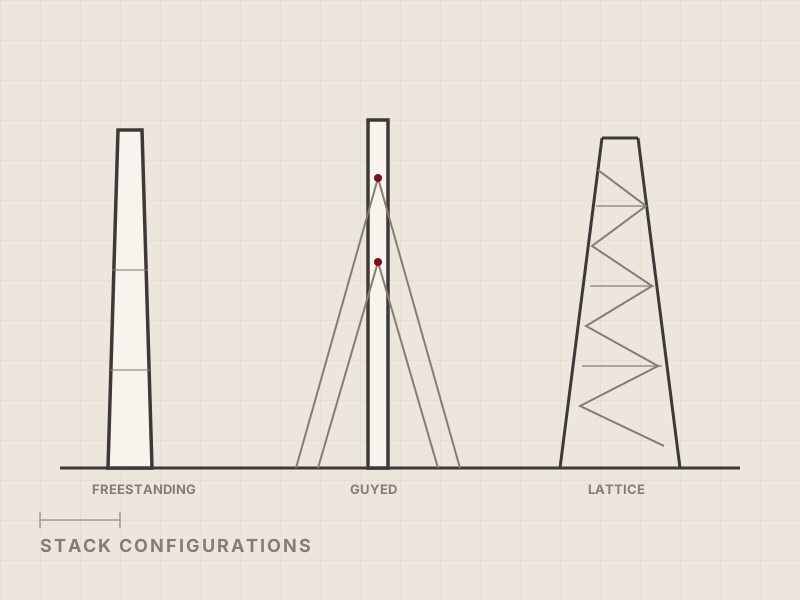
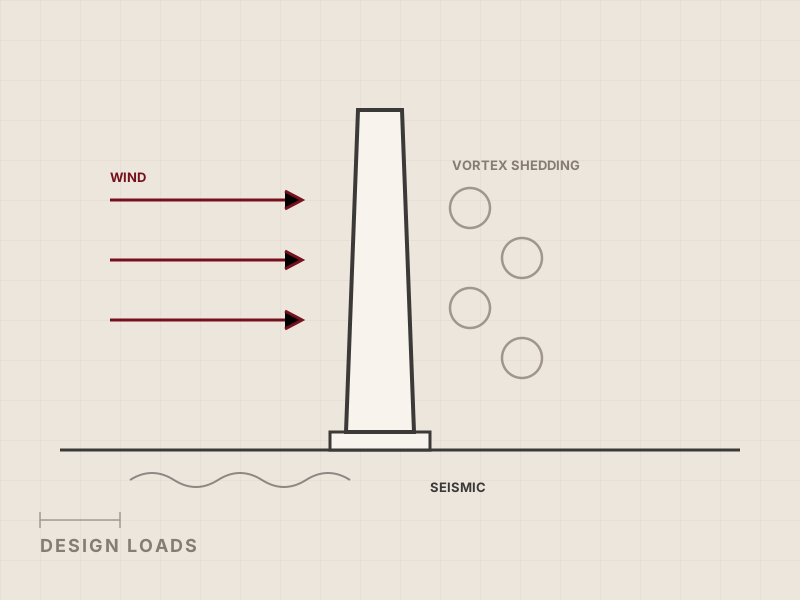
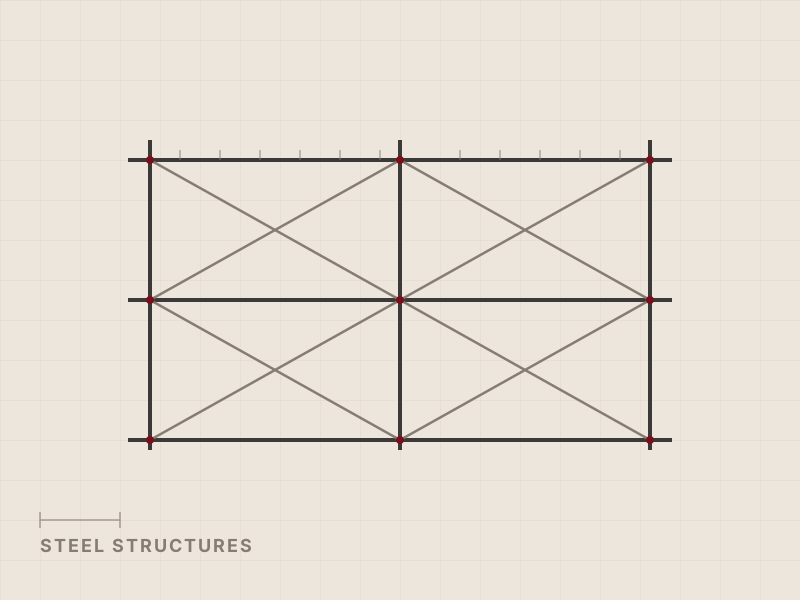
Once the dispersion study and the permit have fixed the height, the problem changes discipline. Height is the dominant structural cost driver of a freestanding single-flue stack: wind overturning moment, dynamic sensitivity to vortex shedding, foundation size, and transport and erection effort all grow rapidly with it. The study fixes more than height alone: outlet diameter follows from the exit-velocity requirement, and flue count from the operating profile: on multi-engine plants, individual flues keep exit velocity and plume rise high when only part of the plant runs. How these choices interact with the structural concept is covered in our guide to industrial stack configurations.
One scope note, because it prevents confusion in tenders: dispersion modelling is a permitting activity, project-specific by nature, normally performed by specialist air-quality consultants and assessed by the competent authority. Axces’s role sits on the delivery side: we engineer and build the stack to the height and outlet conditions the dispersion study and permit require, and advise on the parameters the stack itself controls: outlet height, flue arrangement, exit diameter and velocity.
If a draft permit or dispersion study has put a height requirement on your project, or you are still iterating between abatement and height, involve the stack designer early. Start at our industrial stacks solutions overview, or contact our engineers to talk through your height requirement and site constraints.
References
- European Union. Directive (EU) 2024/2881 of the European Parliament and of the Council of 23 October 2024 on ambient air quality and cleaner air for Europe (recast), OJ L, 2024/2881, 20.11.2024: Annex I, Section 1, Table 1 (limit values to be attained by 1 January 2030). https://eur-lex.europa.eu/eli/dir/2024/2881/oj/eng
- EUR-Lex. Summary of legislation: Cleaner air for Europe (Directive (EU) 2024/2881): repeal of Directives 2008/50/EC and 2004/107/EC as of 12 December 2026; transposition by 11 December 2026; standards for 13 pollutants; review against WHO guidelines; postponement procedure to 2040; 2050 objective. https://eur-lex.europa.eu/EN/legal-content/summary/cleaner-air-for-europe.html
- European Union. Directive 2010/75/EU on industrial emissions (integrated pollution prevention and control): Article 15(1) (emission limit values apply at the point where the emissions leave the installation; dilution prior to that point disregarded) and Article 18 (additional measures where an environmental quality standard requires stricter conditions than those achievable by BAT). https://eur-lex.europa.eu/eli/dir/2010/75/oj/eng
- European Union. Directive (EU) 2024/1785 amending Directive 2010/75/EU on industrial emissions and Directive 1999/31/EC on the landfill of waste: entered into force 4 August 2024; transposition deadline 1 July 2026. https://eur-lex.europa.eu/eli/dir/2024/1785/oj/eng
- US Code of Federal Regulations. 40 CFR 51.100(ii) (definition of good engineering practice stack height: greater of 65 m and H + 1.5L) and 40 CFR 51.118 (stack height provisions: dispersion credit limited to GEP height). https://www.ecfr.gov/current/title-40/chapter-I/subchapter-C/part-51/subpart-F/section-51.100 and https://www.ecfr.gov/current/title-40/chapter-I/subchapter-C/part-51/subpart-G/section-51.118
- LAI (German Federal/State Working Group on Immission Control). Merkblatt Schornsteinhöhenbestimmung zur TA Luft 2021 (guidance note on stack height determination under TA Luft 2021, Nr. 5.5 and Annex 2), 2023. https://www.lai-immissionsschutz.de/documents/merkblatt-schornsteinhoehenbestimmung-stand-2023-07-04_1698063774.pdf
- European Environment Agency. Air quality status report 2025: benchmark analysis against the standards in the revised Directive (EU) 2024/2881. https://www.eea.europa.eu/en/analysis/publications/air-quality-status-report-2025/benchmark-analysis-against-the-standards-in-the-revised-directive-eu-2024-2881