On this page
- Where steel structures and platforms fit in an EPC scope
- Fabrication standard: EN 1090 and the execution class
- Design basis: Eurocode 3 (EN 1993)
- Access, platforms and walkways: EN ISO 14122
- Coatings and corrosion protection: ISO 12944
- Shop versus site: fabrication, transport and erection interfaces
- Documentation handover
- What to ask your steel supplier: an EPC checklist
- Working with Axces
For an EPC contractor, industrial steel structures and platforms are rarely the headline scope, but they sit squarely on the erection critical path and they carry real liability. This guide sets out what to specify and what to ask a steel structures supplier: the fabrication standard and execution class, the design code, access and coating requirements, and the delivery interfaces that decide whether your steel arrives ready to erect. It is written for the plant engineer, EPC package owner, or procurement lead who has to turn a structural scope into a defensible purchase order.
Where steel structures and platforms fit in an EPC scope
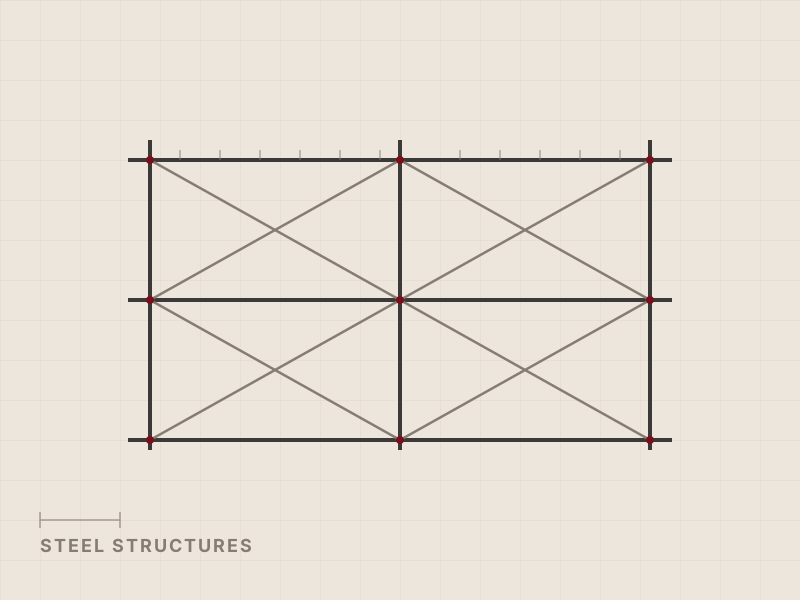
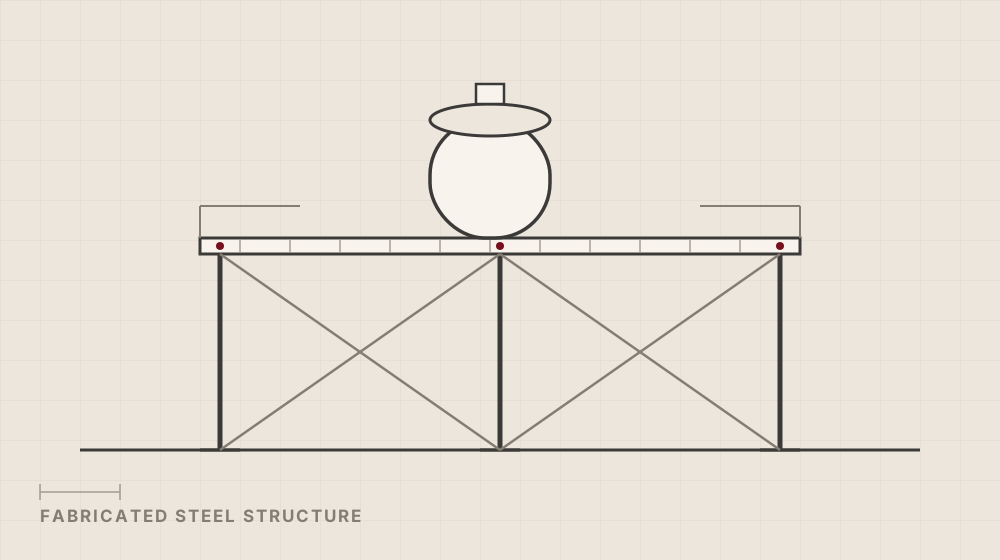
“Steel structures” on an industrial site covers equipment support frames, pipe racks, access platforms, walkways and stair towers, and the support steel for tall equipment such as stacks, silos, and vessels. Much is secondary steel from a process standpoint, yet it governs safe access, maintainability, and, for support structures, the integrity of the equipment it carries.
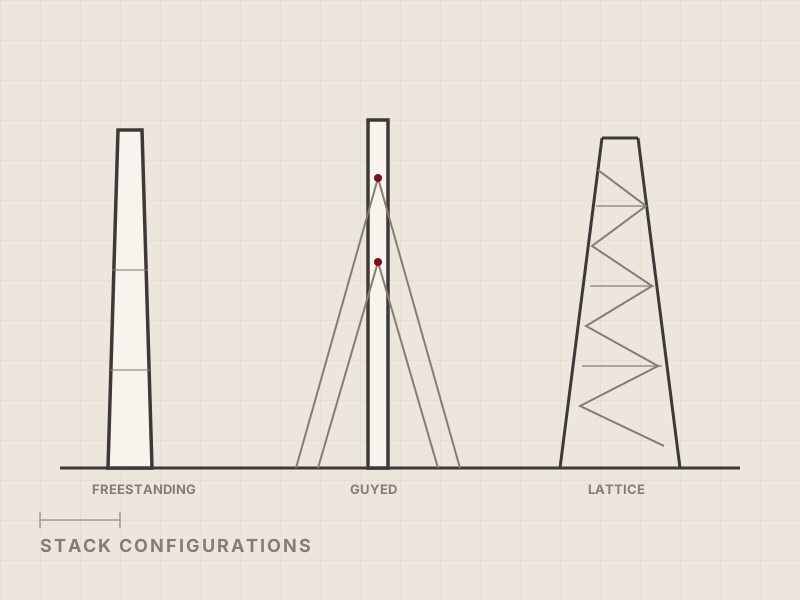
A recurring efficiency for EPC buyers is to combine equipment with its support steel in one delivery scope. Stacks are the clearest example: a stack and its structural steelwork share load paths, interfaces, and erection sequence, so procuring them together removes an interface, and a finger-pointing risk. See the industrial stacks solutions overview for how that combined scope is structured, and the guide to industrial stack configurations for where self-supporting versus supported arrangements drive the steel.
Fabrication standard: EN 1090 and the execution class
In the EU, the fabrication of structural steelwork is governed by the EN 1090 series. EN 1090 comprises three parts: EN 1090-1 covers requirements for conformity assessment of structural components, the route to CE marking, while EN 1090-2 sets the technical requirements for the execution of steel structures, and EN 1090-3 does the same for aluminium [1][2]. For structural steel components placed on the European market as construction products, CE marking under EN 1090-1 has been mandatory under the Construction Products Regulation (EU) No 305/2011 since 1 July 2014 [2]. In practice your supplier must operate a certified Factory Production Control system, perform welding under the relevant quality requirements, and issue a Declaration of Performance for the components it supplies [2].
Execution classes EXC1 to EXC4
EN 1090-2 defines four execution classes, EXC1 to EXC4, running from the least to the most demanding. The requirements are cumulative (EXC3 includes everything required for EXC2, plus more) and the class drives how strict the welding, traceability, and non-destructive testing (NDT) requirements become [1][3].
The class is not chosen by the fabricator. It is assigned by the designer, and it flows from the structure’s consequences (or reliability) class and its type of loading, following Annex C of EN 1993-1-1 [3]. As a rough orientation: EXC1 suits simple, low-consequence fabrications; EXC2 is the common default for ordinary buildings and structures; EXC3 applies to higher-consequence or fatigue-loaded structures; and EXC4 is reserved for structures with extreme consequences of failure [1][3]. The practical takeaway: confirm the execution class on the design documents and carry it explicitly into the purchase order. It is the biggest single driver of fabrication cost and inspection scope, and getting it wrong either way is expensive.
Design basis: Eurocode 3 (EN 1993)
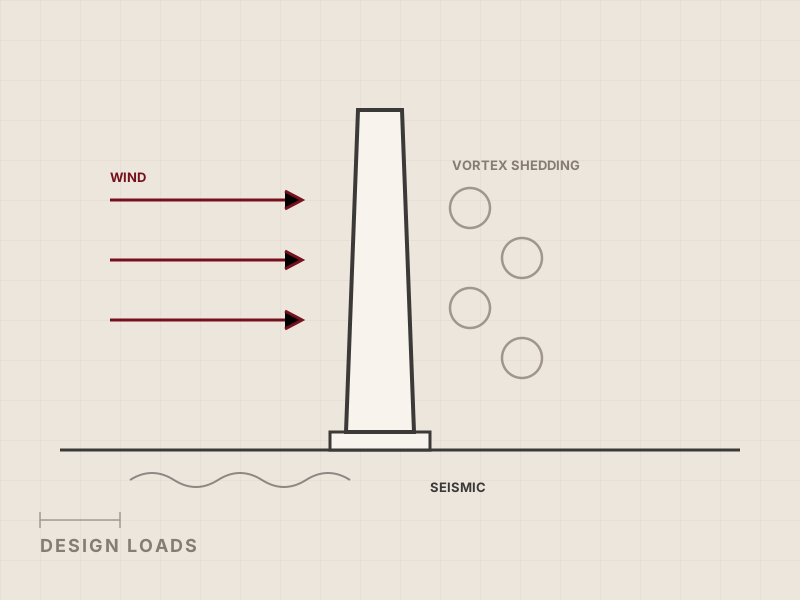
Where EN 1090 governs how the steel is made, the EN 1993 series (Eurocode 3) governs how it is designed. The base part, EN 1993-1-1, gives general rules and rules for buildings; the wider series adds parts for specific structure types, and for support steel under a stack the chimney rules sit in EN 1993-3-2 (towers, masts and chimneys: chimneys) [4]. The load actions the steelwork must resist (wind, seismic, thermal, and equipment loads) come from the wider Eurocode suite; our guide to industrial stack design loads covers that load picture for tall plant. For an EPC buyer, the point is to confirm which design code and edition the structure was verified against, and that the as-fabricated execution class matches the design assumption.
Access, platforms and walkways: EN ISO 14122
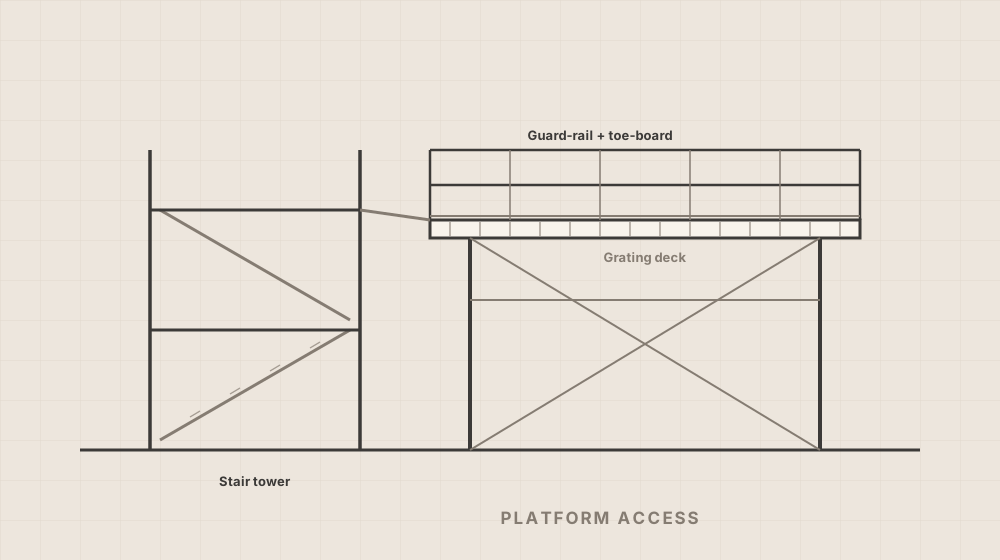
Permanent fixed access to plant and machinery (working platforms, walkways, stairs, and fixed ladders) is covered by the four-part EN ISO 14122 series (2016): Part 1 covers the choice of fixed means and general access requirements; Part 2 covers working platforms and walkways; Part 3 covers stairs, stepladders and guard-rails; and Part 4 covers fixed ladders [5][6]. Specifying platforms and stairs against EN ISO 14122 keeps guard-rail heights, stair geometry, and ladder provisions consistent and defensible. Make the access standard explicit in the enquiry. It affects steel tonnage and detail, and retrofitting compliant access after erection costs far more than building it in.
Coatings and corrosion protection: ISO 12944
Corrosion protection by protective paint systems is governed by the ISO 12944 series: Part 1 (ISO 12944-1:2017) gives the general introduction, Part 2 (ISO 12944-2:2017) classifies the environment, and Part 5 (ISO 12944-5:2019) covers the paint systems [7][8][9]. Two parameters from this series define a coating specification, and both belong in the enquiry.
Corrosivity category (C1 to CX)
ISO 12944-2 classifies atmospheric environments into six corrosivity categories: C1 (very low), C2 (low), C3 (medium), C4 (high), C5 (very high), and CX (extreme) [7][9]. An onshore process plant typically falls in the C3–C5 range; coastal, offshore, or heavy-industrial exposure pushes toward C5 or CX. The category is set by the site environment, not by preference.
Durability range
The second parameter is the durability range, the expected time to first major maintenance, defined in ISO 12944-1 as low (up to 7 years), medium (7–15 years), high (15–25 years), and very high (more than 25 years) [8]. Durability is a maintenance-planning figure, not a warranty period; the warranty is normally shorter [8]. For long-life plant steel, hot-dip galvanising, a high-build paint system, or a duplex system (galvanising plus paint) are the usual routes, trading off corrosivity category, target durability, and access for future re-coating. Specify category and durability together. One without the other is not a complete spec.
Shop versus site: fabrication, transport and erection interfaces
The interface between shop and site is where steel schedules slip. A few questions settle most of the risk:
- Shop versus site work split. Maximising shop fabrication improves quality and shortens site time, but transport envelopes cap the size of pre-assembled modules.
- Bolted versus welded site joints. Bolted connections speed erection and need no site NDT or joint coating repair; welded site joints are sometimes unavoidable but add site inspection and touch-up.
- Transport and erection. Confirm piece sizes against road/shipping limits and crane access, and agree match-marking and trial-fit for complex assemblies.
- Coating at interfaces. Agree how site joints and transport damage are touched up so the coating system remains continuous.
Documentation handover
For a CE-marked structure, the documentation is part of the deliverable. Expect, as a minimum, the Declaration of Performance and CE marking for the execution class supplied, material certificates with traceability, welding and NDT records appropriate to the execution class, and coating inspection records (surface preparation and dry film thickness). Agreeing the deliverables and their format up front avoids a scramble at handover and keeps the package audit-ready.
What to ask your steel supplier: an EPC checklist
- Are you certified to EN 1090-1, and can you supply components CE-marked to the execution class our design requires?
- Which execution class (EXC1–EXC4) is the structure assigned, and is your shop set up for it (welding coordination, traceability, NDT)?
- Against which EN 1993 part and edition was the structure designed, and does the as-built execution class match the design assumption?
- Do platforms, walkways, stairs, and ladders comply with EN ISO 14122?
- What is the ISO 12944 corrosivity category and durability range for the coating, and which system (galvanising, paint, or duplex) meets it?
- What is the shop/site work split, and are site connections bolted or welded?
- What are the transport piece sizes and erection assumptions?
- What documentation is handed over (DoP, material certs, welding/NDT records, coating records)?
Working with Axces
Axces fabricates its products in its own production facility (Axces Production), letting us control the fabrication standard, execution class, and coating specification against the project requirement, and CE-mark structural components under EN 1090 to the execution class a project demands. Because stacks and their support steel are often one delivery scope, combining them removes an interface and keeps design, fabrication, and erection under single responsibility. To scope a structure or a combined stack-and-steel package, see Axces steel structures or contact our engineering team.
References
- Wikipedia: EN 1090 (overview of the three parts: EN 1090-1 conformity assessment / CE marking; EN 1090-2 technical requirements for execution of steel structures; EN 1090-3 aluminium; execution classes 1–4). https://en.wikipedia.org/wiki/EN_1090
- SV Cert Group / RINA: EN 1090-1: CE marking for structural components in steel or aluminium (mandatory CE marking under Construction Products Regulation (EU) No 305/2011 from 1 July 2014; Factory Production Control and Declaration of Performance requirements). https://www.svcertification.com/en/en-1090-1-ce-marking-for-structural-components-in-steel-or-aluminium/
- SteelConstruction.info / BCSA: Specifying the right Execution Class and EN 1090-2:2018 execution classes EXC1–EXC4, cumulative requirements; assignment by the designer via Annex C of EN 1993-1-1 based on consequence/reliability class and type of loading. https://www.newsteelconstruction.com/wp/specifying-the-right-execution-class/
- Eurocodes (JRC) / Wikipedia: Eurocode 3: Design of steel structures (EN 1993); EN 1993-1-1 general rules and rules for buildings; EN 1993-3-2 towers, masts and chimneys: chimneys. https://eurocodes.jrc.ec.europa.eu/EN-Eurocodes/eurocode-3-design-steel-structures
- ISO: ISO 14122-1:2016, Safety of machinery: Permanent means of access to machinery: Part 1: Choice of fixed means and general requirements of access (four-part series). https://www.iso.org/standard/61279.html
- ISO: ISO 14122-2:2016 (working platforms and walkways) and ISO 14122-3:2016 (stairs, stepladders and guard-rails); Part 4 covers fixed ladders. https://www.iso.org/standard/61281.html
- ISO: ISO 12944-2:2017, Corrosion protection of steel structures by protective paint systems: Part 2: Classification of environments (atmospheric corrosivity categories C1, C2, C3, C4, C5, CX). https://www.iso.org/standard/64834.html
- ISO 12944-1:2017 general introduction, durability ranges: low (up to 7 years), medium (7–15 years), high (15–25 years), very high (more than 25 years); durability is a maintenance-planning parameter, not a warranty. (Summarised via European Coatings / Conro.) https://www.european-coatings.com/news/raw-materials/understanding-iso-12944/
- ISO: ISO 12944-5:2019, Corrosion protection of steel structures by protective paint systems: Part 5: Protective paint systems. https://www.iso.org/standard/77795.html