On this page
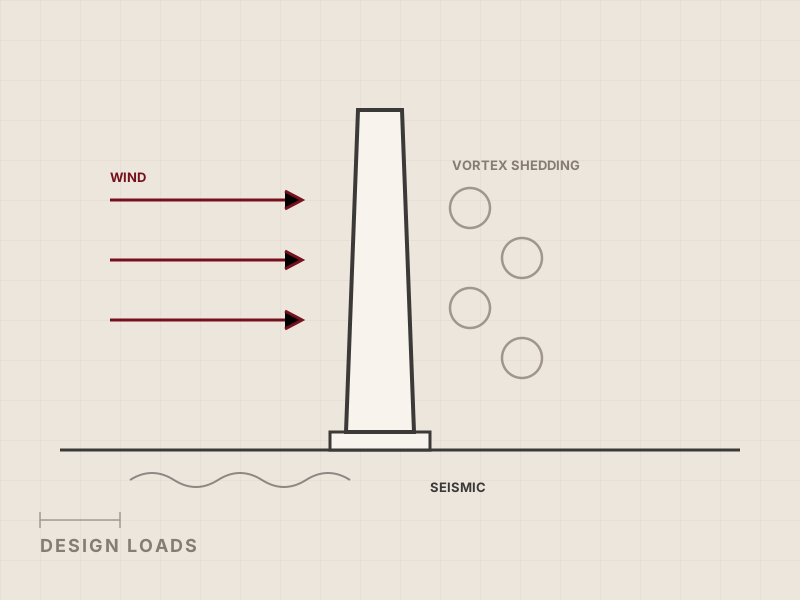
Industrial stack design loads fall into three groups: static along-wind loading from gusts, dynamic cross-wind loading from vortex shedding, and seismic action. For slender steel stacks it is usually not the storm gust but vortex-induced vibration that governs, driving shell thickness, damping measures, and fatigue life. This article explains each load case as the Eurocodes treat it (EN 1991-1-4 for wind, EN 1998-6 for seismic, EN 1993-3-2 for the steel chimney itself) and when each one dominates.
Why stacks are a special structural case
A freestanding stack is one of the most dynamically sensitive structures an EPC will ever procure. Its geometry is fixed by the process: height by dispersion requirements, diameter by flue-gas velocity. The result is a tall, light, welded steel cantilever with almost no inherent damping: none of the partitions, cladding, or friction interfaces that dissipate energy in a building. That combination of slenderness, low mass, and low damping is why freestanding industrial stacks have dedicated design codes rather than being treated as ordinary steel structures.
Along-wind loading: the gust response
The baseline load case is wind acting in its own direction. EN 1991-1-4 (Eurocode 1, Part 1-4: Wind actions) converts a mapped basic wind velocity into a peak velocity pressure on the structure, accounting for terrain roughness, orography, and height; the standard applies to structures up to 200 m tall [1].
Because a gust never loads the whole structure simultaneously, and because a flexible structure amplifies gust energy near its natural frequency, the code applies a structural factor (cscd) combining both effects. For circular chimneys the factor may be taken as 1.0 only when the height is below 60 m and below 6.5 times the diameter; taller or more slender stacks require the detailed dynamic procedures of Annexes B and C [1]. National Annexes supply the wind maps and national choices for the country of installation.
Along-wind loading sets the overturning moment, and with it the base connection, anchor bolts, and foundation. For short, stocky stacks it is typically the governing case. For slender ones, it usually is not, which brings us to the load case that is.
Cross-wind loading: vortex shedding
The mechanism, and why it often governs
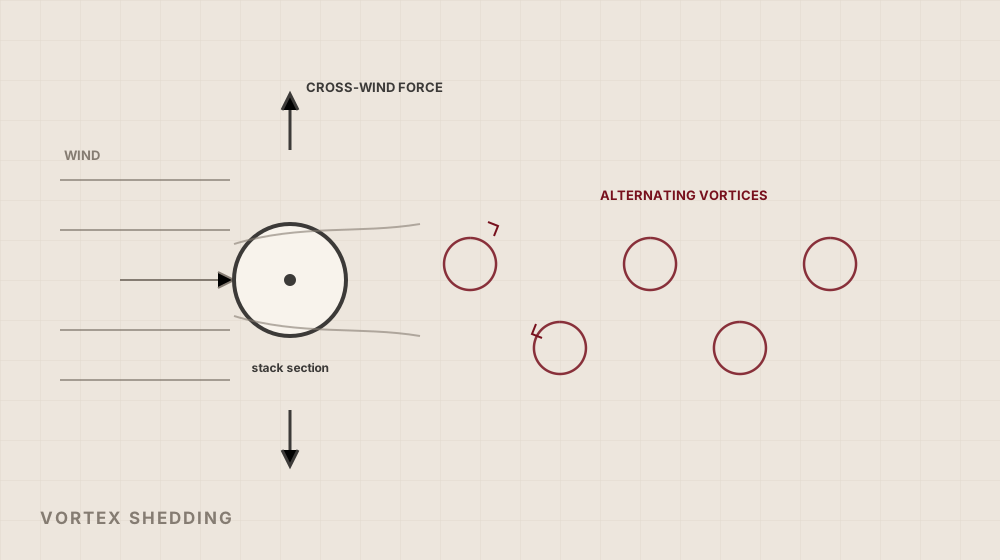
As wind flows past a circular stack, vortices shed alternately from each side, pushing the structure side to side at a frequency that rises with wind speed and falls with diameter (set by the Strouhal number). At one specific wind speed, the critical wind velocity, shedding frequency and natural frequency coincide and the stack resonates; the motion then synchronises the shedding along the height, a self-reinforcing effect known as lock-in.
Three things make this the dominant load case for slender steel stacks. First, the critical velocity for the first bending mode is often a moderate, frequently occurring wind speed, not a rare storm, so resonance conditions can recur week after week. Second, welded steel shells have very little damping to limit the response. Third, the damage mechanism is fatigue: millions of stress cycles accumulating at welded details such as the base joint, manholes, and flanged connections. EN 1993-3-2, the Eurocode part for steel chimneys, treats fatigue as a core verification alongside strength and stability [2].
How the codes treat it
EN 1991-1-4 handles vortex shedding in Annex E. The annex requires the effect to be investigated when the ratio of the structure’s largest to smallest crosswind dimension exceeds 6 (true of virtually every stack) and allows it to be ignored only where the critical wind velocity exceeds 1.25 times the mean wind velocity at the relevant height [1].
Where investigation is required, Annex E offers two methods: Approach 1 (clause E.1.5.2), a vortex-resonance model based on an effective correlation length, and Approach 2 (clause E.1.5.3), a spectral model that treats turbulence intensity explicitly and is noted by the code as appropriate where very cold, stratified low-turbulence flow can occur, such as coastal Northern Europe [1][5]. Both predict the maximum cross-wind amplitude and the stress ranges feeding the fatigue check; in both, the response is steered by the stack’s mass-damping parameter (the Scruton number): the lighter and less damped the stack, the larger the amplitudes. The choice of approach is subject to national choice; the calculation itself belongs with the stack designer.
Annex E also covers related aeroelastic phenomena: ovalling of thin shells, galloping, and interference effects between closely spaced cylinders, which matter where several flues or stacks stand in a row [1]. Alongside the Eurocodes, the CICIND Model Code for Steel Chimneys (Revision 2, September 2010) is the internationally recognised industry alternative, covering self-supporting circular steel chimneys taller than 15 m, with along-wind and across-wind load models refined in that revision to reflect site surface roughness [4].
Seismic loading
Seismic design of stacks is governed by EN 1998-6 (Eurocode 8, Part 6: Towers, masts and chimneys), which covers free-standing industrial chimneys explicitly and gives additional provisions for steel chimneys in its Section 6 [3].
Because stacks are light, seismic base shear is often modest compared with wind, and in low-seismicity regions such as the Netherlands wind almost always governs the shell. Seismic action moves up the agenda when the site is in a high-seismicity region (southern and southeastern Europe, Turkey, parts of Asia), when the stack carries heavy concentrated masses (internal flues, liners, silencers, platforms), or when an elevated importance class applies because the plant must remain operational after an earthquake. Even where wind governs the shell plate, seismic load combinations can still govern anchorage details, foundation design, and the supports of internal components.
A note on editions: those cited here are first-generation Eurocodes; BSI plans to withdraw them on 30 March 2028 as second-generation replacements arrive [2].
Which load case governs?
| Stack profile | Typically governing load case | Primary design consequence |
|---|---|---|
| Short, stocky, low slenderness | Along-wind gust loading | Base moment, anchor bolts, foundation |
| Tall, slender single-flue steel stack | Cross-wind vortex shedding | Fatigue life of welds, damping measures |
| High-seismicity site or heavy internals | Seismic (EN 1998-6) | Anchorage, foundations, flue and liner supports |
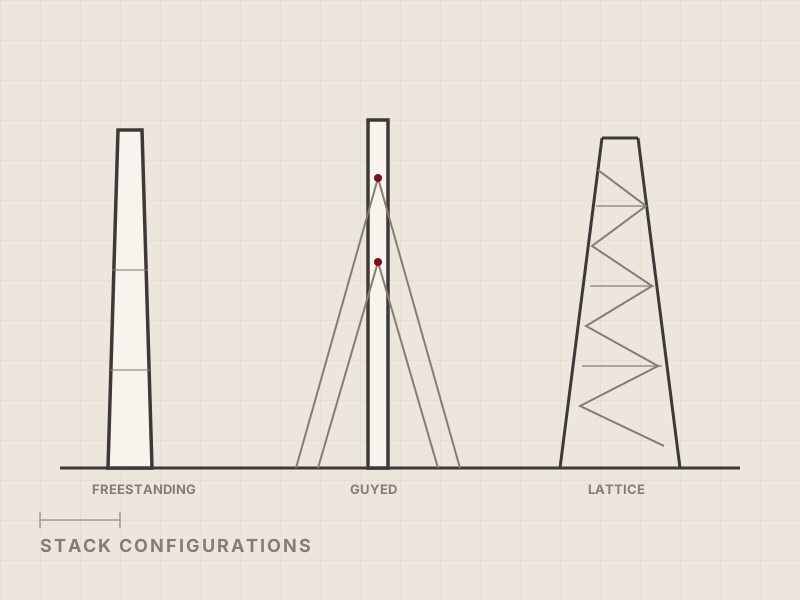
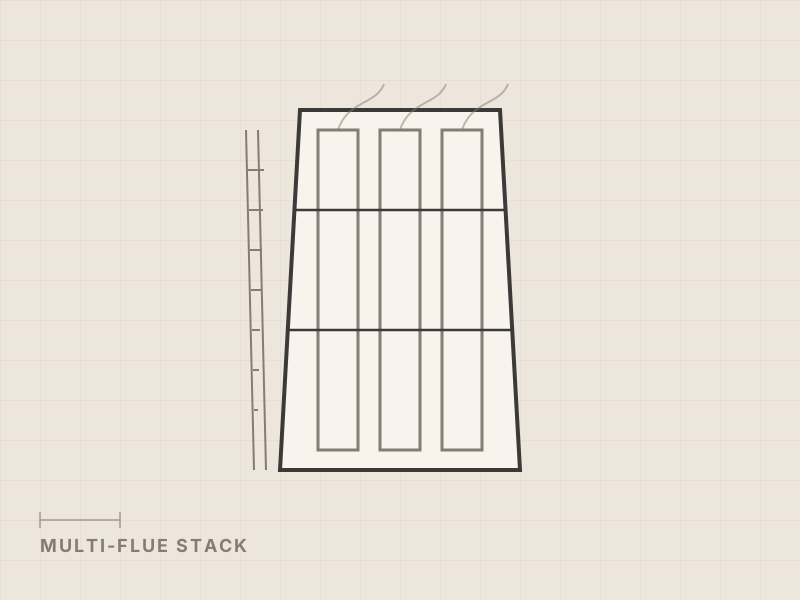
Configuration shifts the balance. A freestanding single-flue stack is the lightest and most slender option, and therefore the most vortex-sensitive. A freestanding multi-flue stack concentrates several flues in one heavier, stiffer structure, which tends to raise both the critical wind velocity and the mass-damping parameter, at the price of flue-interference effects the designer must address. How to choose between them is covered in our guide to single-flue and multi-flue stack configurations.
Mitigation: strakes, dampers, and design measures
When the predicted cross-wind response is too large, the designer has three families of countermeasures:
- Helical strakes: spiral fins on the upper part of the shell that break up the coherence of vortex shedding along the height. Simple and maintenance-free, but they increase drag and thus the along-wind load; Annex E lists aerodynamic devices of this kind among its measures against vortex-induced vibration [1].
- Dampers: tuned mass or pendulum dampers near the stack top add the damping the bare steel shell lacks, directly cutting the resonant amplitude and improving fatigue life, and they can be retrofitted to an existing stack with vibration problems.
- Design-side measures: adjusting diameter, taper, shell thickness, or mass distribution to move the critical wind velocity away from frequently occurring wind speeds, and detailing welds for fatigue class from the outset.
The right measure depends on site wind climate, stack geometry, and cost, which is why the load assessment must come before the steel is sized.
Getting the load cases right from day one
Every Axces stack, single-flue or multi-flue, is engineered against all governing load cases: EN 1991-1-4 wind and vortex shedding, EN 1993-3-2 strength and fatigue, and EN 1998-6 seismic where the site demands it. If you are specifying a stack and want the governing load case identified early, before it surprises you in detail design, contact our stack engineering team with your site location, terrain, and process data.
References
- CEN, EN 1991-1-4:2005+A1:2010, Eurocode 1: Actions on structures, Part 1-4: General actions, Wind actions. Section 1.1 (scope to 200 m), Section 6.2 (structural factor for chimneys), Annex E (vortex shedding and aeroelastic instabilities; criteria in E.1, Approach 1 in E.1.5.2, Approach 2 in E.1.5.3, measures against vortex-induced vibrations). https://knowledge.bsigroup.com/products/eurocode-1-actions-on-structures-general-actions-wind-actions
- CEN, EN 1993-3-2:2006, Eurocode 3: Design of steel structures, Part 3-2: Towers, masts and chimneys, Chimneys. Scope: vertical steel chimneys of circular or conical section; strength, stability, and fatigue; first-generation Eurocode, BSI withdrawal planned 30 March 2028. https://knowledge.bsigroup.com/products/eurocode-3-design-of-steel-structures-towers-masts-and-chimneys
- CEN, EN 1998-6:2005, Eurocode 8: Design of structures for earthquake resistance, Part 6: Towers, masts and chimneys. Scope includes free-standing industrial chimneys; Section 6: additional provisions for steel chimneys. https://knowledge.bsigroup.com/products/eurocode-8-design-of-structures-for-earthquake-resistance-towers-masts-and-chimneys
- CICIND, Model Code for Steel Chimneys, Revision 2, September 2010 (supersedes Revision 1 incl. Amendment A, 2002). Self-supporting circular steel chimneys taller than 15 m; revised along-wind and across-wind load models. https://cicind.org/publications/cicind-model-codes.html
- European Commission JRC, EN 1991-1-4:2005 Wind actions (Eurocodes: Background and Applications, dissemination workshop, Brussels, 2008): background on the structural-factor procedures and the Annex E Approach 1 (vortex-resonance) vs Approach 2 (spectral) models. https://eurocodes.jrc.ec.europa.eu/sites/default/files/2022-06/EN1991_4_Hansen.pdf