On this page
Choosing an industrial stack configuration comes down to matching three structural families (freestanding (self-supporting) stacks, guyed stacks, and structure-supported stacks) to the height, plot, and load conditions of a specific site. The decision is driven less by preference than by physics: wind loading, vortex shedding, seismic action, and foundation constraints narrow the field quickly. This guide explains each configuration, the criteria that decide between them, and the European design codes that govern the result.
First, the terminology
“Freestanding” and “self-supporting” are used almost interchangeably in practice: both describe a stack that stands on its own foundation without guys or external support. The distinction that actually matters structurally is threefold, and the steel chimney Eurocode reflects it: EN 1993-3-2 applies to vertical steel chimneys that are cantilevered, supported at intermediate levels, or guyed [1]. In plant terms:
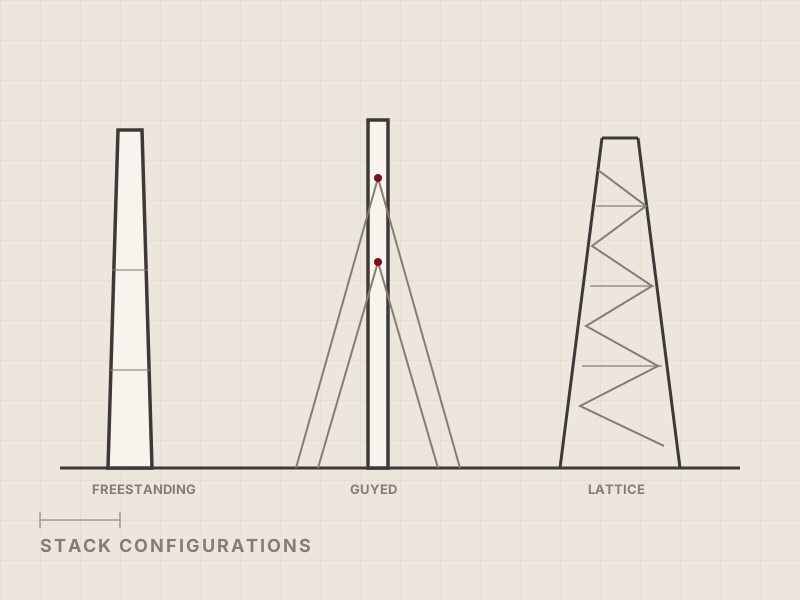
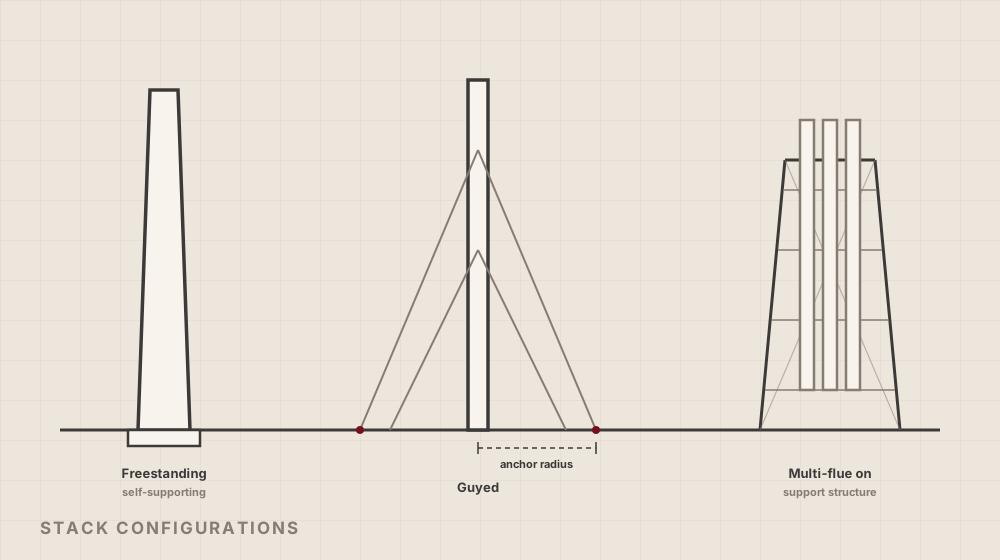
- Freestanding (self-supporting): a cantilever fixed at its foundation; the stack structure resists all loads itself.
- Guyed or stayed: a light shaft held laterally by guy cables, or by stays to an adjacent structure.
- Structure-supported: one or more flues carried by a separate steel tower or frame.
The three configurations compared
Freestanding stacks: single-flue and multi-flue
In a freestanding single-flue stack, the gas-carrying shell is also the load-bearing structure. It has the cleanest interface set on a project (one foundation, no guy anchors, no carrier steelwork) which is why it is the default for most industrial sites.
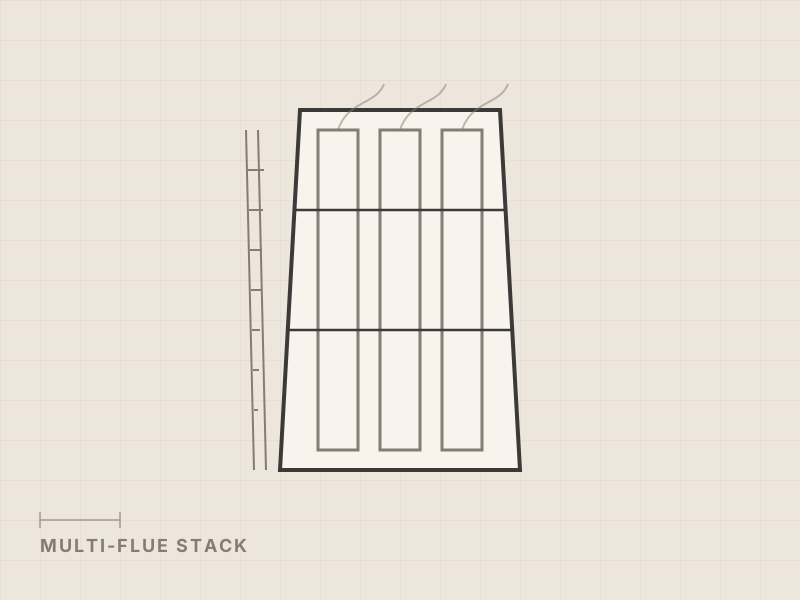
Where a plant has several emission sources (generator sets, boilers, engines) a freestanding multi-flue stack groups the flues inside one structural windshield or carrier shell. The site gets one foundation and one wind obstacle instead of a row of individual stacks, and individual flues can be sized for their own gas stream and velocity.
The trade-offs: the full overturning moment arrives at the stack base, so foundation size and shell thickness grow with height, and a tall, slender single-flue is the configuration most exposed to vortex shedding (more on that below).
Guyed and stayed stacks
Guy cables at one or more levels turn the shaft from a pure cantilever into a beam with intermediate supports. The shell can be far lighter and the central foundation far smaller. The CICIND Model Code for Steel Chimneys addresses guyed and stayed chimneys as a distinct category: stayed meaning laterally supported by an adjacent structure, guyed meaning held by pretensioned guy ropes [4].
The price is paid in plot and upkeep: guy anchors need a substantial clear radius around the stack, the cables interfere with site logistics, and pretension must be inspected and maintained over the stack’s life. Guyed configurations earn their place where the height-to-diameter ratio is extreme, weight must be minimal, or the surrounding plot is genuinely free.
Structure-supported stacks
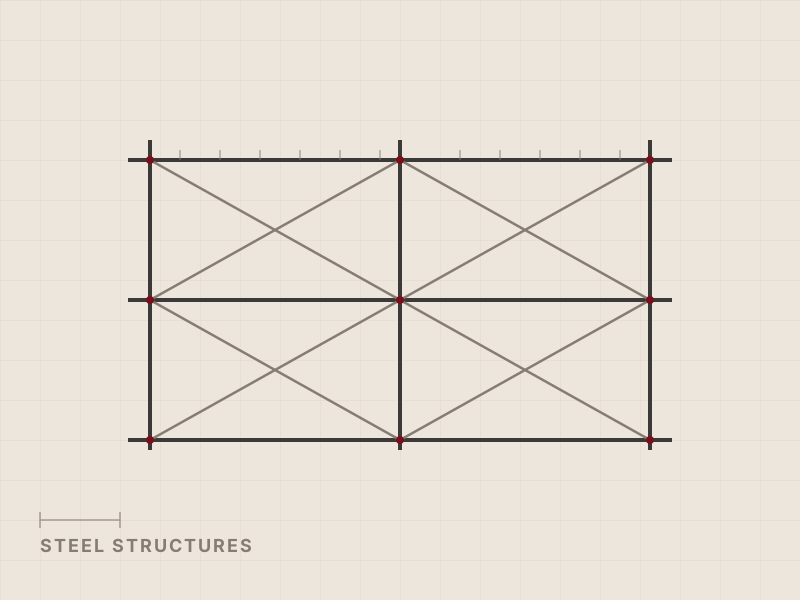
Here a lattice tower or braced frame, engineered as dedicated steel support structures, carries the flues, which span between supports instead of cantilevering. Because the flues are relieved of structural duty, they can be thin-walled or built in corrosion-resistant alloy, and they can be replaced or added individually without touching the primary structure.
This configuration suits multi-flue installations with staged expansion plans, stacks carrying heavy ancillary equipment, and sites where foundation loads must be spread across several tower legs. The counterpoint is more steel, more fabrication, and more erection work than an equivalent freestanding stack.
What actually decides the choice
- Required height and flue count. Dispersion requirements and permit conditions set the minimum height; the number of sources sets the flue count. Together they shortlist the configuration before any structural work starts.
- Plot and interfaces. No clear guy radius means no guyed stack. Congested foundations or poor soil favour spreading loads through a support structure.
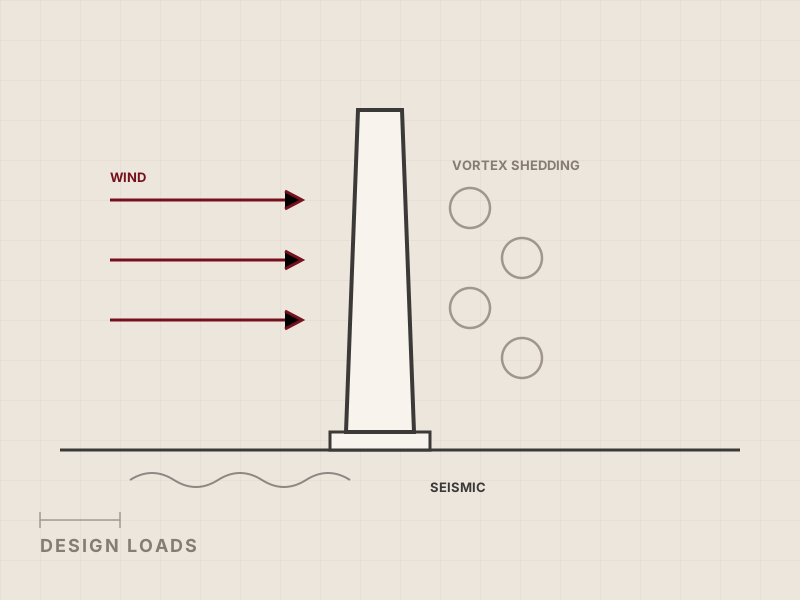
- Wind environment. Along-wind drag sizes the shell and foundation; the across-wind (vortex shedding) response often governs slender designs.
- Seismic input. EN 1998-6 sets the seismic design rules for towers, masts, and chimneys, with dedicated provisions for steel chimneys and for guyed masts [3]. Each configuration distributes mass and restraint differently, so the seismic answer can differ from the wind answer.
- Operations and lifecycle. Inspection access, coating renewal, guy retensioning, flue replacement, and future expansion all carry costs that belong in the comparison, not after it.
Vortex shedding: the phenomenon that bites slender stacks
When wind flows past a circular shaft, vortices shed alternately from each side, producing a fluctuating force perpendicular to the wind. If the shedding frequency coincides with a natural frequency of the stack, the structure oscillates across the wind and can lock in to the excitation. Annex E of EN 1991-1-4 defines this critical wind velocity, the wind speed at which the vortex-shedding frequency equals a natural frequency of the structure, and provides the models used to assess the resulting amplitudes and fatigue effects [2].
Susceptibility rises with slenderness and falls with mass and structural damping, the balance captured by the mass-damping (Scruton) parameter used in Annex E. A slender stack with a low critical wind velocity is excited often, at moderate everyday wind speeds, and the resulting stress cycles accumulate as fatigue damage at welds and flanged connections.
Configuration is itself a mitigation lever: guys add restraint and shift natural frequencies, while multi-flue and structure-supported arrangements change the diameter, mass, and aerodynamics of what the wind sees. Where a chosen configuration remains sensitive, the established countermeasures are:
- Aerodynamic devices: helical strakes on the upper part of the shell disrupt coherent vortex shedding, at the cost of higher drag; Annex E of EN 1991-1-4 covers such measures against vortex-induced vibration [2].
- Damping devices: tuned mass dampers and other passive dynamic control measures, treated explicitly in the CICIND Model Code (§7.2.9) [4].
- Structural tuning: adjusting diameter, wall thickness, or mass, or adding stays at intermediate levels.
Thin-walled shells additionally need a check on ovalling, breathing oscillations of the cross-section, which the CICIND Model Code also covers (§7.2.5) [4].
The codes that govern industrial stack design
- EN 1993-3-2:2006: Eurocode 3, Part 3-2: strength, stability, and fatigue of steel chimneys, covering cantilevered, intermediate-supported, and guyed configurations [1]. In the second generation of the Eurocodes, the towers/masts and chimneys parts are being merged into a single EN 1993-3 [5]; until national withdrawal of the first generation, the 2006 part remains the operative reference.
- EN 1991-1-4:2005+A1:2010: Eurocode 1, Part 1-4: wind actions, with Annex E for vortex shedding and aeroelastic instabilities [2].
- EN 1998-6:2005: Eurocode 8, Part 6: seismic design of towers, masts, and chimneys [3].
- CICIND Model Code for Steel Chimneys, Revision 2 (September 2010): the international model code for circular steel chimneys of 15 m and taller (and shorter chimneys with a slenderness ratio above 16), with Normal and Critical reliability classes [4]. It is frequently specified on international projects alongside, or in place of, national Eurocode annexes.
One practical note: specify a single governing code set in the contract. Mixing CICIND and Eurocode safety formats in one specification is a recurring source of dispute and rework.
Selecting a configuration in practice
- Fix the required height and flue count from dispersion and permit requirements.
- Map the plot: foundation space, guy radius, crane access, adjacent structures.
- Shortlist configurations that fit both. Usually one or two survive.
- Screen the shortlist for dynamic sensitivity: slenderness, expected frequencies, exposure.
- Compare lifecycle costs: access, inspection regime, maintenance, future flues.
The final word always belongs to the project-specific structural analysis carried out to the governing codes. The steps above do not replace it, but they ensure the analysis confirms a sound choice rather than rescues a poor one.
If you are weighing stack configurations for a specific site, Axces engineers freestanding single-flue, multi-flue, and structure-supported systems to the EN and CICIND frameworks described here. Start at our industrial stacks solutions overview, or contact our stack engineers to talk through your site constraints.
References
- CEN. EN 1993-3-2:2006: Eurocode 3: Design of steel structures: Part 3-2: Towers, masts and chimneys: Chimneys. Scope: vertical steel chimneys, cantilevered, supported at intermediate levels, or guyed. https://standards.iteh.ai/catalog/standards/cen/956fe6d6-0bb0-4d63-ae38-ae975a976448/en-1993-3-2-2006
- CEN. EN 1991-1-4:2005+A1:2010: Eurocode 1: Actions on structures: Part 1-4: General actions: Wind actions, Annex E (Vortex shedding and aeroelastic instabilities). https://www.thenbs.com/publicationindex/documentsummary.aspx?DocID=296379
- CEN. EN 1998-6:2005: Eurocode 8: Design of structures for earthquake resistance: Part 6: Towers, masts and chimneys. https://knowledge.bsigroup.com/products/eurocode-8-design-of-structures-for-earthquake-resistance-towers-masts-and-chimneys
- CICIND. Model Code for Steel Chimneys, Revision 2, September 2010 (ISBN 1-902998-16-2); §1 Scope, §7.2.4 Vortex shedding, §7.2.5 Ovalling, §7.2.9 Passive dynamic control, §14 Guyed and stayed chimneys. https://cicind.org/publications.html?file=files/content/publications/table-of-contents/Model-Code-for-Steel-Chimneys.pdf&cid=115
- European Commission Joint Research Centre / CEN TC 250. Second generation of the Eurocodes, including the merger of EN 1993-3-1 and EN 1993-3-2 into a single EN 1993-3 (Towers, masts and chimneys). https://eurocodes.jrc.ec.europa.eu/2nd-generation/second-generation-eurocodes-what-new and https://www.researchgate.net/publication/335847108_New_Eurocode_for_Towers_Masts_and_Chimneys