On this page
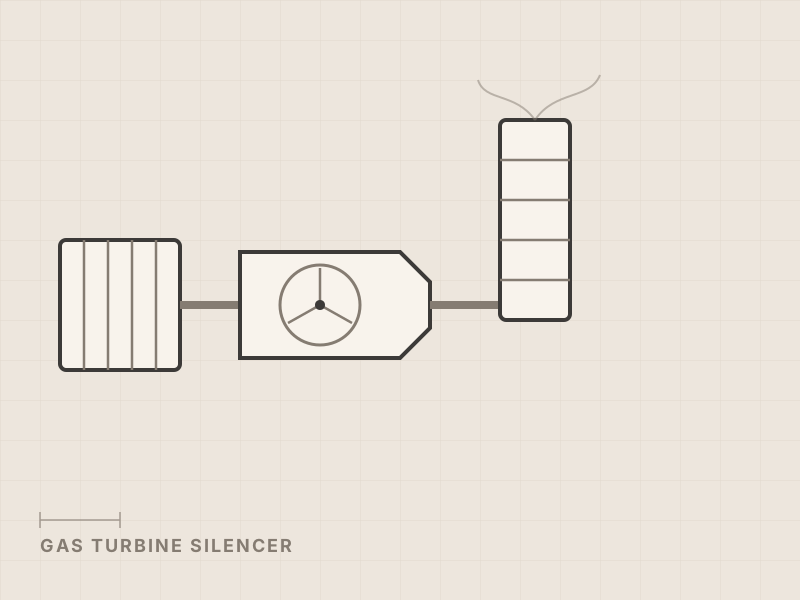
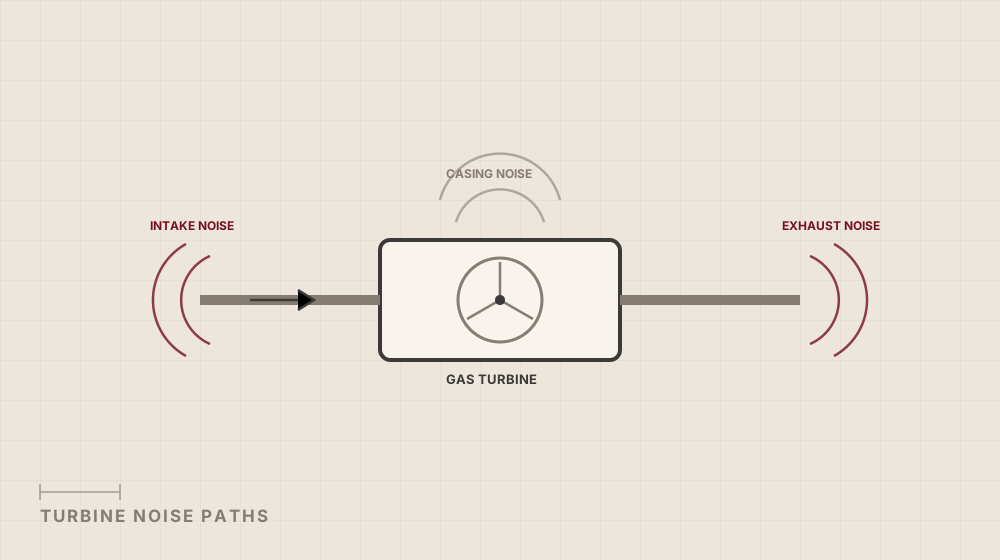
A gas turbine silencer controls the two dominant airborne noise paths of a turbine package: the air intake and the exhaust. The two paths produce very different noise (characteristically high-frequency, tonal noise at the intake and low-frequency, broadband noise at the exhaust) so each needs its own silencer design, sized against the noise limits that apply at the site boundary. This article explains both noise sources, the silencer concepts that address them, and how a workable specification comes together for a power generation site.
Why gas turbine noise dominates the site noise picture
A gas turbine moves a very large mass flow of air, and both ends of the machine are open to the atmosphere through ducts: the intake via the filter house, the exhaust via a stack or heat recovery steam generator (HRSG). Untreated, these two openings are typically among the loudest individual sources on a power generation site. The casing and auxiliaries (lube oil systems, coolers, generators) radiate noise as well, but those are normally handled with acoustic enclosures and building design; the ducted intake and exhaust paths are silencer territory.
Power generation makes the problem harder than most industrial settings: plants run continuously or are dispatched at night, when limits are strictest, and peaking plants are often sited near the load, close to residential or mixed-use areas.
Intake noise: high-frequency and tonal
Intake noise originates in the axial compressor. Each blade row chops the incoming air at the blade-passing frequency, and high shaft speeds combined with high blade counts push that frequency and its harmonics well up the spectrum. The result is the familiar compressor “whine”: strong tonal components riding on broadband flow noise, concentrated in the mid-to-high frequency range. Tonal noise is disproportionately annoying for its level, and assessment frameworks commonly treat it more strictly than broadband noise.
The standard design response is an absorptive splitter silencer (parallel-baffle silencer) in the intake duct, usually integrated with the filter house. Absorptive silencers are at their best in exactly this mid-to-high frequency range, and relatively slim splitters with narrow airways suit the intake spectrum well. Two constraints shape the design: the velocity distribution into the compressor must stay even, and every increment of intake pressure loss costs turbine output and efficiency. Intake silencers are therefore sized generously in cross-section rather than pushed to minimum dimensions.
Exhaust noise: low-frequency, broadband and hot
Exhaust noise comes from combustion and from the turbulent mixing of high-velocity gas leaving the turbine. The spectrum is broadband with its energy weighted toward low frequencies, the volume flow is enormous, and the gas arrives at several hundred degrees Celsius. This combination makes the exhaust the most demanding silencer application on the site.
Low-frequency noise is intrinsically hard to attenuate. Wavelengths are long, absorptive materials become progressively less effective as frequency falls, and low-frequency sound diffracts over barriers and propagates over long distances with little atmospheric attenuation. It is the component most likely to generate complaints at distance, where it is perceived as rumble even indoors.
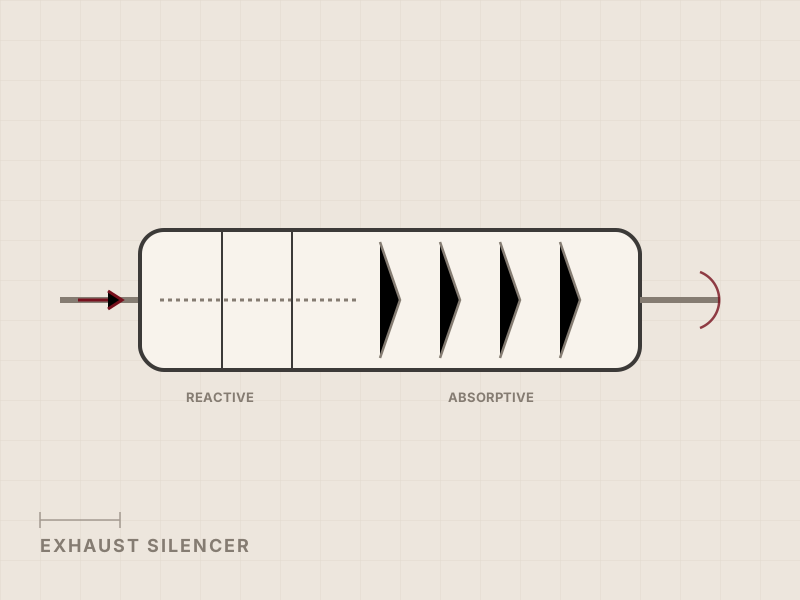
The design response is again absorptive splitter technology, but shifted toward the low end: thicker splitters, wider airways and greater silencer length move the insertion-loss curve down the spectrum. In simple-cycle plants the silencer is typically integrated into the exhaust stack; in combined-cycle plants the HRSG itself attenuates part of the noise, and the governing case is often bypass operation, when the gas path goes straight to the bypass stack. The absorptive and reactive working principles behind these configurations are covered in our overview of industrial exhaust silencer types.
Exhaust silencers are as much a mechanical design task as an acoustic one: provisions for thermal expansion, temperature-rated materials, protection of the acoustic infill against gas-flow erosion, and structural robustness against turbulence-induced vibration all have to be engineered in, within a strict back-pressure budget, because exhaust back-pressure, like intake depression, degrades turbine performance.
The trade-offs that shape every silencer
Four interlocking constraints decide the final design:
- Attenuation versus pressure drop. More splitters, narrower airways and greater length raise insertion loss, and pressure loss. The acoustically ideal silencer and the thermodynamically ideal one pull in opposite directions.
- Flow-generated self-noise. Above a certain gas velocity, the silencer regenerates noise of its own, setting a floor under achievable performance. Controlling face velocity drives the silencer cross-section.
- Spectrum matching. Insertion loss must be specified per octave band against the required attenuation spectrum for that path. A single overall dB(A) figure says little about whether a silencer fits a turbine’s actual spectrum.
- Footprint and structure. Intake silencers must integrate with the filter house, exhaust silencers with the stack or bypass system, including wind, weight and access implications.
How these are balanced is project-specific engineering; there is no catalogue answer for a turbine silencer of this class.
Meeting noise limits at the site boundary
Limits are set locally: confirm them per project
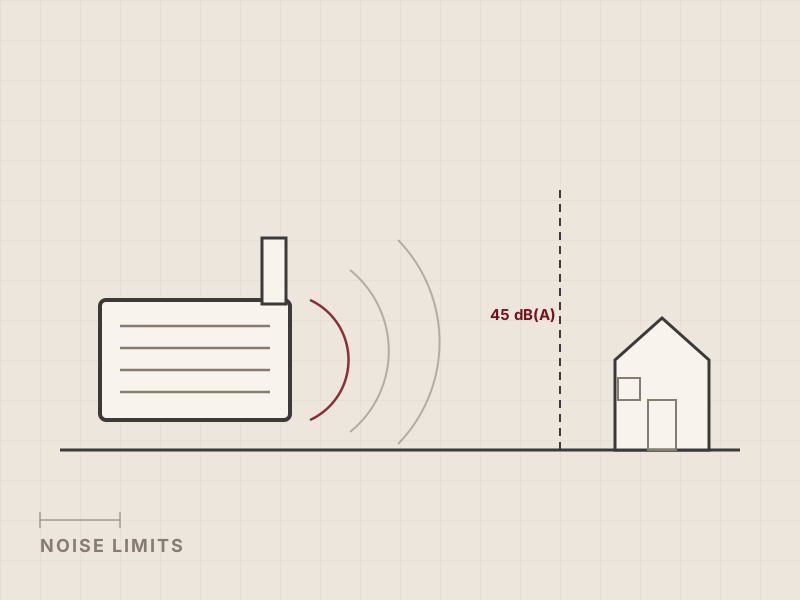
There is no universal numeric noise limit for power plants. In the EU, the Environmental Noise Directive 2002/49/EC harmonises how noise is described and assessed (common indicators (Lden, Lnight), strategic noise maps and action plans) but deliberately sets no EU-wide limit values: Article 5(4) instead required Member States to report the limit values in force within their own territories, including for noise on industrial activity sites [1]. Noise also enters the environmental permit itself: the Industrial Emissions Directive 2010/75/EU defines an “emission” as the release of “substances, vibrations, heat or noise” from an installation (Article 3(4)), so noise conditions can sit directly in the integrated permit of installations within its scope [2]. The binding numbers for any given project therefore come from national or municipal regulation and the site’s permit (typically differentiated by day, evening and night) and must be confirmed before any silencer is specified.
Working back from the boundary to the silencer
Compliance is demonstrated by a chain of measurement and prediction. Source strength of the turbine package is established per ISO 10494:2018, the engineering/survey method for measuring the emitted airborne noise of turbines and turbine sets [3]. Propagation to receptors is predicted with the octave-band engineering method of ISO 9613-2:2024 [4], and boundary or receptor levels are determined per ISO 1996-2:2017 [5]. A site noise study built on these standards allocates an allowable contribution to each source path; the required insertion loss per octave band for the intake and exhaust silencers falls out of that allocation. That spectrum, not a headline dB(A) figure, is the real silencer specification.
Specifying a gas turbine silencer: what the design needs
A silencer supplier can only engineer to the boundary if the enquiry carries the right inputs: octave-band sound power or sound pressure data for the turbine’s intake, exhaust and casing; duct and stack geometry; gas temperature and flow; the allowable pressure drop per path; and the required insertion-loss spectrum or the boundary limits plus receptor distances. With those in hand, the acoustic and mechanical design can be developed together rather than patched afterwards.
Axces engineers gas turbine silencers for power generation plants as part of a complete industrial noise control scope, from the site noise study through intake and exhaust silencer design to installation. If you have a noise study, permit limit or turbine noise datasheet on the table, send it to our acoustic engineers and we will translate it into a silencer specification.
References
- European Parliament and Council, Directive 2002/49/EC of 25 June 2002 relating to the assessment and management of environmental noise, Article 5(4) (Member States’ national limit values, including for noise on industrial activity sites). EUR-Lex: https://eur-lex.europa.eu/eli/dir/2002/49/oj/eng
- European Parliament and Council, Directive 2010/75/EU of 24 November 2010 on industrial emissions (integrated pollution prevention and control), Article 3(4) (definition of “emission” including noise). EUR-Lex: https://eur-lex.europa.eu/eli/dir/2010/75/oj/eng
- ISO 10494:2018, Turbines and turbine sets: Measurement of emitted airborne noise: Engineering/survey method. ISO: https://www.iso.org/standard/64946.html
- ISO 9613-2:2024, Acoustics: Attenuation of sound during propagation outdoors: Part 2: Engineering method for the prediction of sound pressure levels outdoors. ISO: https://www.iso.org/standard/74047.html
- ISO 1996-2:2017, Acoustics: Description, measurement and assessment of environmental noise: Part 2: Determination of sound pressure levels. ISO: https://www.iso.org/standard/59766.html