On this page
- Why one silencing principle is rarely enough
- Absorptive exhaust silencers: dissipation for broadband noise
- Reactive exhaust silencers: reflection and resonance for low-frequency tones
- Combination exhaust silencers: both mechanisms in one casing
- Matching the silencer type to the noise spectrum
- How performance is predicted and specified
- Specifying the right exhaust silencer
Exhaust silencer types come down to three design classes: absorptive, reactive, and combination. Absorptive silencers dissipate broadband mid- and high-frequency noise as heat in porous packing; reactive silencers reflect low-frequency tones back toward the engine using tuned chambers and resonators; combination designs integrate both mechanisms in one casing. Which class fits depends almost entirely on the frequency content of the engine’s exhaust noise. This article explains each mechanism and how to match design to spectrum.
Why one silencing principle is rarely enough
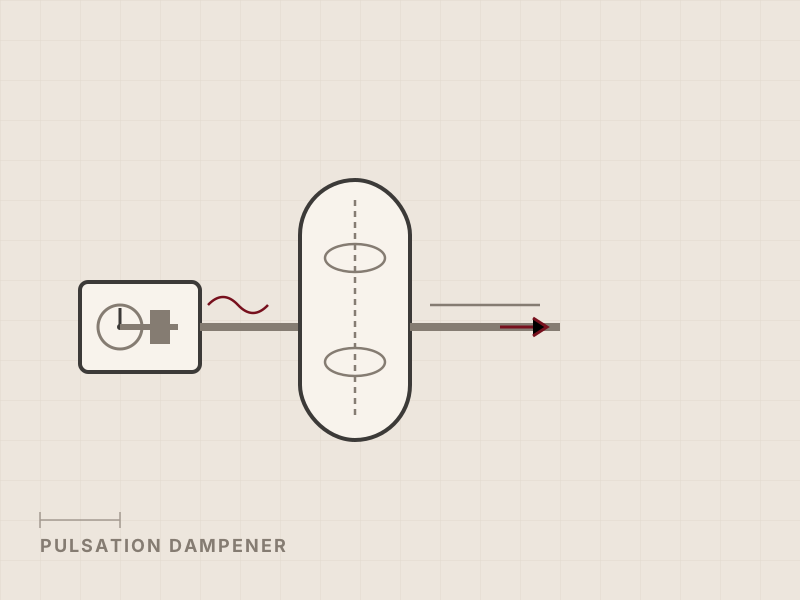
A reciprocating engine releases exhaust gas as a train of pressure pulses, one per cylinder firing. The result is a series of discrete tones at the engine’s firing frequency and its harmonics, with most of that tonal energy in the low end of the audible spectrum, where wavelengths run to several metres. Superimposed on the tones is broadband noise (turbulence in the manifold and piping, turbocharger noise, flow noise at bends and junctions) spread across the mid and high frequencies.
Low-frequency sound is the harder half of the problem. Long wavelengths diffract around barriers, lose little energy to air absorption, and carry far beyond the site boundary, which is why a firing tone often remains audible where the broadband content has long faded. No single attenuation mechanism handles both ends of the spectrum well, exactly why three silencer classes exist.
Absorptive exhaust silencers: dissipation for broadband noise
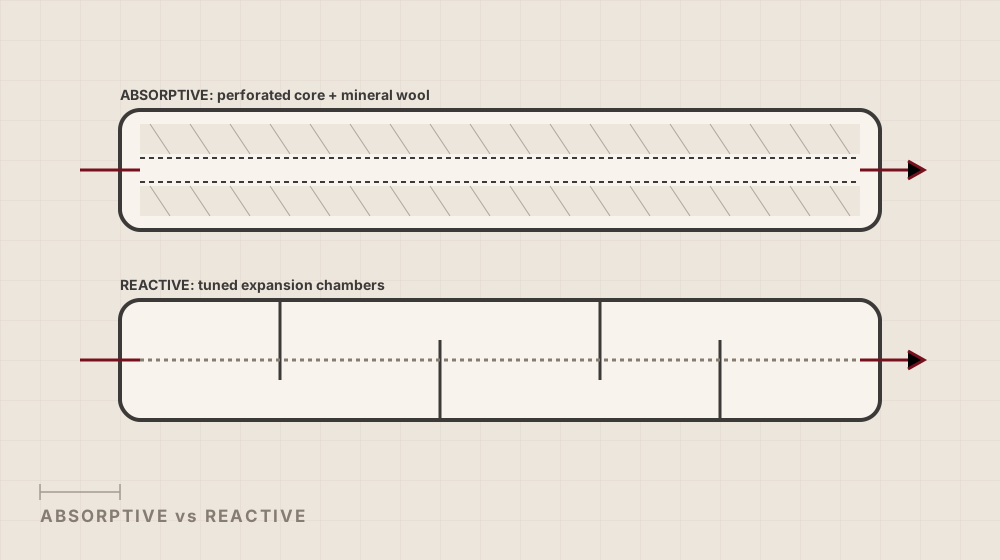
An absorptive silencer routes the gas through a perforated flow tube, or between parallel lined splitters, backed by a packing of mineral wool or similar porous fibre. Sound propagating along the passage drives air in and out of the pores; viscous friction and heat exchange inside the packing convert acoustic energy into heat. Because nothing obstructs the gas path, a straight-through absorptive silencer combines smooth broadband attenuation with low pressure drop.
Attenuation grows with the length of the lined section and the depth of the packing relative to wavelength. Since wavelength shrinks as frequency rises, practical packing depths make absorptive silencers most effective from the mid frequencies upwards; suppressing a deep firing tone by absorption alone would demand impractically thick linings. The packing imposes two constraints: gas velocity must stay within limits to prevent fibre erosion and regenerated flow noise, and the facing, perforated sheet often with retaining mesh, must protect it at operating temperature.
Reactive exhaust silencers: reflection and resonance for low-frequency tones
A reactive silencer works by reflection rather than dissipation. Wherever the cross-section changes abruptly, whether pipe into chamber or chamber back into pipe, part of the incident sound energy is reflected back toward the source rather than transmitted onward; nothing is absorbed, the energy is simply prevented from reaching the outlet.
Expansion chambers
The basic reactive element is an expansion chamber: the larger the area ratio between chamber and pipe, the stronger the reflection, while the chamber length determines which frequencies are attenuated most. Multi-chamber silencers with internal connecting pipes stack these effects where the engine needs them; the behaviour is inherently periodic, with pass-bands between attenuation peaks.
Resonators
Helmholtz resonators (a closed volume connected to the duct through a neck) and quarter-wave stubs act as tuned elements that produce strong, narrow-band attenuation around their resonance frequency. They are the tool of choice for notching out a persistent firing harmonic that survives the chamber stages.
Reactive designs are strongest precisely where absorption is weakest: discrete low-frequency tones. They contain no fibrous material, so they tolerate high temperatures, soot, moisture, and pulsating flow without degradation. The trade-off is selectivity. Attenuation comes in tuned peaks with weaker pass-bands between them, so a reactive silencer must be matched to the engine’s firing spectrum, and variable-speed engines need particular care in tuning. Chamber volume also trades against installation size and back-pressure.
Combination exhaust silencers: both mechanisms in one casing
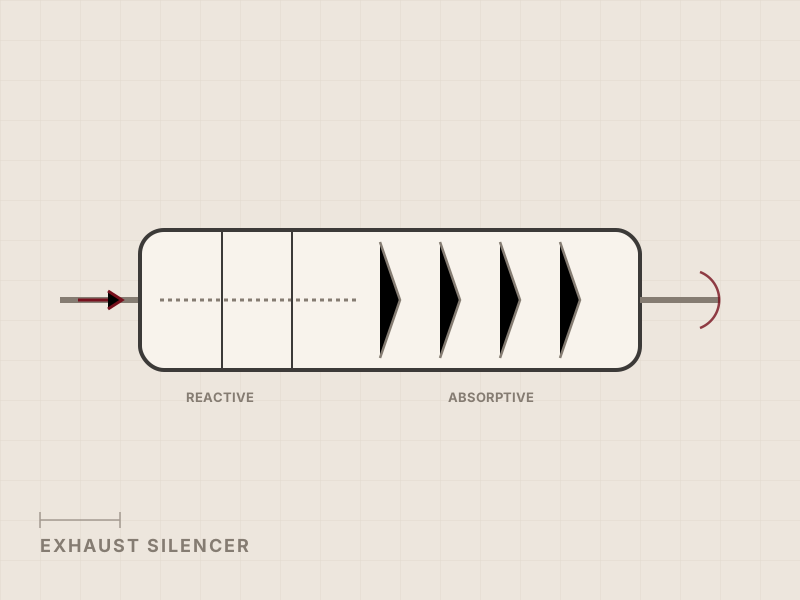
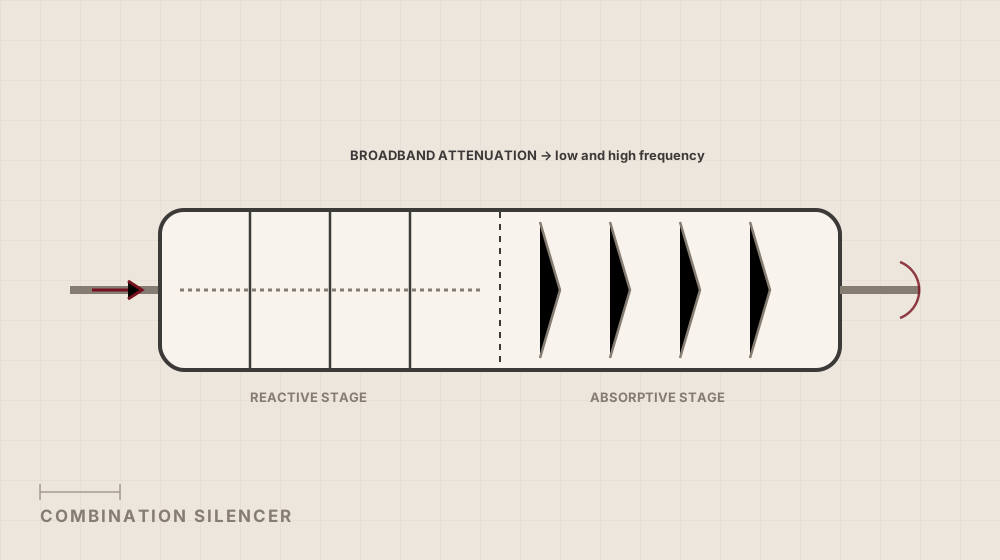
A combination silencer places reactive chambers and an absorptive section in series: the chambers handle the firing fundamental and low harmonics, the absorptive stage takes out the broadband remainder. Because real exhaust spectra contain both components, most industrial exhaust silencers are combination designs. Placing the reactive stage first also shields the absorptive packing from the strongest pressure pulsations leaving the engine.
Matching the silencer type to the noise spectrum
| Dominant noise character | Typical source | Suitable design class |
|---|---|---|
| Discrete low-frequency tones (firing frequency and harmonics) | Reciprocating engines, especially at fixed speed | Reactive: tuned chambers and resonators |
| Broadband mid/high-frequency noise | Turbochargers, flow turbulence, gas turbines | Absorptive |
| Both tonal and broadband content | Most diesel and gas engine exhausts | Combination |
The key discipline is to treat insertion loss as a spectrum, not a single number. A silencer is selected by comparing the predicted octave-band source spectrum against the level to be met at the receiver; the shortfall per band defines the required insertion loss, and its shape points to the design class. The laboratory quantities that characterise a ducted silencer, insertion loss, flow (self-)noise, and total pressure loss, are defined and measured per ISO 7235:2003 [2]. All three matter: a silencer that meets its attenuation target but regenerates flow noise at high velocity, or adds more back-pressure than the engine tolerates, has not solved the problem.
How performance is predicted and specified
On the prediction side, the established framework for piping noise is VDI 3733 (Noise at pipes), reissued in December 2025 as VDI 3733:2025-12 and replacing the 1996 edition [1]. It structures the problem as a chain (sound generation in the pipe system, transmission along the line, radiation from pipe wall and orifice, reduction measures) the sequence a plant noise study follows when deriving the insertion loss an exhaust line needs. Within the silencer, the attenuation of chambers, resonators, and lined sections is predicted element by element with established duct-acoustics techniques such as transfer-matrix modelling and validated against measurement; that detail lives in the design office, because temperature, flow, and geometry interact in ways a generic figure cannot capture.
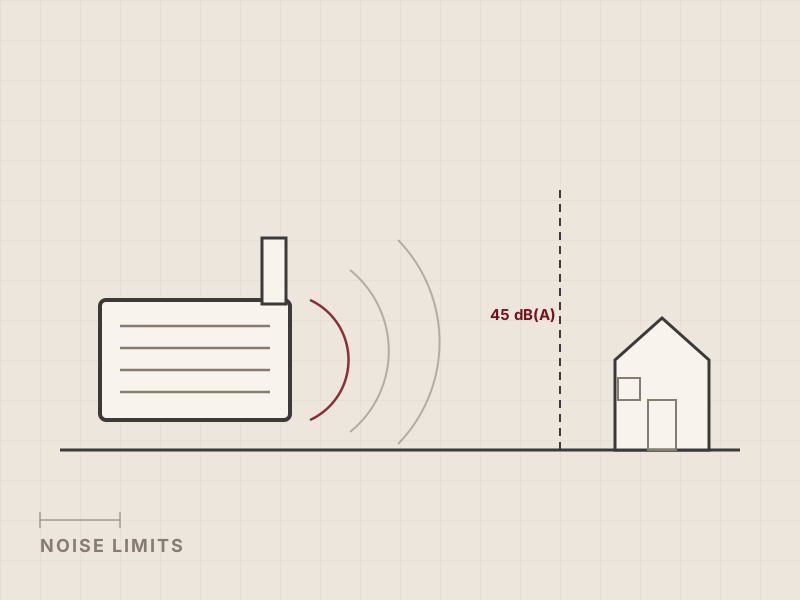
At the receiving end, the EU’s Environmental Noise Directive 2002/49/EC sets the common assessment framework: harmonised indicators (Lden for day–evening–night exposure, Lnight for sleep disturbance), strategic noise maps, and action plans that explicitly cover noise from industrial sites [3]. It imposes no EU-wide numeric limits (limit values for industrial noise are set at Member State level) so the binding number for an installation comes from its national or local permit, and the silencer specification follows from that number and the predicted spectrum.
Specifying the right exhaust silencer
Four inputs determine the design: engine type and rated speed (which fix the firing spectrum), exhaust flow and temperature at the silencer inlet, the maximum back-pressure the engine accepts, and the acoustic target: a required insertion loss or a level at a defined position. With those fixed, the choice between absorptive, reactive, and combination becomes an engineering conclusion rather than a guess.
Axces designs and manufactures absorptive, reactive, and combination exhaust silencers for diesel and gas engines as part of its industrial noise control solutions. Explore the Axces exhaust silencer range, or send our engineers your engine data for a design proposal matched to your spectrum, back-pressure budget, and site noise limits.
References
- VDI 3733:2025-12, Noise at pipes (Geräusche bei Rohrleitungen), Verein Deutscher Ingenieure (VDI), December 2025. Covers sound generation, transmission, radiation, and reduction for pipe systems in industrial plants; replaces VDI 3733:1996-07 (withdrawn). VDI: https://www.vdi.de/en/home/vdi-standards/details/vdi-3733-noise-at-pipes-1; edition status: DIN Media, https://www.dinmedia.de/en/technical-rule/vdi-3733/394376096
- ISO 7235:2003, Acoustics: Laboratory measurement procedures for ducted silencers and air-terminal units: Insertion loss, flow noise and total pressure loss, International Organization for Standardization. https://www.iso.org/standard/30385.html
- Directive 2002/49/EC of the European Parliament and of the Council of 25 June 2002 relating to the assessment and management of environmental noise, OJ L 189, 18.7.2002, p. 12–25. Lden/Lnight indicators, noise maps and action plans; industrial-noise limit values are set at Member State level. EUR-Lex: https://eur-lex.europa.eu/eli/dir/2002/49/oj/eng