On this page
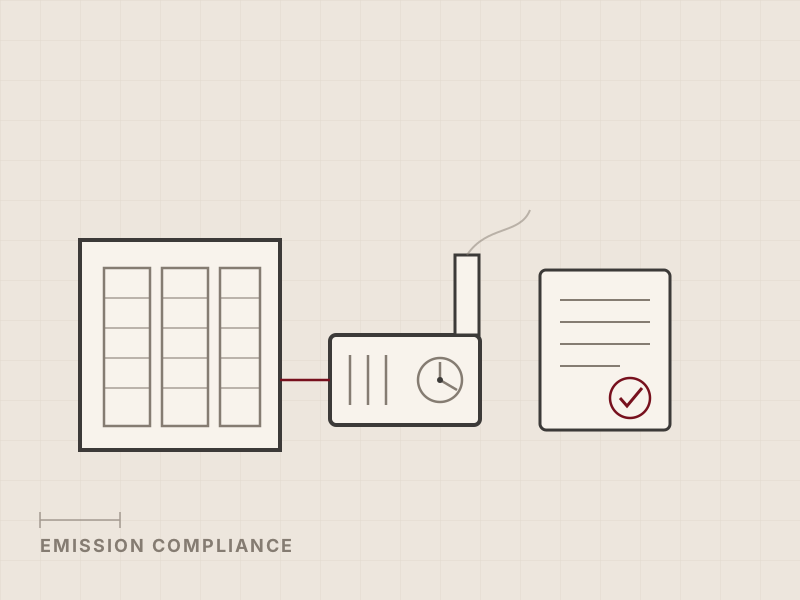
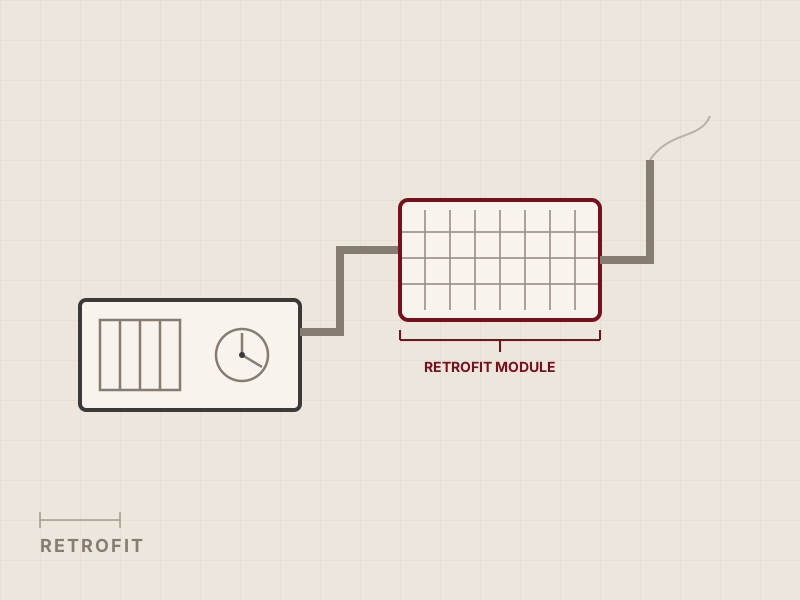
An emission control retrofit fits selective catalytic reduction (SCR) for NOx and, where needed, particulate (soot) control to generators that are already installed and running. On existing genset fleets the retrofit is driven by tightening regulation (chiefly the transitional deadlines of the EU Medium Combustion Plant Directive for existing plants) and constrained by the physical realities of the engine and the room it sits in: space, weight, exhaust backpressure, exhaust temperature at part load, urea logistics, controls integration, and the downtime window. None of those can be signed off from a datasheet; a site survey is the gate.
Why retrofit now: the regulatory trigger
Stationary diesel and gas gensets used for standby, peaking or prime power are combustion plants in their own right. Where a unit’s rated thermal input sits between 1 MW and 50 MW it falls under Directive (EU) 2015/2193, the Medium Combustion Plant Directive (MCPD) [1]. Note that rated thermal input is the fuel energy the engine consumes, not its electrical output, so a genset’s MWth band is higher than its nameplate kWe suggests; units that “feel” small are often in scope. Plants put into operation before 20 December 2018 (or permitted before 19 December 2017 and running by 20 December 2018) count as existing plants, with later deadlines than new builds [2].
For existing plants the directive phases in two distinct obligations, split by thermal-input band.
Registration and permitting
- Existing plant greater than 5 MW: must hold a permit or be registered as of 1 January 2024 [3].
- Existing plant of 1 MW up to and including 5 MW: the same obligation applies as of 1 January 2029 [3].
Emission-limit compliance
- Existing plant greater than 5 MW: must meet the SO2, NOx and dust limits (Tables 2 and 3 of Part 1, Annex II) from 1 January 2025 [4].
- Existing plant of 1 MW up to and including 5 MW: must meet the limits (Tables 1 and 3 of Part 1, Annex II) from 1 January 2030 [4].
As of June 2026, for the larger band (above 5 MW) both the registration date (January 2024) and the emission-limit date (January 2025) have already passed; those plants should already be compliant. For the smaller band (1 MW to 5 MW) the registration date (January 2029) and the limit date (January 2030) are still ahead, which is the live retrofit-planning window today. For the data-centre-specific view of which limits bite and when, see the emission limits that trigger a backup-power retrofit.
Two qualifiers matter for generator duty. First, Member States may exempt existing plants that run no more than 500 operating hours per year (as a rolling five-year average) from the emission limits (relevant to genuine emergency-standby sets), though a narrow extension to 1 000 hours applies only to island backup during a main-supply interruption and to heat production in exceptionally cold-weather events [5]. Crucially, that exemption is from the limits, not from registration: an exempt set still has to be registered or permitted. Second, national transposition can be stricter than the directive floor: Germany’s 44th BImSchV, for instance, transposes the MCPD but adds tighter limits and regulates pollutants the directive does not (CO, ammonia, formaldehyde) [6]. Always check the limits in the country of installation, not just the EU baseline. (A Commission “omnibus” simplification proposal, COM(2025) 986 of 10 December 2025, would make targeted MCPD amendments (chiefly an exemption route for firing gas with a high hydrogen content) but it does not change the existing-plant transitional dates above and had not been adopted at the time of writing [7].)
What actually gets retrofitted
Two technologies cover most genset retrofits. SCR for NOx reduction is the standard route: a urea reagent is dosed into the exhaust and reduced over a catalyst to nitrogen and water; the mechanism is covered in how SCR reduces NOx. Where particulate limits or visible-smoke concerns drive the project, a diesel particulate filter or oxidation catalyst is added for the soot fraction. The two are frequently combined into a single exhaust-line package; see the wider emission control range for how they sit together.
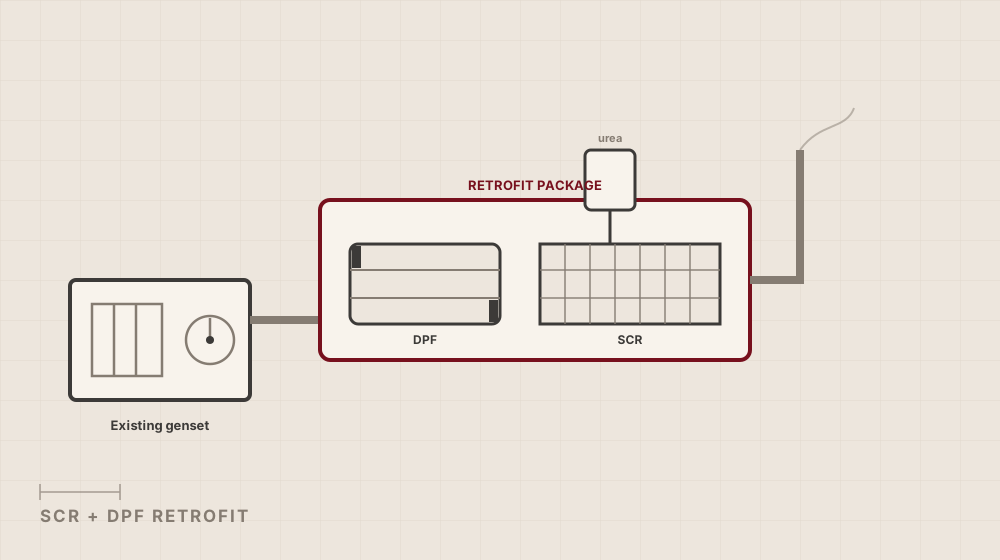
The retrofit constraint list
A new-build genset is engineered around its aftertreatment from the start. A retrofit has to insert that aftertreatment into a machine and a building that were not. The constraints that decide feasibility are, in rough order of how often they bite:
- Space and weight. An SCR housing, plus a particulate filter, urea tank and dosing skid where fitted, needs floor area and structural support that an existing plant room, rooftop plinth or container was never sized to carry. Containerised and rooftop sets are the tightest.
- Exhaust backpressure. The engine maker sets a maximum allowable backpressure, and the existing silencer already spends part of that budget. Adding SCR and a particulate filter in series consumes more. Exceed the limit and you risk lost output, higher fuel consumption, raised exhaust temperature and warranty exposure.
- Exhaust temperature at part load. SCR only works once the catalyst is in its active temperature window and reagent can be dosed safely. Emergency-standby sets start cold and may run at low or variable load, where exhaust temperature can sit below that window, so light-off behaviour and dosing strategy have to be checked against the unit’s real duty, not its rated point.
- Urea supply and storage. Reagent (AUS 32 / AdBlue) needs bunded storage, freeze protection, refill access and managed shelf life, a small logistics chain many sites do not run today.
- Controls integration. The SCR dosing controller has to communicate with the engine and the site control system without delaying an emergency start; the start sequence cannot be made to wait on aftertreatment readiness.
- Downtime window. The set must come offline to be modified. Where it is the site’s backup, that means planning the outage and, often, arranging temporary backup cover.
No number in any of these areas, backpressure headroom, available space, achievable temperature, can be promised from a desk. They are measured on site.
Where the retrofit meets the silencer
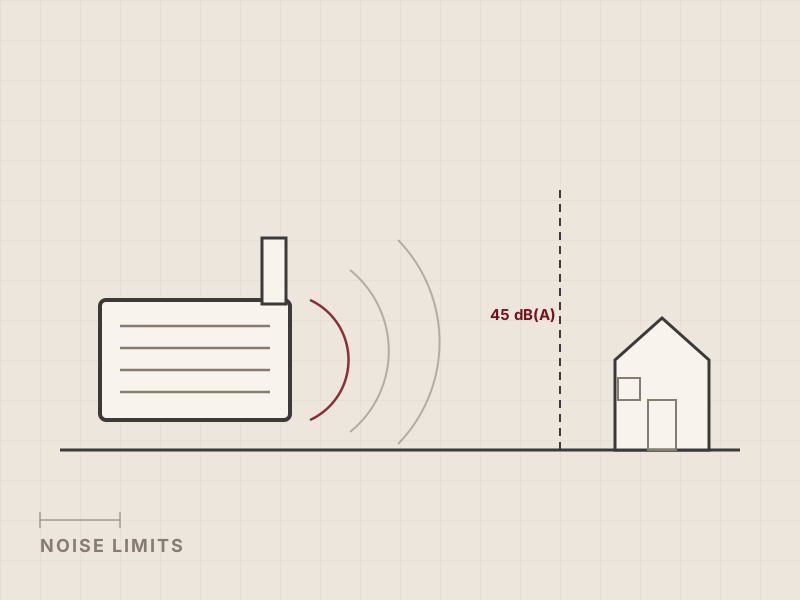
A generator emission retrofit almost always touches the exhaust line at the point where the silencer already sits. That is both a constraint and an opportunity: an SCR reactor housing can be designed to provide acoustic attenuation as well, so the retrofit can replace or absorb the existing silencer rather than compete with it for space and backpressure. It also means the project usually carries a noise dimension: the works open the one part of the system that governs exhaust noise, and the site’s noise limits have to be held at the same time. Plan the two together; see the noise control solutions and, for the standby-generator picture, noise limits for backup generators.
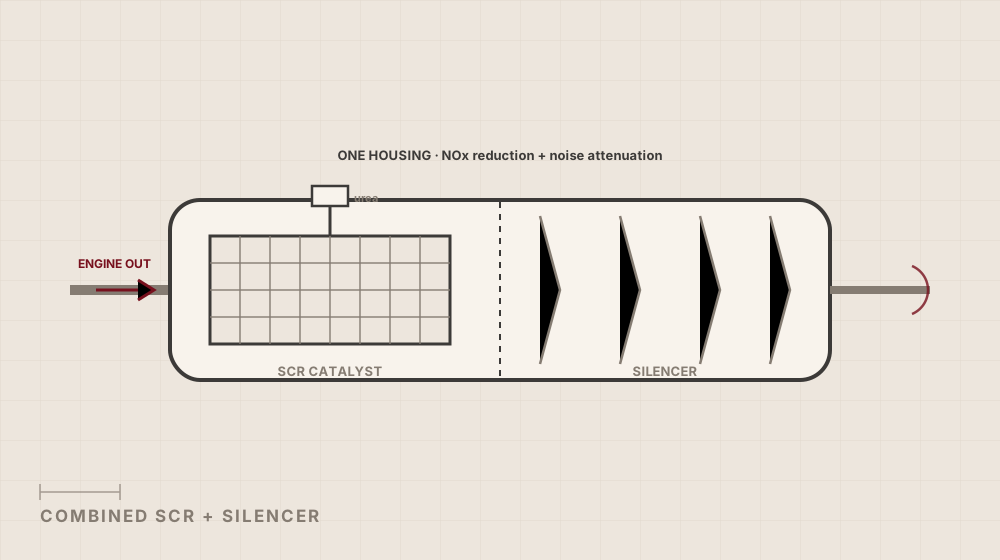
The site survey is the gate
Because every one of the constraints above is site-specific, Axces does not commit to feasibility or to a performance figure before a survey. The survey establishes the engine’s backpressure budget and current exhaust arrangement, the real operating duty and temperatures, the available space and structure, the reagent and controls situation, and the achievable downtime window. Only with those in hand can a retrofit be scoped, and only then can limit compliance and noise targets be confirmed. Treat any pre-survey indication as exactly that: an indication, not a commitment.
Plan your retrofit around a survey
If you are planning an emission control retrofit on an existing generator fleet, the fastest route to a firm answer is a site survey. Tell us about your NOx reduction or soot reduction requirement, or contact the Axces team to arrange one.
References
- Directive (EU) 2015/2193 of the European Parliament and of the Council, Article 2 (Scope): applies to combustion plants with a rated thermal input equal to or greater than 1 MW and less than 50 MW. EUR-Lex: https://eur-lex.europa.eu/legal-content/EN/TXT/?uri=CELEX:32015L2193
- Directive (EU) 2015/2193, Article 3(6) (definition of “existing combustion plant”: operation before 20 December 2018, or permit before 19 December 2017). EUR-Lex: https://eur-lex.europa.eu/legal-content/EN/TXT/?uri=CELEX:32015L2193
- Directive (EU) 2015/2193, Article 5(2) (Permits and registration for existing plants: 1 January 2024 for greater than 5 MW; 1 January 2029 for 5 MW and below). EUR-Lex: https://eur-lex.europa.eu/legal-content/EN/TXT/?uri=CELEX:32015L2193
- Directive (EU) 2015/2193, Article 6(2) (Emission limit values for existing plants: from 1 January 2025 for greater than 5 MW, Tables 2 and 3 of Part 1, Annex II; from 1 January 2030 for 5 MW and below, Tables 1 and 3 of Part 1, Annex II). EUR-Lex: https://eur-lex.europa.eu/legal-content/EN/TXT/?uri=CELEX:32015L2193
- Directive (EU) 2015/2193, Article 6(3) (Member State option to exempt existing plants operating no more than 500 operating hours per year as a rolling five-year average; limited 1 000-hour extension for island backup and exceptional cold-weather heat). EUR-Lex: https://eur-lex.europa.eu/legal-content/EN/TXT/?uri=CELEX:32015L2193
-
- BImSchV (Verordnung über mittelgroße Feuerungs-, Gasturbinen- und Verbrennungsmotoranlagen): German transposition of the MCPD with stricter limits and additional pollutants (CO, ammonia, formaldehyde); existing-plant limits effective 1 January 2025. DieselNet, Germany: Stationary Engines: https://dieselnet.com/standards/de/taluft.php
- European Commission, COM(2025) 986 final (10 December 2025): “omnibus” simplification proposal amending, among others, Directive (EU) 2015/2193 (pending; does not alter existing-plant transitional dates). https://environment.ec.europa.eu/topics/industrial-emissions-and-safety/medium-combustion-plant-directive_en