On this page
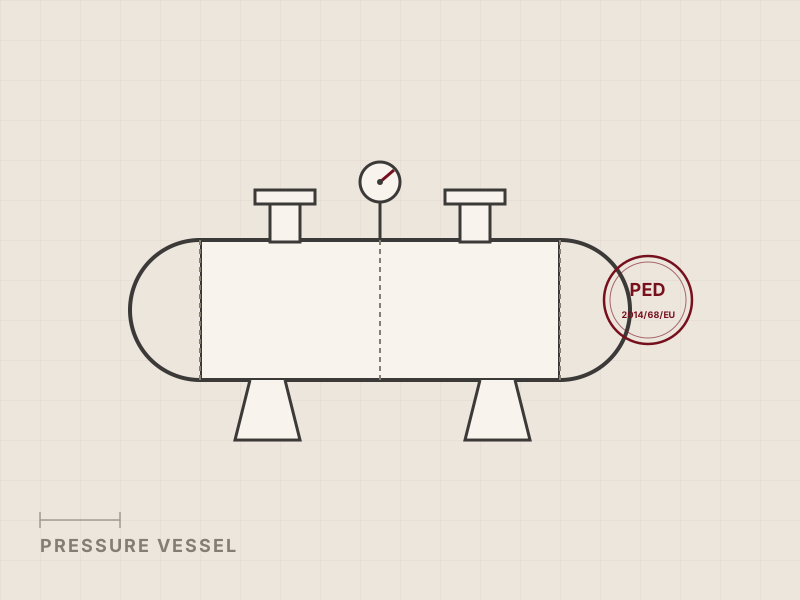
Directive 2014/68/EU, the Pressure Equipment Directive (PED), is the EU law governing the design, manufacture and conformity assessment of pressure vessels and other pressure equipment with a maximum allowable pressure above 0.5 bar [1]. It classifies equipment into four hazard categories, I to IV, and links each category to defined conformity assessment modules involving the manufacturer and, for most categories, a notified body [1]. This article explains the classification logic, what each module means, and what a buyer should verify before accepting a CE-marked vessel.
What the PED covers, and what it does not
The PED applies to pressure equipment and assemblies with a maximum allowable pressure PS above 0.5 bar gauge (Article 1(1)); “pressure equipment” means vessels, piping, safety accessories and pressure accessories (Article 2(1)) [1]. It replaced Directive 97/23/EC with effect from 19 July 2016; certificates issued under the old directive remain valid (Articles 48 and 50) [1].
Article 1(2) lists exclusions. The most relevant to industrial buyers: pipelines beyond the installation’s last isolation device, simple pressure vessels covered by Directive 2014/29/EU, well-control equipment, machinery where pressure is not a significant design factor (turbines, compressors, pumps), exhaust and inlet silencers, and vessels holding liquids under a gas blanket of up to 0.5 bar [1].
Equipment at or below the Article 4(1) thresholds falls under Article 4(3): it must be designed and manufactured to the sound engineering practice (SEP) of a Member State, supplied with adequate instructions, and must not carry the PED CE marking [1].
Classification: fluid group, pressure and volume
Classification combines two questions: how hazardous is the fluid, and how much stored energy does the equipment contain?
Fluid groups
Article 13 divides fluids into two groups. Group 1 comprises substances and mixtures classified as hazardous under specified physical and health hazard classes of the CLP Regulation (EC) No 1272/2008 (explosives, flammable gases (categories 1 and 2), oxidising gases, flammable liquids, acutely toxic substances and others), plus any fluid held above its flashpoint [1, 6]. Group 2 is everything else; in practice this covers air, nitrogen, water and steam.
From thresholds to category
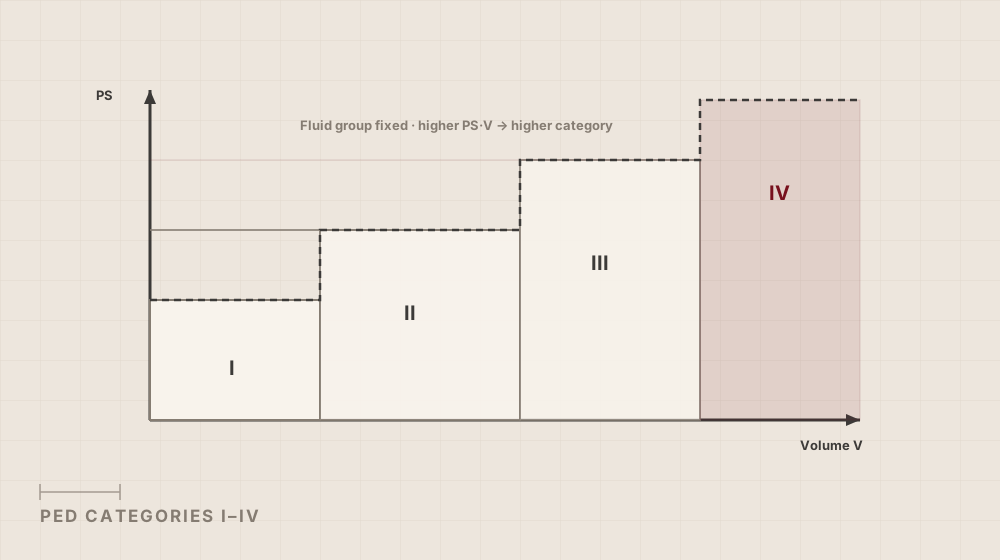
For vessels, the category is read from Annex II Tables 1–4 based on fluid group, fluid state and the product of PS (bar) and volume V (litres). The demarcation lines in each table mark the upper limit of every category (Annex II, point 4) [3]. The thresholds at which a vessel enters the harmonised regime (category I and above) are set in Article 4(1)(a) [1]:
| Vessel contents | Fluid Group 1 | Fluid Group 2 | Annex II table |
|---|---|---|---|
| Gases, liquefied gases, vapours | V > 1 L and PS·V > 25 bar·L, or PS > 200 bar | V > 1 L and PS·V > 50 bar·L, or PS > 1,000 bar | Table 1 / Table 2 |
| Liquids (vapour pressure ≤ 0.5 bar above atmospheric) | V > 1 L and PS·V > 200 bar·L, or PS > 500 bar | PS > 10 bar and PS·V > 10,000 bar·L, or PS > 1,000 bar | Table 3 / Table 4 |
Above these entry points, rising PS·V pushes the vessel up through categories I–IV along the table’s demarcation lines. Three special rules: a multi-chamber vessel takes the highest category of any chamber (Article 13(2)); vessels for unstable gases that would land in category I or II under Table 1 move up to category III; and safety accessories default to category IV (Annex II, points 2 and 4) [1, 3].
Categories I–IV and the conformity assessment modules
Each category gives the manufacturer a defined menu of conformity assessment procedures (Article 14(2)), set out in full in Annex III [1, 4]:
| Category | Permitted modules |
|---|---|
| I | A |
| II | A2, D1, E1 |
| III | B (design type) + D, B (design type) + F, B (production type) + E, B (production type) + C2, H |
| IV | B (production type) + D, B (production type) + F, G, H1 |
In plain terms: Module A is internal production control: the manufacturer self-certifies, with no notified body. From category II upward a notified body is involved, through random checks (A2) or approval of the quality system (D1, E1). Category III and IV routes pair an EU-type examination (Module B) of a design or production type with a production-phase module (C2, D, E or F), or use full quality assurance (H, or H1 with design examination). Under Module G, unit verification, the notified body examines and tests each individual vessel, a common route for one-off, engineered-to-order category IV equipment [4].
The manufacturer chooses freely among the modules of its category and may also apply a higher category’s procedure (Article 14(3)); under category III and IV quality-assurance routes the notified body additionally makes unexpected factory visits (Article 14(4)) [1].
The result is the CE marking (affixed before placing on the market, followed by the notified body’s identification number where that body is involved in production control, Article 19) and an EU declaration of conformity per the Annex IV model (Article 17) [1].
Essential safety requirements and EN 13445
Whatever the module, the vessel must meet the essential safety requirements (ESRs) of Annex I. The manufacturer must analyse the hazards, design for all foreseeable loadings (pressure, temperature, wind and earthquake loads, reaction forces, corrosion and fatigue, point 2.2.1) and apply adequate safety coefficients [2]. For categories II–IV, welding procedures and welders must be approved by a notified body or a recognised third-party organisation (point 3.1.2); for categories III–IV, NDT personnel must be approved by a recognised third-party organisation (point 3.1.3). Final assessment includes a proof test, normally hydrostatic, at no less than the greater of 1.25 times the maximum in-service loading or 1.43 times PS (points 3.2.2 and 7.4). Main pressure-bearing parts of category II–IV equipment need material certificates of specific product control (point 4.3) [2].
Designing to the harmonised EN 13445 series for unfired pressure vessels gives a presumption of conformity with the ESRs it covers (Article 12); its parts are listed in the Official Journal via Commission Implementing Decision (EU) 2019/1616 and its amendments [1, 5]. Other design codes remain permissible, but conformity with the ESRs must then be demonstrated within the chosen module.
What buyers need to verify at procurement
For an EPC or plant engineer specifying a pressure vessel, the PED paper trail is as much a deliverable as the steel. Check that:
- The classification is stated and justified: fluid, fluid group, PS, V and the resulting category, traceable to the correct Annex II table.
- The module matches the category: the EU declaration of conformity names the procedure used and, for category II and above, the notified body and certificate references.
- The CE marking is correct: on the vessel or dataplate, followed by the notified body number where required (Article 19(4)). A CE mark on SEP equipment is a red flag.
- Material certificates are included: specific product control certificates for main pressure-bearing parts in categories II–IV.
- Welding and NDT approvals exist: approved procedures and personnel per Annex I points 3.1.2 and 3.1.3.
- Proof-test records meet point 7.4: test pressure, date and result documented on the dataplate or in the dossier (Annex I point 3.3).
- Operating instructions are supplied per Annex I point 3.4, in the required language.
- The design code is declared: EN 13445 or an alternative route, so future requalification and repair work has a defined basis.
PED compliance at Axces
Axces engineers and supplies pressure vessels for industrial process and exhaust systems within its wider pressure control solutions. Equipment is CE-marked under the applicable PED category, with conformity assessment under the appropriate notified-body module where the category requires it, and each delivery includes the supporting dossier: declaration of conformity, material certificates, weld and NDT records, and test reports.
Specifying a PED vessel for an upcoming project? Contact our engineers to review the classification and certification requirements early in the design phase.
References
- Directive 2014/68/EU of the European Parliament and of the Council (Pressure Equipment Directive): Articles 1, 2, 4, 12, 13, 14, 17–19, 48 and 50. EUR-Lex: https://eur-lex.europa.eu/eli/dir/2014/68/oj (text verified against the consolidated version CELEX 02014L0068-20140717 as reproduced verbatim at https://www.legislation.gov.uk/eudr/2014/68)
- Directive 2014/68/EU, Annex I: Essential safety requirements, points 2.2.1, 3.1.2, 3.1.3, 3.2.2, 3.3, 3.4, 4.3 and 7.4. https://www.legislation.gov.uk/eudr/2014/68/annex/I
- Directive 2014/68/EU, Annex II: Conformity assessment tables 1–9 and points 1–4. https://www.legislation.gov.uk/eudr/2014/68/annex/II
- Directive 2014/68/EU, Annex III: Conformity assessment procedures, Modules A, A2, B (production type / design type), C2, D, D1, E, E1, F, G, H and H1. https://www.legislation.gov.uk/eudr/2014/68/annex/III
- Commission Implementing Decision (EU) 2019/1616 on the harmonised standards for pressure equipment drafted in support of Directive 2014/68/EU (lists the EN 13445 series, Unfired pressure vessels). EUR-Lex: https://eur-lex.europa.eu/eli/dec_impl/2019/1616/oj
- Regulation (EC) No 1272/2008 (CLP): hazard classes referenced by PED Article 13 for fluid Group 1. EUR-Lex: https://eur-lex.europa.eu/eli/reg/2008/1272/oj