On this page
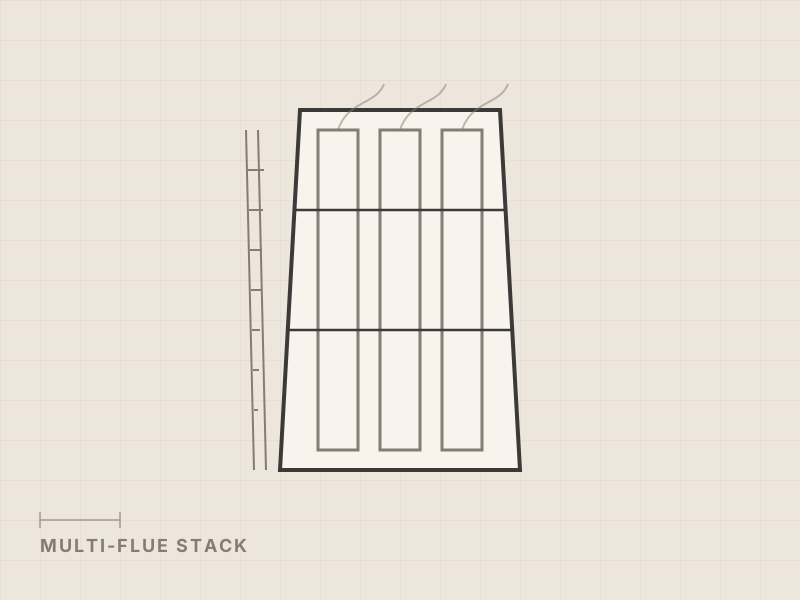
Combined-cycle blocks, engine power plants and generator halls share the same exhaust problem: several units, each needing its own gas path, on a site with room, and planning consent, for one chimney. The multi-flue stack answers this by carrying two or more independent flues inside a single self-supporting windshield. This article explains why the arrangement is standard for multi-unit plants, and what drives the structural and thermal design.
One windshield, many flues
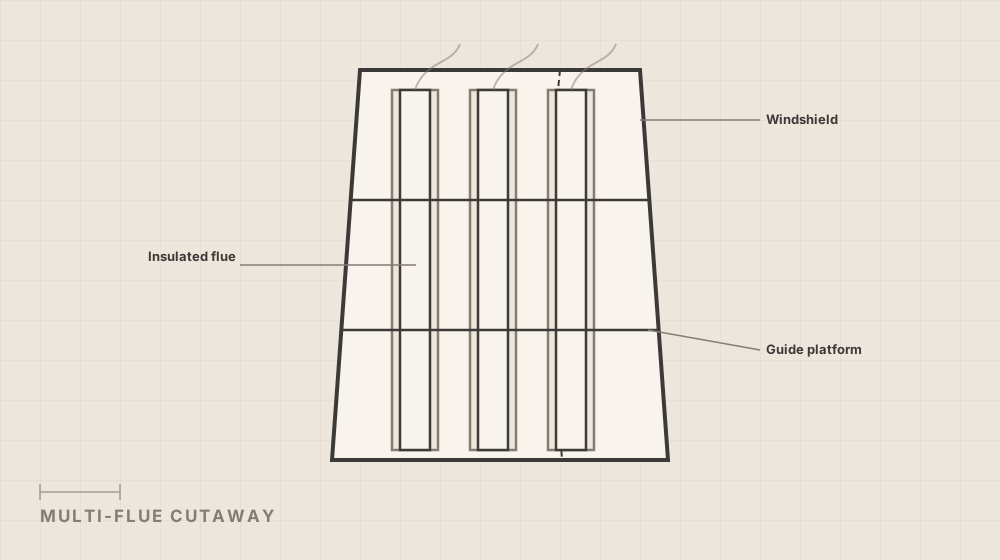
A multi-flue stack separates the two jobs every chimney performs. The windshield (a self-supporting shell, in steel for most plant-scale stacks) provides the structure: it resists wind and seismic actions, carries the dead loads and provides access. The flues inside it carry the gas: each is an insulated duct serving one gas turbine train, engine bank or boiler, designed around temperature, velocity and corrosion rather than around wind. The flues typically terminate just above the windshield top so the gas discharges clear of the structure.
This division of duties is the configuration’s core advantage. Because the windshield shelters them, the flues see no direct wind load and can be built in thinner plate, in material matched to the gas chemistry. Because the flues carry the heat, the windshield stays near ambient temperature and can be designed as a conventional steel chimney to EN 1993-3-2 [1] or the CICIND Model Code for Steel Chimneys [2]. Axces supplies the arrangement as freestanding multi-flue stacks within its industrial stack solutions.
Why multiple flues instead of one common flue
Merging all units into one large flue is rarely good engineering:
- Exit velocity at part load. Plume rise depends on the gas leaving the stack with sufficient velocity. A common flue sized for full plant output sees its exit velocity collapse when only one or two units run; a flue per unit keeps design exit velocity at every plant load.
- Isolation between units. Separate flues prevent flue gas from a running unit migrating back through the ductwork of an idle one, where it would cool, condense and corrode.
- Availability. A unit can be taken out of service and its flue isolated and inspected while the rest of the plant keeps operating.
- Different gas conditions per train. In a combined-cycle plant each flue must cover its own range: relatively cool gas downstream of the heat-recovery steam generator, far hotter gas in bypass operation where a diverter is fitted. Materials and insulation are selected per flue.
- Future units. A spare flue position is cheap to configure at design stage and very expensive to add later.
Why one stack instead of a row of stacks
Beyond the civil savings (one foundation, one set of platforms, ladders, lightning protection and aviation lights, one structure to permit) grouping the flues in a single windshield removes an aerodynamic problem.
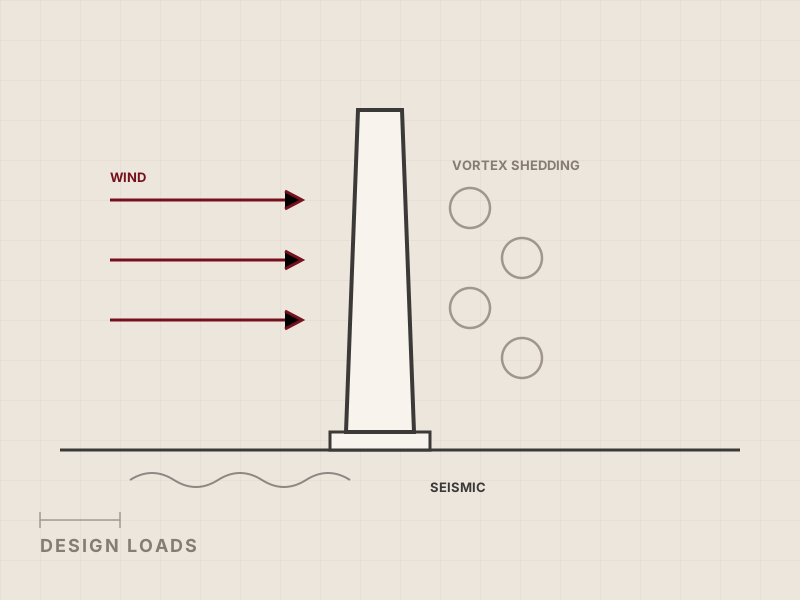
Slender stacks standing close together interact with the wind. EN 1991-1-4 requires wake buffeting to be taken into account for chimneys of slenderness h/d > 6,5 in tandem or grouped arrangement; the effect may only be neglected if the stacks stand more than 25 times the upstream stack’s crosswind dimension apart, or if the downstream stack’s natural frequency exceeds 1 Hz, conditions a row of tall plant stacks rarely satisfies [3, clause 6.3.3]. Annex E of the same standard adds interference galloping checks for two or more free-standing cylinders in proximity [3, Annex E.3]. A multi-flue stack replaces that group of dynamically coupled slender cylinders with one wider, stockier body, designing the interference between the plant’s own stacks out entirely, though the windshield itself must still be verified for vortex excitation [2, §7.2.4; 3, Annex E.1].
Structural design of the windshield
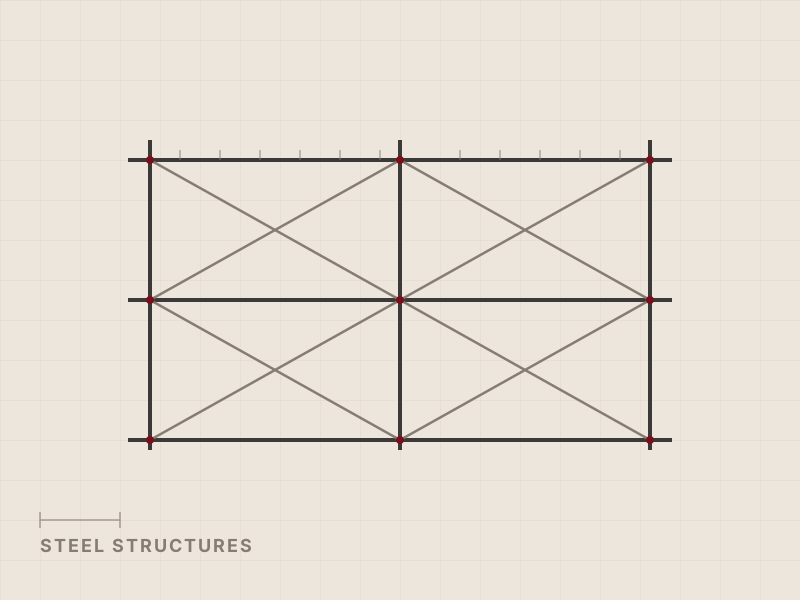
Steel windshields are designed as chimneys. EN 1993-3-2 covers the structural design of vertical steel chimneys of circular or conical section, whether cantilevered, supported at intermediate levels or guyed [1]. The CICIND Model Code for Steel Chimneys (Revision 2, September 2010) applies to circular steel chimneys of 15 m and taller, explicitly “with or without linings” [2]. Project specifications regularly invoke both, with wind actions taken from EN 1991-1-4 [3]. In the second-generation Eurocode programme, Parts 3-1 and 3-2 are being merged into a single EN 1993-3 covering towers, masts and chimneys [6].
The governing checks are those of any large chimney (along-wind gust response, cross-wind vortex shedding and the resulting fatigue, and ovalling of large thin shells [2, §7.2.4–7.2.5]) but the multi-flue arrangement changes the inputs. The windshield diameter is set by the number of flues plus internal access, so the shell is markedly less slender than a single-flue chimney of the same height, which generally improves its cross-wind behaviour; the internal flues, guides and platforms also add mass and energy dissipation, and CICIND literature specifically documents shell-to-flue impact damping in dual-wall and multi-flue chimneys [5]. Concentrated details still demand attention: flue support levels, internal platforms and large duct-entry openings all introduce local forces and require shell reinforcement [2, §11.3, §13].
Thermal movement: the defining design detail
The windshield stays near ambient; the flues run at flue gas temperature, from around a hundred degrees Celsius downstream of a heat-recovery boiler to several hundred in engine or bypass service. Steel expands as it heats, so each flue grows in length relative to the windshield (over a tall stack, a difference measured in tens of millimetres or more) and that movement repeats with every start and stop. Crucially, the flues also move relative to each other: in a multi-engine plant one flue may be at full temperature while its neighbour is cold.
The design response is to support each flue at one defined level and let the rest of it move. EN 13084-6 covers exactly these systems for steel liners in a load-bearing structure: base-supported, sectional (supported at intermediate levels) and top-hung liners [4]. Lateral guides at intervals up the stack hold each flue in position against the windshield while allowing free vertical sliding, with clearances chosen so no flue can bind in any combination of hot and cold neighbours. Expansion joints at the inlet duct connections decouple the stack from the ductwork, and the flue insulation and ventilation of the interspace keep the windshield and its protective coatings within temperature limits. The CICIND Model Code addresses the load side of this picture under thermal effects, high-temperature flue gases, temperature effects at the base connection and steel liners [2, §7.4, §7.6.1, §9.3.3, §10]. How far each flue moves and where its supports and guides belong is project-specific engineering, an outcome of the thermal design, not a rule of thumb.
Practical considerations
- Internal clearance between flues for inspection and guide maintenance, set early. It drives windshield diameter.
- Corrosion protection for idle flues, which can sit below acid dewpoint while neighbours run.
- Emission-measurement ports and platforms per flue, at heights agreed with the measurement authority.
- Modular fabrication, so flue sections install efficiently within windshield sections during erection.
Choosing the right configuration
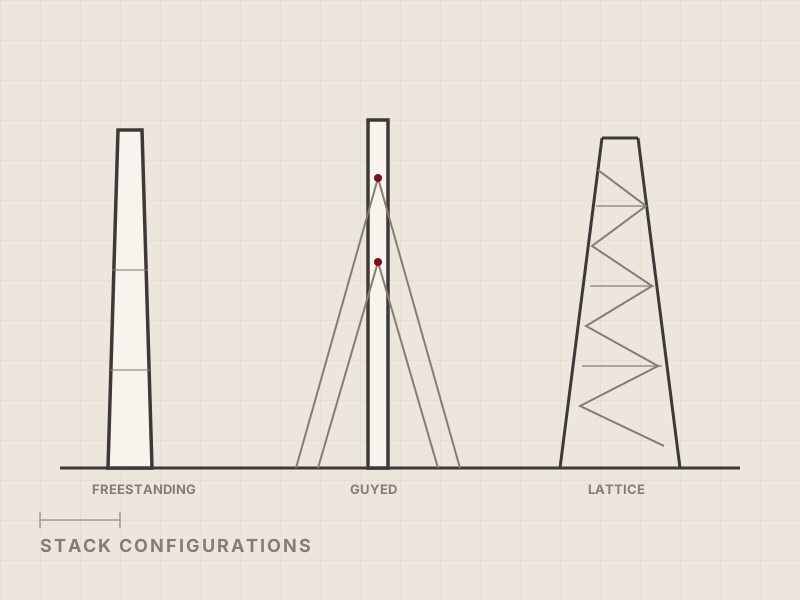
Whether a project is best served by one multi-flue stack, individual stacks or another arrangement depends on unit count, gas conditions, site and permitting. Our guide to industrial stack configurations walks through those trade-offs. If you are configuring the exhaust for a combined-cycle or multi-engine plant, request a quote for a freestanding multi-flue stack or talk to our engineers about your gas data and site constraints.
References
- CEN, EN 1993-3-2:2006: Eurocode 3: Design of steel structures: Part 3-2: Towers, masts and chimneys: Chimneys (structural design of vertical steel chimneys of circular or conical section). https://knowledge.bsigroup.com/products/eurocode-3-design-of-steel-structures-towers-masts-and-chimneys
- CICIND, Model Code for Steel Chimneys, Revision 2, September 2010, ISBN 1-902998-16-2; §7.2.4 (vortex shedding), §7.2.5 (ovalling), §7.4 (thermal effects), §7.6.1 (high-temperature flue gases), §9.3.3 (temperature effects), §10 (steel liners), §11.3/§13 (opening reinforcement). https://cicind.org/publications.html?file=files/content/publications/table-of-contents/Model-Code-for-Steel-Chimneys.pdf&cid=115
- CEN, EN 1991-1-4:2005+A1:2010: Eurocode 1: Actions on structures: Part 1-4: General actions: Wind actions; clause 6.3.3 (wake buffeting for chimneys in tandem or grouped arrangement) and Annex E (E.1 vortex shedding; E.3 interference galloping of two or more free-standing cylinders). https://knowledge.bsigroup.com/products/eurocode-1-actions-on-structures-general-actions-wind-actions
- CEN, EN 13084-6:2015: Free-standing chimneys: Part 6: Steel liners: Design and execution (base-supported, sectional and top-hung liners). https://www.intertekinform.com/en-gb/standards/en-13084-6-2015-325482_saig_cen_cen_750276/
- Warren, R.M. & Reid, S.L., “Shell to Flue Impact Damping for Dual Wall and Multi-Flue Chimneys”, CICIND Report, Vol. 10, No. 1, 1994 (as listed in the references of [2]). https://cicind.org/publications.html?file=files/content/publications/table-of-contents/Model-Code-for-Steel-Chimneys.pdf&cid=115
- The Construction Information Service, Eurocode 3: Design of steel structures: Towers, masts and chimneys (second-generation EN 1993-3, superseding EN 1993-3-1:2006 and EN 1993-3-2:2006). https://cis.ihs.com/CIS/document/354237